Spend $50, Get 10% Off

Labels list by amount, hide behind formal names, and bury the good and the questionable in plain sight. Here's a simple 6-step way to decode any label with confidence.

Read a skincare label in order of amount: ingredients are listed from most to least, so the first few make up the bulk of the product. Ingredients at 1% or less can appear in any order near the end. Translate the INCI (formal) names, scan for anything you personally prefer to skip (like fragrance), learn to recognize the simple good stuff, and trust the regulated ingredient list over unregulated front-of-pack words like “clean” or “natural.” Six quick steps, and you can confidently decode almost any label you pick up.
Skincare ingredient lists can feel like they're written to be confusing — formal Latin names, a jumble of additives, and marketing words on the front that may not match the back. But there's actually a logic to them, and once you know the rules, any label becomes readable in about thirty seconds flat.
This is a simple, repeatable method: six steps that work on any product, from a two-ingredient balm to a twenty-ingredient serum, no exceptions. Tap any step to jump ahead. By the end you'll be able to glance at a label and know what a product mostly is, whether it's simple or complex, and whether it matches what you're looking for. And unlike a lot of skincare advice, this is a skill that never goes out of date — the rules for how labels are written don't change, so once you learn them, you can read any product in any aisle for the rest of your life.
One honest note up front: reading labels is about making informed choices, not scaring yourself. Conventional products are regulated and generally safe. This skill just helps you match products to your own preferences — simpler lists, fewer fragrances, ingredients you recognize.
If you remember nothing else, remember this: ingredients are listed in order of how much is in the product, from most to least.
The first ingredient is the largest part of the product; the last is the smallest. That single rule tells you what a product mostly is at a glance — and it's the foundation for every step below, the one rule that makes all the others make sense. (The one exception: ingredients at 1% or less can be listed in any order, usually at the end.)
With that rule in hand, the six steps below turn a confusing block of text into useful information. Let's walk through them. Don't worry about memorizing anything — after you've run through the six steps a couple of times on real products, they become automatic, and you'll find yourself flipping bottles over out of habit.
Ingredient lists are written in descending order by amount, so the first few ingredients make up most of the product. If you only read three things, read the first three — they tell you what the product mostly is. This alone cuts through most marketing: a product can call itself a “nourishing botanical treatment,” but if the first ingredient is water and the second is a filler, that’s mostly what you’re buying.
Do this: glance at the top 3–5 ingredients first. A simple product will have recognizable ones up top (like an oil, a butter, or a wax). A long list led by things you can't picture tells you the product is mostly those.
Ingredients present at 1% or less can be listed in any order, usually toward the end. Everything after that point is a minor player — preservatives, actives, fragrance, and additives — so their order stops meaning “more of.” This trips people up constantly: they see an alarming-sounding preservative listed and assume there’s a lot of it, when it may be sitting below the 1% line at a whisper of a concentration, doing a small, necessary job.
Do this: mentally split the list in two. The top portion is what the product mostly is; the tail is the small stuff. Don't be alarmed by a scary-sounding name near the very end — it may be a tiny fraction of a percent. Judging a product by one scary-sounding word at the very end of the list is like judging a recipe by a pinch of an unusual spice — the amount is the whole story, and the tail of the list is where the tiny amounts live.
Labels use INCI (International Nomenclature of Cosmetic Ingredients) — standardized, often Latin or scientific names. “Butyrospermum Parkii” is shea butter; “Cera Alba” is beeswax. Scary-looking often just means “the official name.”
Do this: don't panic at Latin. Look up unfamiliar INCI names — many are simply oils, butters, and waxes under their formal names. A quick search turns “Helianthus Annuus” back into “sunflower.” Most of the intimidating-looking names on a natural product’s label are simply the formal versions of plants you already know — olives, sunflowers, shea, jojoba. The Latin is a naming convention, not a warning label.
This is a preference, not fear: many people choose to skip “Fragrance/Parfum” (a common irritant that can hide many undisclosed components), and watch for long lists of unfamiliar additives. None of this means a product is unsafe — it's about what you personally prefer.
Do this: decide your own “skip” list (fragrance is a common one) and scan for it. Remember conventional products are regulated and generally safe; this step is about matching a product to your preferences, not avoiding danger. It’s worth being clear-eyed here, because the “clean beauty” world can tip into fear fast. If you have sensitive skin, skipping fragrance is a sensible preference — but framing every additive as a toxin isn’t accurate. Read to choose what suits you, not to be alarmed.
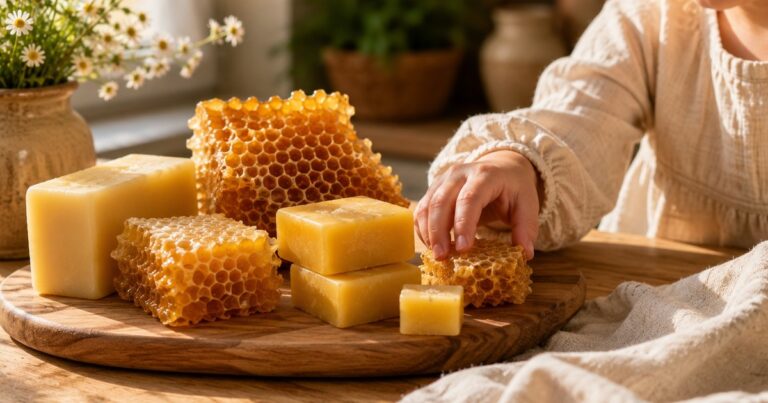
On the flip side, learn to spot the recognizable, skin-friendly basics: plant oils, butters, beeswax, and simple humectants. A short list of these is often a sign of a straightforward, gentle product, and it’s exactly the kind of formula that tends to agree with sensitive skin.
Do this: reward simplicity. Simpler isn’t automatically “better” for everyone, but it is easier to understand, easier to troubleshoot if something reacts, and often gentler. If the whole list is a handful of things you recognize — an oil, a wax, a vitamin — that's usually a good sign you’re looking at a simple, honest formula. See our guides on beeswax and vitamin E for examples.
The front of the pack is marketing — “clean,” “natural,” “pure” are unregulated words. The ingredient list on the back is the regulated, honest part. When they disagree, believe the back.
Do this: make the ingredient list your source of truth. Read it before the front-of-pack claims, and let it — not the packaging — form your first impression. If a product boasts “clean” but the list is long and full of unknowns, the list wins the argument. This is the single most freeing habit in skincare shopping: once you trust the back of the pack over the front, no slogan can push you around — marketers spend enormous effort on front-of-pack language precisely because it works on people who don’t flip the product over.
It’s worth pausing on the amount-order rule, because it quietly answers the question people most want answered: “is this product actually what it claims to be?” A cream that markets itself on a hero botanical, but lists that botanical dead last, is telling on itself — there’s barely any in there. The order is a built-in honesty check that no front-of-pack copy can hide.
This is also why the first two or three ingredients deserve most of your attention. They’re the bulk of what touches your skin, the main drivers of how a product feels and behaves, and the clearest signal of what kind of formula you’re holding. Everything after them refines the picture; the top of the list paints it. the top of the list paints it, and the tail just fills in the fine detail.
You don’t need to analyze every ingredient. Reading just the top few, translating anything unfamiliar, and glancing at the tail for your personal “skip” list is enough to size up almost any product in half a minute.
Let's decode a simple label the way you would in a store. Say the list reads: Cocos Nucifera (Coconut) Oil, Cera Alba (Beeswax), Ricinus Communis (Castor) Oil, Tocopherol (Vitamin E).
That's the whole method in action: read the order, translate the names, and judge simplicity. A list like that and judge simplicity, all in a few seconds. A list like that tells you exactly what you're getting. Contrast it with a label that opens with water, a couple of synthetic emulsifiers, and a long tail of names you'd have to look up one by one — not necessarily a worse product, but unmistakably a more complex one. The method reads both the same way; it just reports back different pictures, and you decide which you want.
A few subtler things worth knowing as you get comfortable:
The theme: the front is written by marketers; the back is written by regulators — so once you make the back your first stop, you’re reading the honest version of the product before anyone gets a chance to spin it. Once you trust the ingredient list over the slogans, you become genuinely hard to mislead — in either the fear-mongering or the greenwashing direction. A reader who trusts the list is equally unimpressed by a doom-laden “this contains a scary chemical!” post and by a glossy “clean, conscious, pure” rebrand — both get checked against what’s actually printed on the back. That balance matters, because both extremes are trying to sell you something — one sells anxiety, the other sells virtue — and the ingredient list quietly ignores both pitches and just tells you what’s actually in the jar.
One myth worth retiring: “chemical-free” skincare doesn't exist — water is a chemical, so is coconut oil. Everything is made of chemicals, natural or not. The useful question isn't “chemical vs. natural,” it's “do I recognize and want these specific ingredients?” Reading the label answers that far better than any “chemical-free” badge on the front. The same goes for “non-toxic” and “clean” — comforting words that feel like information but aren’t regulated and don’t tell you a single specific thing about what’s in the bottle. Don't let that word (in either direction) do your thinking for you — the list already tells you what you need to know. Reading the label puts the decision back in your hands, where it belongs — not with the marketing team who chose which flattering word to stamp on the front. That small shift, from trusting slogans to trusting the ingredient list, is what this whole guide is really about.
Reading a skincare ingredient label comes down to a few simple habits: read in order of amount (the top few ingredients are most of the product), remember the 1% line, translate the formal INCI names, scan for anything you personally prefer to skip, recognize the simple good stuff, and trust the regulated list over front-of-pack marketing.
Do that and you can decode almost any product in seconds — and match it to what you actually want, whether that's maximum simplicity or just fragrance-free, or something in between that simply suits your skin. It's a small skill with a big payoff. Ten minutes of learning the rules pays off on every product you buy from here on — in the store, online, for yourself, or for your kids. For more plain-English ingredient breakdowns, explore our ingredient guides, or see how simpler swaps add up in the 5 highest-impact swaps.
Megan co-founded Bear Basics and leads design. As a mom, she writes our gentlest, most practical guides — on ingredients, sourcing, and simple family skincare — with an emphasis on honest, well-sourced, and simple. Read the full story →