More moisturizing?
Bar — concentrated, water-free.

One is a solid, water-free bar of concentrated moisture. The other is a light, water-based lotion that absorbs fast. Here's the honest comparison — and which one your skin will thank you for.

A lotion bar and a regular lotion do the same job differently. A lotion bar is solid and water-free — concentrated, longer-lasting, preservative-free, and great for dry skin and travel, but a touch richer and slower to apply. Regular lotion is water-based — light, fast-absorbing, and quick to use, but it needs preservatives and can leave skin feeling tight again sooner. For deep moisture and simplicity, choose the bar; for a light everyday feel and speed, choose lotion. Many people use both.
Lotion bars have gone from a niche curiosity to a genuine favorite, and people naturally wonder whether they're actually better than the lotion they've used their whole lives. As with most "which is better" questions, the honest answer is: better at what?
The core difference is simple and drives everything else: a lotion bar is solid and water-free; a regular lotion is water-based. That single distinction explains why the bar is more concentrated and longer-lasting, why it needs no preservatives, and why it feels richer — and why lotion is lighter, faster, and quicker to apply.
So neither wins outright. If your priority is deep moisture, simplicity, and travel, the bar likely suits you. If it's a light, fast, everyday feel, lotion does. This guide compares them fairly, point by point, so you can pick the right tool for your skin — without pretending one is magic.
It's worth clearing up one bit of confusion right away, because the name trips people up: a "lotion bar" isn't a soap bar, and you don't wash with it. It's a leave-on moisturizer that happens to be solid — closer to a solid version of body butter than to a bar of soap. Once that clicks, the whole category makes more sense: it's the same idea as lotion, just delivered without the water and without the bottle.
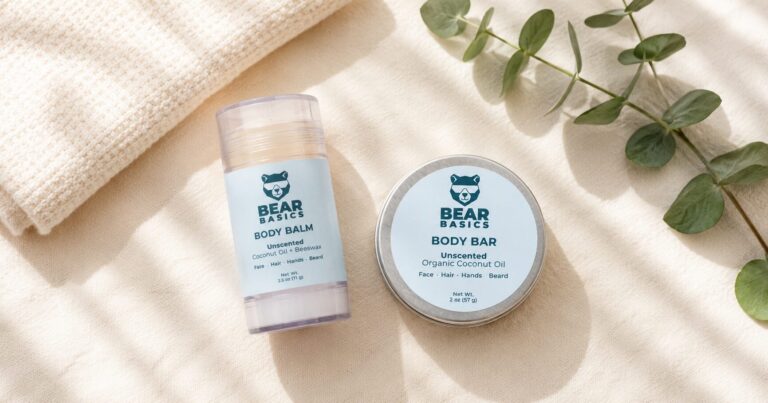
A lotion bar is a solid bar of moisturizing oils and butters, usually held together with beeswax, that melts slightly when it meets the warmth of your skin. You warm it against your skin for a second, glide it over the area, and it leaves a thin, rich layer of moisture behind.
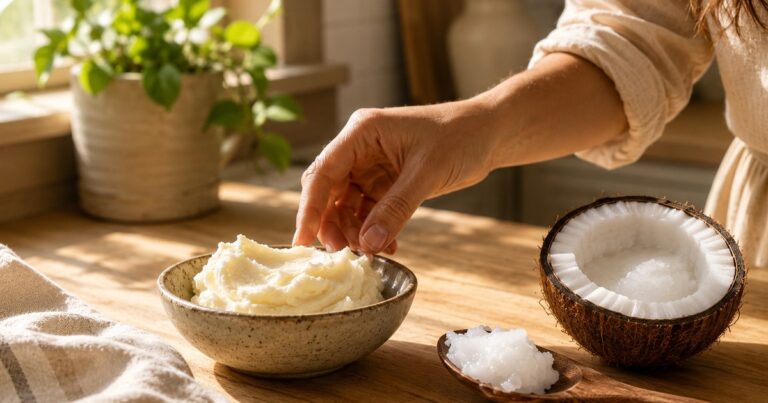
Because it contains no water, everything in a lotion bar is active moisturizer — oils, butters, beeswax — with nothing diluted. That's why it's concentrated and long-lasting, and why it can skip preservatives entirely. Think of it as a solid, travel-proof, no-nonsense version of moisture: what you see is what your skin gets.
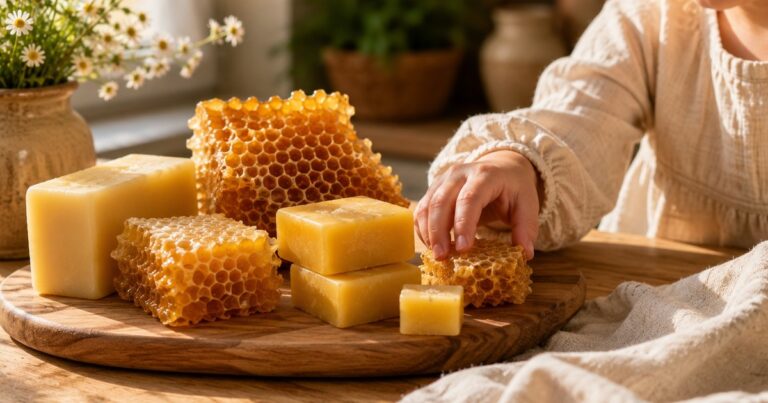
The beeswax is doing quiet double duty here. It gives the bar its firm, solid structure so it holds its shape at room temperature, and it adds a light protective, sealing quality on the skin that helps lock moisture in. That's why a well-made bar feels firm in your hand but glides once it meets your body heat — the wax softens just enough to release the oils and butters onto your skin. It's a genuinely clever little bit of everyday chemistry.
Regular lotion is an emulsion — a blend of water and oils held together with emulsifiers into that familiar smooth, pumpable cream. The water content is what makes it light, easy to spread, and quick to absorb.
That water is also why lotion feels refreshing and disappears fast: a good chunk of what you're applying is water that absorbs or evaporates, leaving the oils behind. It's convenient, it's what most people grew up with, and for a light everyday finish it's hard to beat. The trade-offs — needing preservatives and sometimes leaving skin tight again — come directly from that same water content.
Everything comes back to one thing, so let's make it explicit.
"Anhydrous" means water-free. A lotion bar is anhydrous — no water at all — so it's pure concentrated moisturizer. A regular lotion contains water (often a large share of the bottle), which makes it lighter and faster but also dilutes the actual moisturizing ingredients.
Once you see it through the water lens, the whole comparison clicks. Water makes lotion light, fast, and convenient — but also less concentrated, in need of preservatives, and quicker to leave skin feeling tight. No water makes a bar rich, lasting, and preservative-free — but a touch heavier and slower to apply. Same job, opposite trade-offs, all traceable to that one ingredient (or its absence).
This is a useful lens for skincare generally, not just here. A surprising amount of what a product is like — how it feels, how long it lasts, whether it needs preservatives, how long the ingredient list runs — traces back to whether and how much water it contains. Once you start noticing where water sits on an ingredient list (it's usually listed first as "aqua" or "water" when present), you can predict a lot about how a product will behave before you've even tried it.
Here's a real, practical advantage of the water-free bar that people don't expect.
Microbes need water to grow, so water-based lotions require a preservative system to stay safe. A lotion bar, being water-free, doesn't give microbes the environment they need — so it can skip preservatives entirely. Fewer ingredients, by design.
This isn't a knock on lotion — a water-based product should be properly preserved, and a well-made lotion is. It's simply that the bar sidesteps the whole question. If a short, preservative-free ingredient list appeals to you, that's a genuine point in the bar's favor. For more on why water-free formulas work this way, see what "water-free" means for your skincare.
For sheer staying power, the concentrated bar usually wins — and this is the crux for dry skin.
Because a lotion bar is all moisturizer and no water, it lays down a richer, longer-lasting layer that seals moisture in. Regular lotion, with its water content, can absorb and, on very dry skin, leave you feeling tight again within the hour — the classic "I just moisturized and I'm dry again" feeling. That doesn't happen as readily with a bar.
If your lotion never seems to "stick" and your skin feels tight again fast, a concentrated water-free bar is likely the upgrade. It gives dry skin something durable to hold onto.
This is where lotion has its clearest edge, and it's a real one:
Want weightless and fast before work? Lotion. Want deep, lasting moisture before bed or for rough dry patches? Bar. Neither feel is "wrong" — they suit different moments.
A lot of people discover they actually want both feelings at different times of day, which is worth paying attention to rather than forcing a single choice. Morning, heading out the door, most of us want fast and weightless. At night, or on a cracked-heel winter evening, that same person happily wants the rich, cushioning layer a bar provides. Your preference isn't fixed — it shifts with the moment, the season, and how your skin feels that day.
If you dislike any richness at all, lotion's light finish may simply be more your speed — and that's a perfectly valid reason to choose it.
"Convenient" splits into two different things, and each product wins one:
For a lot of people, the travel case alone sells the bar: no more leaked lotion in a bag, no more decanting into tiny bottles, no security-line liquid rules. A solid bar just goes in your kit and works. If you travel often or hate mess, that convenience is hard to give up once you've had it.
Durability is an underrated part of the travel win, too. Because a bar is concentrated and you only use a thin layer at a time, one small bar tends to last a remarkably long while — far longer than a same-sized bottle of watered-down lotion, a good chunk of which is water you're paying to carry around. For a trip, that means less to pack and less to run out of, which is exactly what you want when you're living out of a bag.
If a short, recognizable ingredient list matters to you, the bar has a structural advantage.
A lotion bar can be as simple as oils, butters, and beeswax — a handful of recognizable things, no water, no preservatives, no emulsifiers. A lotion, by its nature, needs water, an emulsifier to bind water and oil, and a preservative system, which means a longer list before you even add the moisturizing ingredients. Neither is bad, but the bar is simpler almost by definition. For people who like knowing exactly what's on their skin, that simplicity is a real draw.
Everything in one place:
| Lotion Bar | Regular Lotion | |
|---|---|---|
| Form | Solid | Liquid/cream |
| Contains water | No (anhydrous) | Yes |
| Preservatives needed | No | Yes |
| Concentration | High | Lower (diluted) |
| Moisture longevity | Longer | Shorter |
| Absorption speed | Slower, richer | Fast, light |
| Travel-friendly | Very (no spills) | Less (liquid limits) |
| Quick application | A few seconds | Instant |
A practical guide to choosing:
And, as usual, you're not forced to pick just one.
Lotion bars are easy once you know the technique — a couple of tips make them shine:
Give it a few uses and the rhythm becomes second nature — most people who find bars "awkward" at first are just applying to dry skin or expecting instant absorption like a lotion.
Of course — and it's a smart approach. Many people keep a light lotion for fast morning moisture and a rich lotion bar for very dry skin, bedtime, rough patches, or travel. You get lotion's speed when you want it and the bar's lasting richness when you need it.
They're complementary tools, not rivals. If you can't decide, don't — a lotion for quick everyday use and a bar for the heavy lifting covers just about every situation you'll meet.
If you're just curious and want to try a bar without overhauling your routine, that's easy: keep your usual lotion for daytime, and put a bar on your nightstand to use on the driest spots before bed. That low-commitment trial is how a lot of people end up won over — they feel the difference on their hands and heels overnight and gradually reach for the bar more often. No need to pick a side on day one.
Lotion bar vs regular lotion comes down to water. The water-free bar is concentrated, longer-lasting, preservative-free, travel-proof, and simpler — ideal for dry skin and minimalists, at the cost of a richer feel and a few seconds' more effort. Water-based lotion is light, fast, and instantly convenient — ideal for a quick everyday finish, at the cost of needing preservatives and fading sooner on dry skin.
Choose by what you value: deep moisture and simplicity point to the bar; speed and a light feel point to lotion. Or keep both. If the concentrated, water-free route appeals, our body balms and bars are built exactly that way — short list, no water, no fuss.
Ian founded Bear Basics on one idea: personal care built from a short list of food-grade ingredients we all recognize. Everything is small-batch and made in Colorado. Read the full story →