Spend $50, Get 10% Off

Don't ditch it yet. Almost every "it doesn't work" story comes down to one of six fixable things — and most take about ten seconds to correct.

Before you give up on natural deodorant, try these six fixes: (1) apply to clean, dry skin, (2) give it a full two weeks, (3) go baking-soda-free if you're irritated, (4) reapply midday when needed, (5) use a gentle wash, and (6) judge it by odor, not wetness. The vast majority of "it doesn't work" problems trace to one of these — most often applying to damp skin or quitting during the first-week adjustment. Work through the list before concluding natural deodorant isn't for you.
If you're about to throw your natural deodorant in the bin, hold on ten seconds. Here's the encouraging truth: almost every "natural deodorant doesn't work" story isn't about a bad product — it's about a small, fixable mistake in how it's being used or judged.
I've heard all of them, and they cluster into six issues, and once you see them laid out you'll probably recognize your own situation immediately. The good news is that most take seconds to fix: how you apply it, how long you give it, which formula you chose, and — surprisingly often — what you're measuring it against. Tap a fix above to jump ahead, or read straight through and troubleshoot in order. Nothing here requires new products or special effort — it's mostly about small habits and honest expectations, which is exactly why it's worth doing before spending money on yet another stick.
Work through these before you give up. There's a very good chance you're one small change away from it clicking.
It's worth saying why this matters beyond one product: a lot of people try natural deodorant once, have a rough week, and quietly conclude the entire category is a scam. That's a shame, because the fixes below are genuinely simple and the success rate once you apply them is high. You wouldn't abandon coffee forever because your first cup was made wrong — natural deodorant deserves the same fair shake.
Most of the frustration comes from one mismatch, so let's name it before the fixes.
A deodorant controls odor. It does not stop sweat — only an antiperspirant (with aluminum) does that. If you're coming from an antiperspirant, your brain is trained to judge success by dryness. Natural deodorant will always "fail" that test, because it was never trying to pass it.
Keep that distinction in mind as you go through the fixes. Several of them are really about resetting expectations that your old antiperspirant quietly installed. Once the goal shifts from "stay bone-dry" to "don't smell," natural deodorant suddenly starts looking a lot more successful — often it was working all along.
This reframe does a surprising amount of work, so it's worth sitting with. Almost every complaint in the 'not working' bucket is really about wetness, and wetness is the one thing a deodorant was never promising to fix. Separate the two jobs in your head — odor control versus sweat reduction — and half the problem evaporates before you've changed anything at all.
Before the fixes, quickly locate your problem — it makes the rest faster:
Found yours? Jump to it — and don't be surprised if more than one applies; these problems love to travel together. Not sure? Just work through all six — they stack neatly, and doing all of them together is the surest path to success — each fix removes one more reason the product might seem to be failing.
If you only have energy for one, start with the first: dry skin. It's the highest-impact, lowest-effort fix on the list, and for a big share of people it's the entire problem. Everything after it is refinement on top of that foundation — helpful, but secondary to simply keeping your skin dry when you apply.
The single most common reason natural deodorant underperforms is applying it to damp underarms — straight out of the shower, or over sweat.
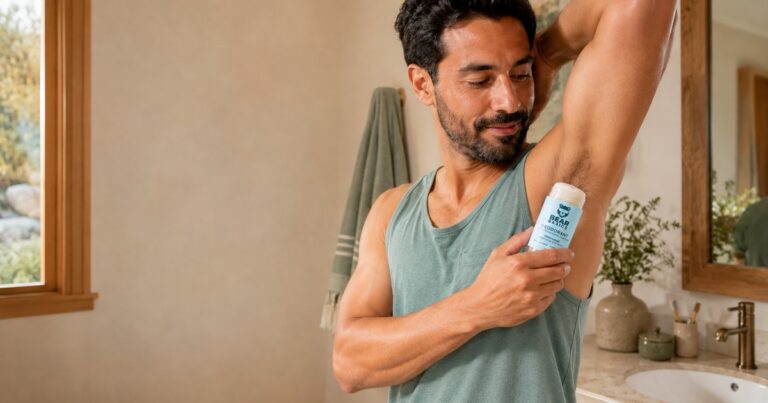
The fix: pat your underarms completely dry before applying, or apply at night before bed when skin is dry and still. Moisture dilutes the product and stops it from making proper contact. This one change fixes more 'it doesn't work' complaints than any other. Think about the physics for a second: a swipe of deodorant on a wet underarm is like trying to write on damp paper — it smears, thins out, and doesn't grip. Give it a dry surface and it actually adheres and stays put. If you shower in the morning, either towel off thoroughly and wait a minute, or flip your routine and apply at night; a lot of people find nighttime application alone solves everything.
If you're within the first week of switching, you're judging it at the hardest possible moment — while your body readjusts to sweating normally without aluminum.
The fix: commit to a full two weeks and measure by smell, not wetness. Week one is the peak of the adjustment, right before it gets dramatically easier. Most 'it failed' verdicts are really 'I quit on day four.' Push through. It helps to write down a reassessment date and refuse to judge before it arrives. Turning week one from an open-ended ordeal into a bounded, two-week experiment changes the whole psychology of the switch. The version of you at day fourteen is having a genuinely different experience than the version at day four — give that later version the chance to weigh in before you decide, because it's usually the one that ends up glad you stuck with it.
If you're getting redness, itching, or a stinging rash, the problem usually isn't 'natural deodorant' — it's one ingredient: baking soda.
The fix: switch to a baking-soda-free formula (many, including ours, use magnesium instead). Baking soda is alkaline and irritates sensitive underarms; magnesium controls odor far more gently. This rescues a huge number of failed switches. Here's the tell: if the problem is a burning, itching, or red rash rather than odor, it's almost certainly irritation, and irritation means baking soda far more often than not. Odor is something you push through during the adjustment; pain is not. Swapping to a magnesium-based formula usually clears it up within a few days, and people who were sure 'natural deodorant hates me' discover it was one ingredient all along.
If your underarms are red, itchy, or stinging, don't push through it the way you would ordinary adjustment odor. That's almost always baking soda, and the fix is switching formulas — not toughing it out. Comfort matters, and enduring a rash never made anyone's underarms smell better.
Expecting one morning swipe to last 16 hours through a workout and a heatwave is setting natural deodorant up to fail — that's an antiperspirant-era expectation.
The fix: keep it with you and reapply midday on hot or active days. A ten-second touch-up covers a lot, and needing one is completely normal, not a sign of failure. Natural deodorant rewards a little maintenance. And it's a tiny amount of maintenance for what you get. Stashing a stick in a bag, a desk drawer, or the car turns 'it stopped working by 3pm' into a ten-second non-issue. Nobody expects a single application of hand cream to last through a day of dishwashing; the same reasonable logic applies here. A quick refresh before a workout or a big afternoon is normal, easy, and effective.
Harsh antibacterial or heavily fragranced washes can throw off the natural balance of skin and bacteria on your underarms, which can make odor harder to manage.
The fix: wash with a simple, gentle soap rather than an aggressive antibacterial one. You're not trying to sterilize your underarms — just keep them reasonably clean, the same way you would any other part of your body. A simpler wash often lets a natural deodorant do its job more easily. This one surprises people, because we're trained to think 'more antibacterial = cleaner = less odor.' In practice, scrubbing your underarms with a harsh wash can strip and unbalance the skin, sometimes leaving you with more to manage, not less. Your underarms don't need to be sterilized — just gently cleaned. A plain, simple soap is usually all it takes, and it plays nicer with a natural deodorant than an aggressive one does.
If you're judging your deodorant by how dry you stay, it will always 'fail' — because it was never designed to stop sweat. That's an antiperspirant's job.
The fix: judge by smell, not wetness. A deodorant controls odor and lets your body sweat normally. Once you stop expecting dryness and start noticing that you don't actually smell, most people realize it was working the whole time. Try this: for one week, ignore how damp you feel and do an honest sniff test at the end of each day. Most people are startled to find that on the days they were convinced it had 'failed,' they didn't actually smell at all — they were just reacting to normal wetness their antiperspirant used to hide. Fix your measuring stick and the product's real performance finally becomes visible.
Give the fixes a fair trial before drawing conclusions. Here's a reasonable timeline:
So a fair overall trial is about two to three weeks with the fixes actually applied — not two days of frustration. If you've truly done all six over that window and it's still not working, then it's reasonable to look at the specific product.
The reason a fair trial matters is that these fixes compound. Dry application plus a settled adjustment plus the right formula plus a sensible measuring stick add up to a completely different result than any one of them alone. People who bounce off natural deodorant usually changed nothing and waited two days; people who succeed usually changed several small things and waited two weeks. The effort gap is tiny; the outcome gap is enormous.
Sometimes you've done everything right and a particular formula just isn't the one. That's real — but it's a reason to try a different natural deodorant, not to write off the whole category.
Natural deodorants differ enormously — baking-soda vs magnesium, light vs rich, different odor-fighters. If one honestly didn't work after the six fixes, a different natural formula may click immediately. Don't let one mismatch convince you "natural doesn't work."
The category works for a great many people once the fit and the fixes are right. Give a second formula a fair shot before concluding it's not for you.
A useful analogy: nobody decides all shampoo is useless because one bottle didn't suit their hair. Deodorant formulas are at least as varied. Body chemistry differs from person to person, and the odor-fighter, richness, and base that work brilliantly for a friend might be merely okay for you — and vice versa. Finding your match is normal, not a failure of the category.
Let's define success clearly, so you know when you've got there:
Once you hit that mark, the whole thing tends to become invisible in the best way — you stop auditing your underarms, stop bracing for the afternoon, and just get on with your day. That quiet, boring reliability, not dramatic dryness, is what a working natural deodorant actually feels like. That's the target: fresh, comfortable, aluminum-free, and off your mind. Note that "bone-dry all day" is not on the list — that was never the goal.
Natural deodorant "not working" is, nine times out of ten, a fixable use or expectation problem: apply to dry skin, give it two weeks, go baking-soda-free if irritated, reapply midday, use a gentle wash, and measure by smell instead of wetness. Work the list before you quit — it's a ten-minute investment against giving up on something that likely just needs a small correction.
Do those six things and most people find it clicks. And if a specific formula still isn't right after an honest trial, try another natural one rather than giving up on the whole idea. Our aluminum-free, baking-soda-free deodorant is designed to sidestep most of these problems from the start — baking-soda-free so it won't irritate, magnesium-based for gentle odor control, and rich enough to feel good going on — see the underarm line. For the full switching timeline, read switching to natural deodorant, week by week.
Ian founded Bear Basics on one idea: personal care built from a short list of food-grade ingredients we all recognize. Everything is small-batch and made in Colorado. Read the full story →