Spend $50, Get 10% Off

It’s one of the most powerful words in skincare — and one of the least defined. “Natural’” doesn’t guarantee safe, better, or greener. Here’s what it actually tells you, where it’s useful, and how to shop past it.

“Natural” has no strict, legal definition in skincare, so any product can use the word regardless of what’s inside. It’s a marketing term, not a safety or quality guarantee. Natural doesn’t automatically mean safer — poison ivy and essential oils are natural too — and synthetic doesn’t automatically mean worse, since many lab-made ingredients are gentle and well-studied. “Natural” can be a perfectly valid preference, and it does loosely point to minimally processed, plant- or animal-derived ingredients. But the reliable move is to judge the actual ingredients and how they’re used — not the word on the front of the pack.
Here’s the honest starting point: in skincare and cosmetics, “natural” doesn’t have a strict, enforced definition. There’s no official rulebook a product must satisfy to earn the word, which means a brand can print “natural” on almost anything, and two products using it can be completely different inside.
That’s not a scandal so much as a gap. The word carries enormous weight with shoppers — it signals wholesome, gentle, trustworthy — but the weight is something we bring to it, not something the label has to earn. The feeling and the facts can drift a long way apart.
“Natural” is a feeling the word gives you, not a standard the product had to meet. Useful as a loose signal; unreliable as a guarantee.
You might reasonably expect regulators to police such an influential word, but for cosmetics they largely haven’t. Agencies have declined to set a single, binding definition of “natural,” partly because it’s genuinely hard to draw the line — almost every ingredient is processed to some degree, and “from nature” is a spectrum, not a switch.
Consider water, salt, or a plant oil: all natural, yet all extracted or purified by human processes before they reach a bottle. At what point does “natural” stop? There’s no obvious, universal answer, which is exactly why a tidy legal definition has proven elusive. Any line a regulator drew would either be so strict that almost nothing qualified, or so loose that the word meant nothing — so, for the most part, the line simply hasn’t been drawn.
The practical upshot is that “natural” functions as a marketing term, defined in practice by whoever is using it. That doesn’t make every use dishonest — many brands mean it sincerely — but it does mean the word alone can’t be trusted to tell you anything precise.
Strip away the marketing and the natural-versus-synthetic distinction is really just about origin. “Natural” loosely means derived from a plant, animal, or mineral source. “Synthetic” means created through a manufacturing process rather than harvested. That’s the whole technical difference — where the molecule came from.
Crucially, origin doesn’t tell you how something behaves on your skin. A molecule can be identical whether it’s extracted from a plant or made in a lab; your skin can’t tell the difference and doesn’t care. What matters is the molecule itself and how much of it is present, not its backstory.
Vitamin C is vitamin C whether it’s squeezed from an orange or synthesized. Treating “where it came from” as if it were “how it acts” is the root of most natural-versus-synthetic confusion.
The deepest problem with “natural” is a thinking trap called the appeal-to-nature fallacy: the assumption that if something is natural, it must be good or safe, and if it’s artificial, it must be bad. It’s intuitive, comforting, and frequently wrong.
Nature is full of things that are potent, irritating, or outright toxic. Poison ivy is natural. Many essential oils — entirely natural — are among the more common causes of skin allergy. Arsenic and belladonna are natural. “Comes from a plant” is not a safety credential; it’s just a description of origin.
The old toxicology line applies here too: the dose makes the poison, and the specific substance makes the difference. A natural ingredient at the wrong concentration can harm; a synthetic one at a sensible level can be perfectly gentle. Origin is not the deciding factor.
If natural doesn’t guarantee good, it follows that synthetic doesn’t guarantee bad — and that half is just as important. “Synthetic” has become a dirty word in some marketing, but it simply means made rather than gathered, and made can be excellent.
Synthetic ingredients are often chosen precisely because they’re reliable, pure, and well-studied. A lab-made version can avoid the natural allergens or inconsistencies of a plant extract, deliver a precise, predictable result, and sometimes ease pressure on a strained natural resource. None of that is inferior to “natural” — in plenty of cases it’s better.
So the fair stance is neutrality: judge each ingredient on its own merits and safety record, not on which side of the natural-synthetic line it happens to fall. Being anti-synthetic is as unfounded as being anti-natural.
A quick example makes it concrete: many modern preservatives are synthetic, and they exist precisely to keep water-based products safe from mold and bacteria. Skipping them in the name of “all natural” can leave a product that spoils — a genuinely worse outcome for your skin than the well-studied ingredient that was avoided. Sometimes the synthetic choice is the responsible one.
None of this means the word is worthless — used honestly, it does point at some real things. When a brand says “natural” sincerely, it usually signals a lean toward minimally processed, plant- animal- or mineral-derived ingredients, and often a short, recognizable ingredient list.
For a lot of people, that’s a genuinely appealing direction: fewer, simpler ingredients you can actually identify, a preference for time-tested materials like beeswax or plant oils, and less interest in long lists of unfamiliar additives. Those are reasonable things to want.
The key is to treat “natural” as a rough signpost pointing you toward the ingredient list, not as a conclusion in itself. It can start the conversation; it just can’t finish it. Our breakdown of beeswax in skincare is a good example of looking past the label at what an ingredient actually is.
Once you start reading labels, you’ll meet a whole family of hedge phrases: “naturally derived,” “made with natural ingredients,” “plant-based,” “nature-inspired.” These sound reassuring and occupy a deliberately fuzzy middle ground.
“Naturally derived” is the classic example. It usually means an ingredient started life as something natural and was then processed — sometimes extensively — to become the final material. That can be completely legitimate, but “derived from” can cover a very long journey, and the phrase tells you nothing about how far.
“Made with natural ingredients” can technically be true of a product that’s mostly something else. “Nature-inspired” means essentially nothing. When a phrase is doing a lot of reassuring work, that’s your cue to check the ingredient list rather than take it at face value.
Let’s be clear that preferring natural products is completely reasonable — this isn’t an argument against it. People choose minimally processed, plant- and animal-derived ingredients for all sorts of legitimate reasons, and there’s nothing naive about it when it’s done with eyes open.
You might simply prefer short ingredient lists you can understand. You might like the ritual and the connection to time-tested materials. You might avoid certain synthetics as a personal choice, or want to support a particular kind of sourcing. All valid — these are preferences, and preferences don’t need to be scientifically superior to be worth honoring.
The only shift worth making is from “natural because it’s safer” to “natural because I understand and prefer these ingredients.” The first is a claim the word can’t support; the second is an honest, informed choice — and a much sturdier foundation that no marketing trend can knock over.
For balance, it’s worth naming the cases where reaching for natural can backfire, so the preference stays clear-eyed. Natural ingredients can be more variable batch to batch, since they come from living things rather than a controlled process. They can also carry more of the allergens and impurities that a purified synthetic leaves behind.
Potency cuts both ways too. Some of the most reaction-prone materials in skincare — certain essential oils and botanical extracts — are entirely natural, and “all natural” blends stacked with many of them can be harder on sensitive skin than a simple, partly-synthetic formula would be.
And “natural” can occasionally be a sustainability problem rather than a solution, when a wild-harvested ingredient is under pressure. The point isn’t that natural is bad — it’s that natural isn’t a free pass, and a thoughtful synthetic is sometimes the kinder or greener choice.
So how do you actually shop once you stop trusting the word? You move your attention from the front of the pack to the back of it, and you ask a few simple questions. It takes seconds once it’s a habit.
This approach frees you from having to decode marketing at all. You’re no longer asking “is this natural enough?” but “do I understand and like what’s in this, and does it work for me?” That’s a better question, and the word on the front stops mattering. Our guide to the swaps with the biggest impact follows exactly this ingredients-first logic.
One more assumption worth untangling: “natural” and “eco-friendly” are often treated as the same thing, but they’re different claims. An ingredient can be natural and still carry a real environmental cost, and a synthetic one can sometimes be the more sustainable choice.
Growing, harvesting, and extracting natural ingredients uses land, water, and energy, and heavy demand for a fashionable botanical can strain the very resource it depends on. Meanwhile, a lab-made ingredient can reduce that pressure and be produced with a smaller footprint. Neither origin wins automatically.
If sustainability is what you care about, look for that specifically — sourcing details, real environmental certifications, sensible packaging — rather than assuming “natural” covers it. Two separate questions deserve two separate answers.
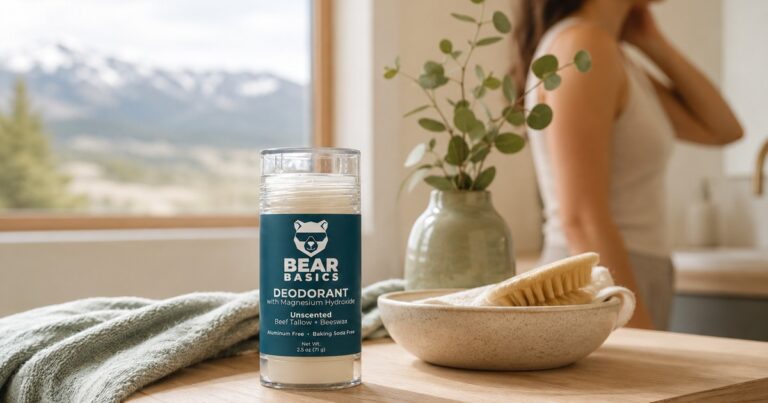
Given all this, we try to be careful with “natural” ourselves. Our ingredients are largely simple and minimally processed — things like beeswax, coconut oil, and beef tallow — and we’re happy that they are. But we don’t want the word “natural” doing work it can’t honestly do.
So rather than leaning on “natural” as a promise of safety or superiority, we’d rather just show you the short ingredient list and explain why each thing is there. That’s the real reason to feel good about a product — not the adjective, but the actual, understandable contents. And we’re candid about the trade-offs, like the fact that our beeswax-based balms aren’t vegan.
If “natural” means “a short list of recognizable ingredients I can understand,” then we’re glad to fit it. If it’s taken to mean “automatically safer and better,” we’d rather you hold us to a higher standard than a word. Our overview of tallow for skin is a good example of judging an ingredient on its merits.
“Natural” is one of the most persuasive words in skincare and one of the least defined. It has no enforced legal meaning, it doesn’t guarantee that a product is safer or better, and it isn’t automatically greener. Natural things can be harsh; synthetic things can be gentle. Origin simply isn’t the same as behavior.
Used honestly, the word does point at something nice — minimally processed, recognizable ingredients — and preferring those is a perfectly valid choice. Just make it because you understand and like what’s inside, not because a label promised you safety it can’t deliver.
The reliable habit, as always, is to read the ingredient list, judge ingredients on their merits, and weigh your own experience. Do that, and “natural” goes back to being a helpful hint rather than a hollow promise — and you get to make genuinely informed choices with real confidence.
Megan co-founded Bear Basics and leads design. As a mom, she writes our gentlest, most practical guides — on ingredients, sourcing, and simple family skincare — with an emphasis on honest, well-sourced, and simple. Read the full story →