Are they the same?
No — two different claims.

They sound like the same promise — but one means “no fragrance added,” and the other can quietly include a masking fragrance to hide a smell. Here’s the real difference and how to tell them apart on a label.

They’re not the same. Fragrance-free means no fragrance ingredients were added to scent the product; unscented means the product has no noticeable smell — which is sometimes achieved by adding a masking fragrance to cover the natural odor of the base ingredients. So an “unscented” product can actually contain fragrance, while a “fragrance-free” one shouldn’t. Neither term is strictly regulated, so for sensitive or allergy-prone skin, choose fragrance-free and confirm by reading the ingredient list — “fragrance,” “parfum,” and essential oils all count as fragrance.
Walk down any skincare aisle and you’ll see “fragrance-free” and “unscented” used almost interchangeably. They feel like the same promise: a product that won’t bother your nose or your skin. But they describe two genuinely different things, and the gap between them matters if you have sensitive skin.
The cleanest way to hold the distinction: fragrance-free is about what went in (nothing added to scent it), while unscented is about the result (you can’t smell it). And here’s the twist that catches people out — achieving “no smell” sometimes requires adding a fragrance to mask the natural odor of the ingredients.
Fragrance-free means no fragrance added. Unscented means no smell — which may involve adding a masking fragrance. They are not synonyms.
Fragrance-free is a claim about the formula. It means the maker didn’t add any ingredient whose job is to give the product a scent — no perfume, no fragrance blend, and no masking agent either. The intent is a product with nothing in it purely for smell.
Importantly, fragrance-free doesn’t always mean the product smells like absolutely nothing. Many ingredients have a faint natural odor of their own: beeswax has a soft honey note, an oil might smell mildly of itself, a butter can carry a whisper of scent. Those smells aren’t added — they’re just inherent to the raw material.
So a fragrance-free balm might carry a barely-there natural scent, and that’s still fragrance-free. The label is telling you nothing was added to perfume it, which is exactly what someone avoiding fragrance wants to know, and it is a meaningfully different promise from simply smelling like nothing.
Unscented is a claim about the outcome, not the method. It tells you the finished product has no noticeable smell — but it doesn’t tell you how that was accomplished. And there’s more than one way to get there.
Sometimes “unscented” simply means nothing was added, and the base ingredients happen to be nearly odorless. In that case it’s effectively the same as fragrance-free. But other times, the base ingredients have a smell the brand wants gone — and rather than leaving it, they add a masking fragrance to cancel it out.
That masking agent is still a fragrance ingredient. So a product labeled “unscented” can contain fragrance — the very thing a fragrance-sensitive person is trying to avoid. “No smell” is not the same as “no fragrance.”
It sounds almost contradictory, so it’s worth spelling out. Some raw ingredients — certain plant extracts, oils, or actives — have odors that manufacturers consider unpleasant or off-putting. To sell an “odor-free” version, they add a small amount of fragrance chemistry specifically engineered to neutralize or cover that smell.
The result reads as “unscented” to your nose, and the label may say exactly that. But if you scan the ingredient list, you’ll often find “fragrance” or “parfum” sitting right there. For most people that’s harmless. For someone with a fragrance allergy or reactive skin, it can be the hidden reason an “unscented” product still causes a flare.
This is the single most useful thing to know from this whole comparison: don’t assume “unscented” equals “fragrance-free.” When it matters, verify on the ingredient list rather than trusting the front of the package.
You might expect terms this important to be tightly defined by regulators. They largely aren’t. In the United States, neither “fragrance-free” nor “unscented” has a strict, legally enforced definition for cosmetics, and usage can vary between brands.
What this means in practice is that the terms are only as trustworthy as the company using them. A conscientious brand uses “fragrance-free” to mean genuinely no added scent; a looser one might use the words more casually. There’s no universal seal guaranteeing what either claim means.
Labeling rules also differ by region. In some markets, individual fragrance allergens must be listed once they pass a certain threshold, which gives shoppers a little more visibility; in others, the single word “fragrance” is all you get. That patchwork is another reason not to lean on the front-of-pack claim alone, wherever you happen to be shopping.
Because the front-of-pack claims aren’t standardized, the ingredient list — which is required — is your most reliable source of truth. Marketing words vary; the ingredient list has to be accurate.
Part of what makes this topic tricky is that a single word on a label — “fragrance” or “parfum” — can stand in for a whole blend of individual scent components. Historically, fragrance formulas have been treated as trade secrets, so brands haven’t had to list every component separately.
That means one word can represent dozens of ingredients, some of which are among the more common skin allergens. It’s not that fragrance is dangerous for most people — the vast majority use scented products with no trouble — but for the fragrance-sensitive, that undisclosed complexity is exactly the problem.
This is why people managing allergies or reactive skin gravitate toward fragrance-free: it removes an entire category of unknowns in one move, rather than trying to figure out which of many hidden components might be the culprit.
It also explains why “fragrance” appearing late in an ingredient list — suggesting a small amount — still matters to sensitive people. Allergy isn’t about quantity the way irritation can be; even a tiny amount of a component you react to can set off a response. For the fragrance-sensitive, present-or-absent matters more than how far down the list it sits.
Here’s a point that surprises a lot of people shopping “natural.” If a product is scented with essential oils — lavender, peppermint, citrus, and so on — it is not fragrance-free. The scent was added; the source being a plant doesn’t change that.
“Naturally scented” is still scented, and essential oils can absolutely irritate or trigger allergies in sensitive people. Some are actually more likely to cause reactions than synthetic fragrance, so “natural” is not a reliable stand-in for “gentle.”
A lavender-scented balm is a scented product. If you’re avoiding fragrance for sensitivity reasons, treat essential oils the same as any other added scent, and check the ingredient list for named oils.
For sensitive, reactive, eczema-prone, or allergy-prone skin, the safer default is fragrance-free — genuinely fragrance-free, confirmed on the ingredient list. Fragrance is consistently one of the most common causes of cosmetic contact allergy and irritation, so removing it removes a leading suspect.
Because “unscented” can hide a masking fragrance, it’s the less reliable choice when skin reactivity is the concern. That doesn’t make every unscented product a problem — many are fine — but if you’re troubleshooting reactions, fragrance-free is the cleaner starting point.
And whatever the label says, patch test anything new: a little on the inner arm, 24 hours, watch for a reaction. If you have significant fragrance allergies or persistent skin issues, an allergist or dermatologist can help you identify specific triggers. Our guide to gentle skincare during pregnancy touches on similar cautious-ingredient thinking.
For babies and young children, fragrance-free is the widely recommended default. Their skin is thinner and more permeable, and there’s little upside to adding scent to a product for a baby — so the sensible move is to skip it entirely and choose genuinely fragrance-free options.
The same “unscented can contain fragrance” catch applies here, which makes reading the label especially worthwhile for anything going on a child. A short ingredient list you can actually read is a real advantage when you’re shopping for the youngest, most sensitive skin in the house.
As always, this is about comfort and gentleness, not treating a condition — and a pediatrician is the right person to ask about any rash, persistent dryness, or reaction. For more on building a gentle lineup, see our guide to the best natural products for baby’s sensitive skin.
All of this comes down to one practical skill: reading the ingredient list instead of trusting the front of the package. It takes about ten seconds once you know what you’re looking for.
A short ingredient list is your best friend here. When a product has five or six recognizable ingredients, you can confirm the fragrance situation at a glance. When it has forty, a masking agent is much easier to miss.
None of this is meant to demonize fragrance. For most people, scented products are completely fine and genuinely enjoyable, and there’s nothing wrong with liking how something smells. Fragrance-free versus unscented only becomes a real decision when sensitivity, allergy, or a preference for simplicity is in play.
If your skin tolerates fragrance well and you love a scent, use it happily. The goal here isn’t fear — it’s clarity, so that when you do want to avoid fragrance, you can actually do it, and you’re not misled by a label that says “unscented” but tells a different story on the back.
Think of it as informed choice. Some days you want a scent; some skin, some people, and some seasons of life call for none. Knowing the difference lets you pick correctly either way.
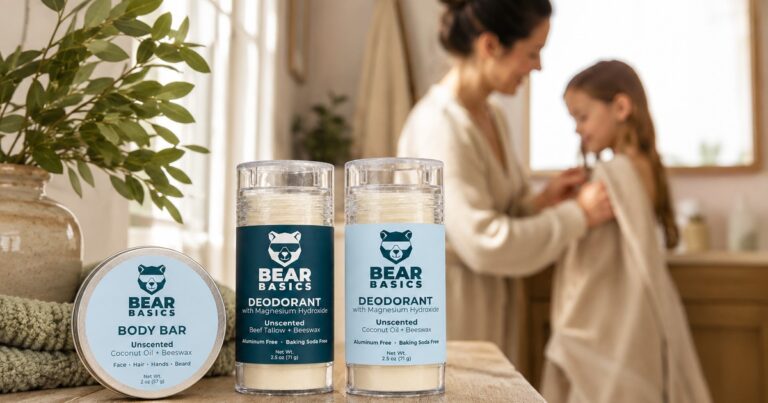
Our products are fragrance-free in the truest sense: we don’t add any scent, and we don’t add a masking agent to cover the natural smell of the ingredients either. What you may notice is simply the faint, natural scent of the raw materials themselves — and that’s exactly what fragrance-free is supposed to mean.
We do it this way because a short, honest ingredient list is the whole point of the brand. Adding a fragrance — even a masking one — would mean one more ingredient, one more potential irritant, and one more thing that isn’t doing anything for your skin. We’d rather leave it out.
That approach makes our products a comfortable default for sensitive skin and for the whole family. If keeping the rest of your routine equally simple appeals to you, our guide to simple skincare for the whole family follows the same idea.
Fragrance-free and unscented are not synonyms. Fragrance-free means nothing was added to scent the product, though a faint natural smell may remain. Unscented means the product has no noticeable smell — which can involve adding a masking fragrance, so an unscented product may still contain the fragrance a sensitive person is trying to avoid.
Neither term is strictly regulated, so the ingredient list is your source of truth. If you’re sensitive, allergy-prone, or shopping for a baby, choose fragrance-free and confirm by looking for “fragrance,” “parfum,” or named essential oils. And remember that “natural” scent is still scent.
Get comfortable reading that one line of the label and the whole confusion disappears. It’s the same habit that makes every ingredient decision easier — know what the words mean, then trust the list over the marketing.
Megan co-founded Bear Basics and leads design. As a mom, she writes our gentlest, most practical guides — on ingredients, sourcing, and simple family skincare — with an emphasis on honest, well-sourced, and simple. Read the full story →