Spend $50, Get 10% Off

When in doubt, simpler is safer. A gentle, plain-English guide to what's generally considered safe through pregnancy — and why a shorter, simpler shelf is a genuine advantage right now.

The safest pregnancy skincare is usually the simplest: gentle, fragrance-free basics and plain moisturizers. Single-ingredient options like tallow or coconut oil, mild cleansers, and mineral-based sun protection are common, low-fuss choices. A handful of stronger active ingredients — retinoids and certain acne treatments among them — are typically flagged to pause or discuss. Rather than memorize a list, the easiest and safest move is to bring your products to your OB or midwife and ask about each one.
If your skin suddenly feels like a stranger's, you're not imagining it. Pregnancy hormones change how your skin behaves — sometimes dramatically. You might get drier, more sensitive, more reactive, or break out in ways you never did before. Some people glow; plenty of us get patchy, itchy, and unpredictable. None of that means something is wrong. It just means the routine that served you for years may not fit the body you have right now.
Because things are changing week to week, this is exactly the wrong season for a complicated, ten-step regimen full of ingredients you'd have to research. The more moving parts, the more there is to second-guess and check. What works beautifully during pregnancy is the opposite: fewer products, gentler ingredients, and a shelf simple enough that you're never unsure what you just put on your skin.
Everything below is organized around that idea — what's generally considered safe, what's worth pausing on, how the trimesters differ, and how to build a short, calm routine you can trust. And throughout, the same honest refrain: confirm anything you're unsure about with your provider.
One reassurance before we dive in: you do not have to overhaul everything the moment you see two lines on a test. For most people, simplifying gradually — trading the most complicated products for gentler ones as you go — is completely reasonable. This isn't about fear or a frantic purge of your bathroom. It's about calmly shortening the list so the things touching your skin are ones you understand and feel good about.
If you remember nothing else from this guide, remember this:
The lowest-stress approach to pregnancy skincare is to shorten your shelf. Fewer ingredients means fewer unknowns to check, and gentle basics tend to handle unpredictable pregnancy skin best.
There's a real advantage hiding in that rule. When a product has three or four recognizable ingredients, you can look at it, understand it, and ask your provider a clear question about it. When it has thirty, you can't — and neither can they, easily. A short, honest label isn't just a nice-to-have during pregnancy; it's a practical tool that makes the "is this okay?" conversation possible in the first place.
This is also why we don't reach for the phrase "pregnancy-safe" as a marketing badge. Safety depends on your specific pregnancy and your provider's guidance, not on a word printed on a box. What we can offer is simplicity — products short and clear enough that you and your OB can actually evaluate them.
It's a small distinction with a big payoff for your peace of mind. A label that promises "pregnancy-safe" is asking you to trust the brand. A label with four recognizable ingredients is letting you and your provider decide for yourselves. During a season when so much feels out of your control, being able to look at a product and actually understand it is worth more than any reassuring claim someone printed on the front.
These are common, widely-used gentle choices. They're a reasonable starting point — still worth confirming with your provider, but the kind of low-fuss basics many people rely on:
Notice the theme: nothing on that list is trying to do anything dramatic to your skin. They moisturize, cleanse gently, and protect. That's exactly what makes them easy to feel good about. A single clean fat like tallow or coconut oil is about as simple as skincare gets — one recognizable ingredient, doing one gentle job. If you want the deeper comparison of those two bases, see beef tallow vs coconut oil.
A quick word on sun protection, since it earns its spot on that list: pregnancy can make skin more prone to dark patches (often called melasma or the "mask of pregnancy"), and gentle daily sun protection is one of the simplest ways to be kind to changing skin. Mineral-based options — the kind that sit on top of the skin rather than absorbing in — are a common, low-fuss choice, but as with everything here, your provider can confirm what fits you.
On the other side, a handful of stronger active ingredients are commonly flagged to pause or discuss during pregnancy. You'll see retinoids (strong anti-aging vitamin-A derivatives) and certain acne treatments come up most often in that conversation.
Rather than trying to memorize which ingredients to avoid, do the reliable thing: gather the products you use and ask your OB or midwife about each one at your next visit. They know your pregnancy; a blog can't. This one habit is safer than any list.
And a related caution: don't assume "natural" or "clean" automatically means pregnancy-safe. Those words aren't regulated safety terms, and even some botanical ingredients get flagged during pregnancy. Judge by the actual ingredients and your provider's guidance — never by marketing language. When in doubt, the simpler and shorter the ingredient list, the easier that judgment call becomes.
Skin priorities shift as pregnancy progresses. Here's the general arc — every pregnancy is different, so treat this as a map, not a rulebook:
| Stage | What often shows up | Gentle focus |
|---|---|---|
| First trimester | Nausea, scent sensitivity, breakouts | Pare back, go fragrance-free |
| Second trimester | Stretching skin, dryness beginning | Regular, simple moisturizing |
| Third trimester | Tight, itchy, very dry belly skin | Rich moisturizers, reapply often |
| Postpartum | Recalibrating skin, sharing with baby | Gentle, fragrance-free basics |
The next few sections walk through these in a little more detail.
Early pregnancy can be a rough patch for your senses. Nausea and a suddenly sharp sense of smell can make scented products — even ones you loved — genuinely unpleasant. Some people also get their first surprise breakouts here as hormones shift.
This is a good time to simplify and go fragrance-free. Pare your routine back to the gentlest versions of what you use, and don't feel you need to add anything new to "fix" pregnancy skin. Often, doing less is the fix. If breakouts appear and you're tempted to reach for a strong acne active, that's exactly the kind of thing to run past your provider first rather than starting on your own.
As your belly grows, the skin over it stretches — and stretching skin gets dry, tight, and often itchy. This is where regular, simple moisturizing earns its keep. Rich, single-ingredient moisturizers applied consistently keep stretching skin far more comfortable.
Apply a rich moisturizer to slightly damp skin morning and night, and again any time your belly feels tight. You're not treating anything — you're keeping stretching skin comfortable, which genuinely helps how you feel day to day.
By the third trimester, that tightness and itch usually peak. Reapply as often as you need to; there's no prize for using less when your skin is asking for comfort. Loose, soft fabrics help too. And as always — if itching becomes sudden, intense, or widespread, that's a reason to call your provider rather than reach for more lotion.
A gentle heads-up worth repeating because it matters: intense itching in the third trimester — especially on the palms and soles, or without any visible rash — is one of those things providers genuinely want to hear about, since it can occasionally point to something beyond dry skin. That's not meant to alarm you; the vast majority of pregnancy itch is simply stretched, dry skin. It's just a good example of why "call your provider when something feels off" isn't a throwaway line — it's the actual safety net.
Here's a simple split for the belly-and-hips stretch of pregnancy — what tends to help comfort, and what's worth flagging to your provider:
The left column is comfort care. The right column is a reminder that some itching in pregnancy can signal something your provider should know about — so when in doubt, call, don't just moisturize harder.
Let's be straight about this, because a lot of marketing isn't. No product is proven to guarantee that you won't get stretch marks. They're influenced heavily by genetics and how quickly your skin stretches — factors a cream can't override.
What moisturizing can do is keep stretching skin feeling supple and comfortable, and reduce that tight, itchy sensation. Many people find that genuinely worthwhile, and if it makes you feel better in your own skin during a big season, that's reason enough to do it. Just go in with clear expectations: you're buying comfort, not a guarantee. A simple, rich moisturizer you'll actually use consistently beats an expensive "stretch-mark" product you use twice — and it's kinder to a short, honest shelf.
Fragrance is one of the most common irritants for reactive pregnancy skin — and paired with a heightened sense of smell, it can turn a product you used to love into something you can't stand to be near. Going fragrance-free solves a surprising number of small problems at once: fewer potential irritants, and no scent to trigger nausea.
Keep in mind that "fragrance" or "parfum" on a label can hide a mix of undisclosed ingredients, which is exactly what you don't want during a season of simplifying. Fragrance-free basics sidestep all of that. If you love a little natural scent normally, pregnancy can be a nice time to take a break from it — your nose will often thank you, and it's one less variable to think about.
After birth, your skin is still recalibrating — hormones shift again, sleep is scarce, and you're often distracted by a tiny new person. This is not the season to introduce a complicated routine. The same gentle, fragrance-free, simple basics that served you through pregnancy keep working here.
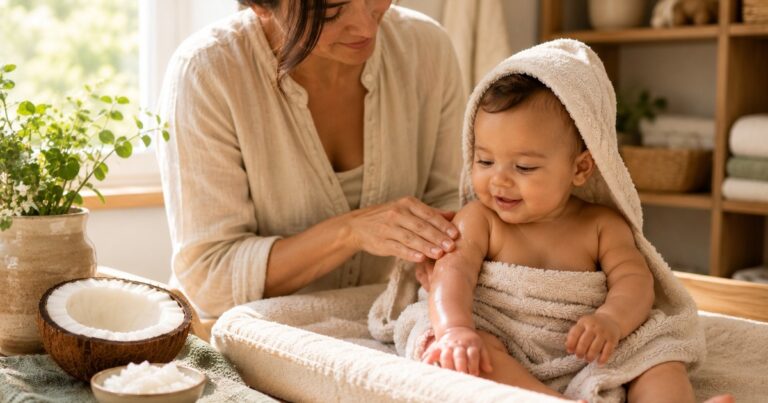
There's a lovely bonus, too: many of those same simple products are gentle enough to consider for baby, which means fewer separate things to buy and track. (Always patch-test and check with your pediatrician before using anything new on a newborn — but a single clean fat like tallow or coconut oil is a common, gentle choice for dry baby skin.) Our Cub Care guides cover the newborn stretch in more detail when you're ready.
One of the quiet joys of a short, simple shelf is that it often works for the whole family. A gentle, fragrance-free moisturizer you're using on your own stretched skin may be perfectly suited to your baby's dry patches as well — which is exactly the kind of overlap that makes early parenthood a little less complicated.
The principle carries over from everything above: fewer ingredients, more recognizable ones, and a provider's okay for anything you're unsure about. What's gentle enough for a newborn is usually gentle enough for a recovering postpartum body, too.
You need far less than the internet suggests. Here's a short, calm routine that covers most of what pregnancy skin actually asks for:
That's genuinely most of it. Everything on that list is gentle, recognizable, and easy to run past your provider. Our short, food-grade line was built for exactly this kind of pared-back routine — browse the simple basics if you'd like a starting point. And remember: the goal isn't to buy the "right" pregnancy products, it's to keep things simple enough that you can stop worrying about your shelf and get back to the bigger, better things you're thinking about.
Pregnancy is a lot to hold. Your skincare, at least, doesn't have to be one of the hard parts. Keep it short, keep it gentle, ask your provider when you're unsure, and let the rest go. Simpler really is safer here — and it's a whole lot calmer, too.
Megan co-founded Bear Basics and leads design and family-care content. She's a mom first, drawn to short ingredient lists you can actually pronounce. Read the full story →