Spend $50, Get 10% Off

Green leaves, earthy fonts, and words like “clean” and “natural” can make almost anything look wholesome — whether or not it is. Here’s a 6-step guide to seeing through the styling, and which claims genuinely mean something.

Greenwashing is when marketing makes a product seem more natural, clean, or eco-friendly than it actually is — usually through vague buzzwords, fear-based “free-from” claims, earthy packaging, and self-made badges. To spot it: ignore unregulated words like “natural,” “clean,” and “non-toxic” (none have legal definitions), read the actual ingredient list instead of the front of the pack, be skeptical of “free-from” claims that demonize safe ingredients, and look for specific, verifiable details and legitimate third-party certifications rather than green leaves and vague promises. The rule of thumb: honest brands get specific; greenwashing stays vague.
Greenwashing is the gap between how “good” a product looks and how good it actually is. The term borrows from “whitewashing,” and it describes marketing that uses the language and look of natural, clean, ethical, or eco-friendly products without the substance to back it up.
It shows up all over personal care because the category is perfect for it: ingredient lists are confusing, shoppers increasingly want gentler and greener options, and a few well-chosen words and design cues can create a wholesome impression in a split second. The impression does the selling; the details rarely get checked, which is exactly the outcome the marketing is hoping for.
Picture two products side by side: one in bright plastic with a clinical name, one in soft kraft-paper with a leaf and the word “pure.” Most of us instinctively trust the second, even though nothing on either package tells us what’s actually inside. That instant, unearned trust is precisely what greenwashing is designed to capture — and it happens before we’ve read a single ingredient.
Greenwashing isn’t always outright lying. More often it’s selective truth, vague implication, and styling — letting you assume something the product never actually claims or delivers — which is what makes it so slippery to pin down.
It’s worth being honest about why greenwashing is so effective, because understanding the psychology makes you harder to fool. Most of us genuinely want to make good choices — for our health, our families, and the planet — and that good intention is exactly what greenwashing borrows against, turning a virtue into a vulnerability.
Add to that the reality that ingredient lists feel like a foreign language, and you get a shopper who’s motivated but overwhelmed. In that state, a reassuring word and a leafy label are a relief. They let you feel like you did your homework without the actual work, which is a very appealing shortcut.
None of this makes anyone gullible — it makes us human and busy. The fix isn’t cynicism; it’s a few reliable habits that let you check the substance quickly, so your good intentions actually land on good products.
The encouraging part is that these habits are fast once they’re second nature. You don’t have to become a chemist or distrust every brand; you just need a short mental checklist you run in a few seconds before you buy. Our guide to simplifying your personal-care routine in 30 days is built on the same idea — small, repeatable habits that quietly do the heavy lifting.
Start by mentally muting the big front-of-pack words: natural, clean, green, pure, non-toxic, eco. Almost none of these have enforced legal definitions in cosmetics, which means a brand can print them regardless of what’s inside. They’re mood words, not facts.
Do this: treat those words as decoration, not information. If the most prominent thing on the package is an unregulated adjective, that’s your cue to go looking for the substance yourself. The bigger and vaguer the promise on the front, the more it’s worth flipping the package over.
The ingredient list is the part that has to be accurate, so it’s where the truth lives. Flip the product over and read it. You don’t need to recognize every word — just get a feel for whether the list is short and readable or long and mysterious, and whether it matches the front-of-pack story.
Do this: compare the claim to the list. A product shouting “simple and pure” over a list of forty ingredients is telling on itself. Let the list, not the slogan, set your expectations. If the two tell different stories, believe the list.
Honest environmental and ingredient claims tend to be specific and checkable; greenwashing tends to be vague and unfalsifiable. “Made with plant-based oils you can read” is specific. “Harnesses the power of nature” is not. Specificity is a strong signal of substance.
Do this: for any feel-good claim, ask “compared to what, and how would I verify it?” If there’s no concrete answer — a number, a named ingredient, a real certification — treat it as atmosphere, not evidence. Real claims survive the question “how would I check that?”; slogans evaporate under it.
That official-looking green badge might mean a lot — or nothing. Many “seals” are simply graphics a brand designed for itself, with no outside body or published standard behind them. A real certification comes from an independent organization with criteria you can look up.
Do this: when you see a badge, ask who issues it and what its standards are. Names like USDA Organic or Leaping Bunny point to real third-party programs; a generic leaf-in-a-circle with a made-up name points to marketing. A thirty-second search for the issuing body usually settles it.
“Free-from” claims can be useful, but they’re also a classic greenwashing tool. Sometimes they trumpet the absence of an ingredient that was never used in that kind of product anyway, or they demonize a safe, well-studied ingredient to make the product seem superior by contrast.
Do this: notice when a product sells itself mainly by what it lacks. Ask whether the “banished” ingredient was ever a real concern at the amount used — and remember that removing one thing says nothing about the quality of everything else in the formula. A short, honest list of ingredients you understand beats a long one wrapped in reassuring absences.
The strongest signal of an honest product is transparency: a brand that tells you exactly what’s in it, why each thing is there, where meaningful ingredients come from, and what the product can’t do. Real confidence looks like specifics and even a few admitted limitations — not a wall of flattering adjectives.
Do this: reward the brands that get concrete and own their trade-offs. A company willing to say “here’s exactly what this is, and here’s what it isn’t” has far less room to greenwash you. Confidence that shows its work is worth far more than confidence that just shows adjectives.
Let’s put a finer point on the vocabulary, because these words do a huge amount of the heavy lifting in greenwashing. In cosmetics, terms like “natural,” “clean,” “pure,” “green,” and “non-toxic” generally have no strict, enforced legal definition. That means they can be applied broadly, and two products using the same word can be worlds apart.
“Clean” is a good example: there’s no official standard for what makes a product “clean,” so each brand essentially defines it for itself. “Non-toxic” is trickier still, because it quietly implies that other products are toxic — a scary suggestion that’s rarely true and even more rarely supported.
This isn’t an argument that words never matter — plenty of brands use them sincerely. It’s that the words alone can’t carry the weight shoppers put on them. When a term does the persuading but has no agreed meaning, the honest move is to look underneath it rather than take it at face value.
Being wary of these words cuts both ways. Just as a “natural” claim doesn’t prove a product is good, a “chemical” scare doesn’t prove a product is bad — everything is chemicals, including water. Honest evaluation ignores both the halo words and the fear words.
“Free-from” deserves its own section because it’s so common and so persuasive. The formula is simple: name an ingredient, imply it’s dangerous, and celebrate not using it. The problem is that the implied danger is often overstated, and the whole move can distract from what the product actually contains.
Sometimes the “free-from” ingredient was never standard in that product type to begin with, so the claim is technically true but meaningless. Other times a perfectly safe, well-studied ingredient gets painted as villainous simply because fear sells. Either way, the absence of one ingredient tells you nothing about the presence and quality of the rest.
This doesn’t mean every “free-from” claim is dishonest — some people avoid specific ingredients for genuine reasons, and clear labeling helps them. It just means the claim should prompt a question rather than a purchase: free from what, and was that ever actually a problem?
There’s an irony worth naming, too: fear-based “free-from” marketing is itself a form of greenwashing. Scaring you about one ingredient to sell you another isn’t transparency — it’s the same game in a different costume. Being consistent means resisting both the halo words and the scare words.
A surprising amount of greenwashing happens before you read a single word, through pure visual design. Greens and earthy browns, leaves and botanical illustrations, kraft-paper textures, minimalist fonts, and images of water or plants all signal “natural” to our brains — instantly and subconsciously.
The catch is that none of these are evidence of anything. Packaging design is a choice, and any product can be dressed in the visual language of nature regardless of what’s inside. A garish neon product and an earthy beige one can contain nearly identical formulas.
Notice the feeling a package gives you, then set it aside and evaluate the claims and ingredient list on their own. The aesthetic is there to make you feel a certain way; your job is to check whether the substance earns the feeling.
This is genuinely hard, because good design works on us whether or not we approve. Even people who know all of this still feel the pull of a beautifully earthy package. The goal isn’t to stop feeling it — it’s to add a beat of “nice look; now what’s actually inside?” before deciding.
Not all seals are created equal, and learning to tell them apart is one of the most useful greenwashing defenses. The key question is always the same: is there an independent organization, with published standards, standing behind this mark?
A legitimate certification isn’t a guarantee a product is perfect for you, and a lack of one doesn’t make a product bad — certifications cost money and small honest brands sometimes skip them. But a real third-party mark is a meaningful signal, while a self-made badge is just more design. Learn a few trustworthy names and the rest gets easier.
It also helps to remember what a certification does and doesn’t promise. An organic seal speaks to how ingredients were grown, not to whether a product suits your skin; a cruelty-free mark speaks to animal testing, not to gentleness. Match the badge to the actual claim you care about, rather than treating any seal as a blanket endorsement.
The most reassuring thing about all this is that honesty has a recognizable style, and once you can see it, good products get easier to find. Honest brands get specific: they name ingredients, explain why each is there, and describe what a product does in plain, checkable terms rather than sweeping promises.
And crucially, they let the ingredient list and the evidence do the talking, keeping the adjectives to a minimum. When the substance is strong, a brand doesn’t need to lean on mood words. They’re also willing to admit limitations. A brand that tells you what its product isn’t — not vegan because it contains beeswax, not a treatment for a medical condition, not right for every skin type — is showing you the kind of candor that greenwashing can’t fake. Admitting a trade-off is a trust signal.
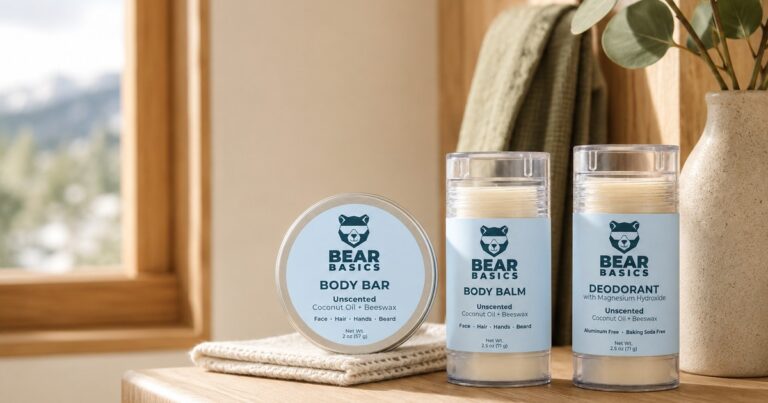
That’s the standard we try to hold ourselves to: short ingredient lists you can read, plain explanations of why each ingredient is there, honest limits, and no fear-based claims. We’d rather tell you exactly what we are than dress up as something we’re not — because a claim you can check is worth more than a dozen you simply have to believe. Our guides on transitioning to cleaner family skincare and the swaps with the biggest impact take the same specific, no-hype approach.
Megan co-founded Bear Basics and leads design. As a mom, she writes our gentlest, most practical guides — on ingredients, sourcing, and simple family skincare — with an emphasis on honest, well-sourced, and simple. Read the full story →