What is it?
A preservative for water-based formulas.

A preservative that stops things growing in water-based products, used at up to one percent. The evenhanded version: what it does, what is actually disputed, and why we do not use it.

Phenoxyethanol is a preservative used at up to about one percent to stop mold, yeast, and bacteria growing in products that contain water. It has been reviewed repeatedly and permitted at that level, and some researchers and consumer groups have raised questions, particularly about cumulative exposure across many products, that are not fully settled. Our products do not contain it because they contain no water, which means a preservative system would have nothing to protect. That is a formulation difference and not a judgment about the ingredient.
Phenoxyethanol is a preservative, used at up to about one percent to stop mold, yeast, and bacteria growing in anything that contains water. That is the entire job, and nearly every argument about it is really an argument about whether that job needs doing.
The email we get is usually some version of: I found this in my kid's lotion and a website told me to throw it out. The honest answer takes longer than the website's did. It became the industry default partly because it works against a broad range of organisms and partly because it was the ingredient the industry reached for as parabens fell out of favour, so a great deal of what is sold now as paraben-free is preserved with phenoxyethanol instead. Reviews by cosmetic safety bodies have permitted it at that one percent level repeatedly. Some researchers and consumer groups have raised questions, particularly about how much a person accumulates across eight products a day, that nobody has settled.
Our products do not contain it for a reason that is dull rather than damning. They have no water in them, so there is nothing for anything to grow in, and a preservative system would have no job. That is a formulation difference, not a verdict, and the two keep getting mistaken for each other.
Phenoxyethanol is a glycol ether, which is a clear, slightly oily liquid with a faint rose-like smell. Green tea and chicory are the plants most often named as natural sources, and that line appears on a great many ingredient pages, but it is repeated far more often than it is documented with measured amounts, so we would treat it as a footnote rather than a reassurance. The phenoxyethanol in cosmetics is made synthetically from phenol and ethylene oxide, because that produces a consistent, pure material and extracting it from a plant would not.
That last point is worth pausing on because it comes up constantly in natural products conversations. An ingredient being made in a factory does not make it a different molecule from the one in the plant. Synthetic vitamin C and vitamin C from an orange are the same compound, and the same logic applies here.
Phenoxyethanol is a preservative used at up to about one percent in cosmetics to prevent microbial growth. It is effective against a broad range of organisms, which is why it is usually the only preservative a formula needs or is paired with just one other.
It is also used as a solvent and occasionally as a stabilizer, though in a skincare panel preservation is almost always the job it is doing. On a label you may also see it written as 2-phenoxyethanol, which is the same compound.
The figure attached to phenoxyethanol everywhere is one percent, and it is a ceiling rather than a typical dose. European cosmetics rules cap it at 1.0 percent of a finished product, and most formulas sold elsewhere stay at or under that same line.
In practical terms, one percent is one gram in every hundred grams of product. A 200-milliliter bottle of lotion at the ceiling holds roughly two grams of it, a little under half a teaspoon spread through the whole bottle, and each application carries a small fraction of that.
Many formulas sit below the ceiling. Suppliers that sell phenoxyethanol pre-blended with a booster typically suggest using between half a percent and one percent of the blend in a finished product, and the blend itself is mostly phenoxyethanol, so the actual amount on many panels is somewhere under one percent.
The rules at the edges do differ. Since 2019, France has required leave-on products containing it, apart from deodorants, hair styling products and makeup, to carry a warning against use on the nappy area of children three and under. That is a narrow, precautionary labeling step aimed at one specific use, and it is the clearest example of regulators reading the same evidence slightly differently.
For a parent, the useful point is that the percentage on any one bottle does not tell you how much reaches your child. How many products contain it, and whether they stay on the skin or rinse off, matters more than whether a single lotion sits at half a percent or a full one.
Phenoxyethanol has been reviewed repeatedly by cosmetic safety bodies and permitted at up to one percent, and some researchers and consumer groups have raised questions that are not fully settled. Both halves of that sentence are true and the second half does not cancel the first.
The concerns fall into a few recognisable groups. Skin irritation and contact allergy is the most concrete one, and it is real but uncommon. Infant exposure drew attention after reports connected to a nipple cream used by nursing mothers, which is a specific route of exposure and not a general finding about lotion. Cumulative exposure is the argument that a person using eight products daily, several containing the same preservative, is getting more than any single-product assessment considered.
The cumulative argument is the hardest to resolve, because it is difficult to study and applies to many ingredients besides this one. Calling it unresolved is more accurate than calling it fine or dangerous, and a page that sounds certain in either direction is overstating what anyone knows. Our own reading is that avoiding it is a reasonable choice, and that a preserved water-based product is still a better buy than an unpreserved one.
It is in a lot of products, and the common thread is water. Knowing the pattern makes it easier to predict what is on a panel before you read it.
| Product type | Usually contains it? | Why |
|---|---|---|
| Lotions and creams | Often | High water content, long open shelf life |
| Baby wipes | Often | Wet, warm, opened repeatedly |
| Shampoo and body wash | Often | Water-based, used in a shower |
| Serums and gels | Frequently | Water or water-gel base |
| Balms and salves | Rarely | No water phase to protect |
| Body bars and oil blends | Rarely | Anhydrous, nothing to grow in |
| Powders | Rarely | No available water |
The bottom three rows are the useful part. If you are trying to avoid this ingredient specifically, the reliable route is not hunting for brands that exclude it but choosing product formats that never needed it. Baby wipes deserve a particular mention, because they are wet, they are used on the nappy area, and a family can go through several a day, which makes them the single product most worth checking if cumulative exposure is what concerns you.
Rinse-off products such as shampoo and body wash spend a minute or two on the skin, while a lotion, or the film a wipe leaves behind, stays on for hours. That is why the leave-on rows matter most if you are counting exposure.
On most panels phenoxyethanol sits near the end, and very often the very next ingredient is ethylhexylglycerin. The pairing is common enough that spotting one is a good predictor of the other.
Ethylhexylglycerin is a glycerin-derived ingredient that does two jobs. It is a skin-conditioning agent with a light, non-greasy feel, and it makes phenoxyethanol work better, which lets a formula reach the same protection with less of the main preservative. Research on the pair has found that ethylhexylglycerin weakens the outer membranes of microbes, which helps phenoxyethanol do its job and is why the combination outperforms either one alone.
Suppliers sell the two pre-mixed, commonly at around nine parts phenoxyethanol to one part ethylhexylglycerin. A label reading “phenoxyethanol, ethylhexylglycerin” in that order is often a single purchased ingredient showing up as two lines, which is worth knowing before you count it as two separate additions.
Because phenoxyethanol is rarely used above one percent, it often marks the point on a panel past which order stops reflecting amount. The one percent line on ingredient labels explains how to read everything that comes after it.
Other partners show up too. Caprylyl glycol is the other common companion, and it does a similar double duty as a humectant and a booster. Seeing either pairing tells you the formulator chose a standard, well-understood system rather than an unusual one.
A brand that avoids phenoxyethanol in a water-based product has to use something else, and every alternative comes with its own list of complaints. There is no preservative with a clean reputation, because every preservative is by definition designed to stop things living.
Benzoic acid, sorbic acid, and their salts, usually sold as blends. They work well but only within a narrow acidic pH range, which constrains the rest of the formula. Products using them are often more acidic than they otherwise would be.
Effective and well understood, and it requires enough alcohol to be drying on skin. This is why you see it in toners and gels far more often than in creams meant for dry or reactive skin.
Caprylyl glycol, pentylene glycol, and similar materials do double duty as humectants and as support for a preservative system. They are usually paired with something else instead of carrying the load alone.
An older category that works reliably and has a worse reputation than phenoxyethanol does. A brand switching away from phenoxyethanol toward one of these has not made an obvious improvement.
An engineering answer instead of an ingredient one. A pump that never lets air or fingers into the product reduces how much preservation is needed, and it raises the cost of the package considerably.
The reason phenoxyethanol became so common is visible in that list. It works across a wide pH range, it does not need alcohol, and it usually works alone. Replacing it means accepting a constraint somewhere else.
Our formulas contain no water, so there is nothing for mold or bacteria to grow in and no job for a preservative to do. Why creams need preservatives covers why every water-based product needs a system, including why “preservative-free” on a lotion is a warning rather than a virtue, and water-free skincare explains how anhydrous formats sidestep the question entirely.
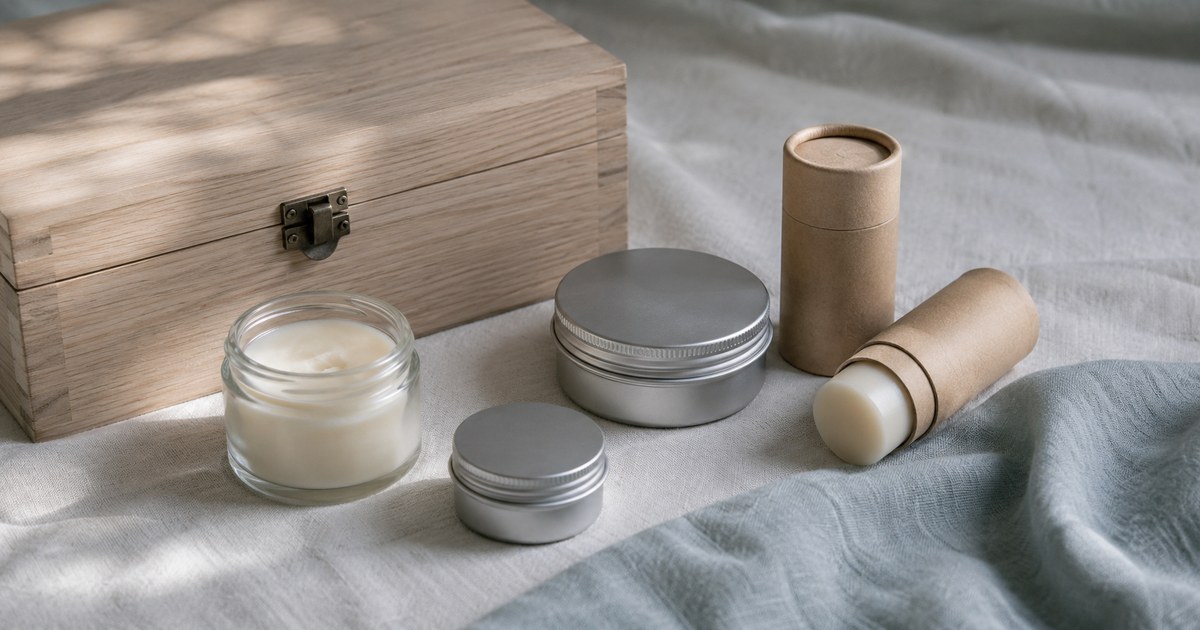
The body balm is four ingredients and the deodorant is five, and none of them is water. Vitamin E is in both, and its job is slowing the oils from going rancid rather than protecting anything against microbes — vitamin E in skincare covers that distinction.
That is a consequence of the format and not a verdict on phenoxyethanol. If a water-based lotion suits your skin better than a balm, a well-preserved one is a sensible thing to buy, and finding phenoxyethanol on its label is not a reason to throw it out.
We would rather say this plainly than print “preservative-free” on our own labels as if it were an achievement, because it is simply what happens when a formula leaves water out. The only upkeep a water-free balm asks for is dry fingers and a closed lid, and nothing more.
The most common everyday complaint about phenoxyethanol is not a long-term worry but a short-term sting, and it shows up most around the eyes. That is worth separating from the bigger debate, because it is something you can notice and act on yourself.
Undiluted phenoxyethanol carries a hazard statement for serious eye irritation on its safety data sheet. That describes the pure chemical in a drum, not a cream with under one percent in it, but it explains why the eye area is where people notice it. Formulators working on eye makeup removers describe preservatives, phenoxyethanol among them, as a known source of stinging and burning there, partly because removers are wiped right up to the lash line and some inevitably reaches the eye.
A sting of that kind is usually a brief prickle or warmth that fades within a minute, and it tends to be stronger on skin that is already dry, windburned or rubbed raw from a cold. A contact allergy is a different thing: it is uncommon, it builds over repeated use, and it shows up as an itchy rash rather than a sting that passes.
If an eye product stings every time, notice whether it stings anywhere else on the face. If it only bothers you near the eye, the location is the problem more than the ingredient, and applying a little further from the lash line or letting a remover sit on a pad instead of rubbing often settles it.
Elsewhere on the body, most people cannot feel phenoxyethanol at all at the levels used. It has no greasy feel, and at under one percent its faint scent is lost among everything else in the bottle.
Plenty of people decide to avoid this ingredient, and that is a reasonable decision to make for yourself even in the absence of a settled answer. Doing it effectively takes a slightly different approach than scanning for the word.
Choose formats, not brands. Balms, body bars, oil blends, and powders are anhydrous by nature, so the question never arises. Hunting for a water-based product that avoids the ingredient means finding one that uses a different preservative, which may or may not be what you wanted. The format differences are laid out in balm versus cream.
Read for the alternatives too. If a lotion does not list phenoxyethanol, something else on that panel is doing the job. Benzyl alcohol, sodium benzoate, potassium sorbate, and the glycols are the common ones. Knowing their names turns a successful search into an informed one.
Count your products. If the cumulative-exposure argument is what concerns you, the most direct response is using fewer products instead of swapping each one for a version with a different preservative. Six products becoming three halves the exposure regardless of what is in them.
Phenoxyethanol does appear in a small number of vaccines, and the internet uses that fact to argue in both directions. One version says it is in vaccines, so it must be harmless in a lotion. The other says it is in vaccines, so it must be something to fear. Neither conclusion follows from the fact itself.
Here is what is actually listed. Published excipient tables for vaccines used in the United States show 2-phenoxyethanol in a handful of combination shots containing tetanus, diphtheria and pertussis components, some of which also include polio, at about 3.3 milligrams per dose, or 0.6 percent. In those tables it is described as a stabilizer rather than as the preservative.
For scale, 3.3 milligrams is the amount in roughly a third of a gram of lotion made at the one percent ceiling. That arithmetic is tidy, and it still does not settle anything, because an injection given a few times in childhood and a lotion applied daily for years are different routes with different patterns of exposure. One tells you very little about the other.
So we would set this argument aside in both of its forms. If you are weighing phenoxyethanol in your skincare, the questions that matter are skincare questions: how many products contain it, whether they stay on or rinse off, and how your own skin responds when you use them.
Checking a phenoxyethanol claim yourself takes about ten minutes, and every source you need is free. This is the routine we use when a customer sends us a link.
Find where phenoxyethanol sits and what surrounds it. Near the end, next to ethylhexylglycerin or caprylyl glycol, is the normal pattern. Note whether the product rinses off or stays on, since that changes how long it is on the skin.
PubChem, the free chemistry database, has an entry for phenoxyethanol with its synonyms, structure and hazard data for the pure substance. Read the summary rather than hunting for the most alarming line.
CosIng, the European Union’s searchable cosmetic ingredient list, shows each ingredient’s function and any concentration limit attached to it, including the 1.0 percent cap on this one.
When a page cites research, find the study and read the abstract. Check whether it tested the pure chemical or a finished product, on skin or by another route, and at what amount.
If you suspect a product, stop it and add things back one at a time with several days between. That tells you more about your skin than any database can.
A reaction that hurts, spreads or blisters is past the point of label reading and is worth having looked at in person.
Phenoxyethanol is a widely used preservative that stops things growing in water-based products. Concerns about it exist and are not fully settled, and it has been reviewed repeatedly and permitted at up to one percent. Both of those are accurate, and flattening them into a single verdict would misrepresent what is known.
Our products do not contain it because they contain no water, which means a preservative system would have nothing to protect. That is a consequence of how we formulate and not a position on the ingredient, and we would be misrepresenting ourselves if we let you read it as one.
If you want to avoid it, choosing anhydrous formats is the reliable way and using fewer products overall is the most direct one. If you are comfortable with it, a preserved water-based product is a perfectly sensible thing to buy, and a lot of people will find one suits their skin better than a balm does. Either way, the panel, the chemical record and your own skin will tell you more than any single website, including this one.
If you take one habit from this page, make it noticing where phenoxyethanol sits on a panel and what sits next to it, because that tells you most of what the label can.
Megan co-founded Bear Basics and leads design. As a mom, she writes our gentlest, most practical guides — on ingredients, sourcing, and simple family skincare — with an emphasis on honest, well-sourced, and simple. Read the full story →