Quick answer
No — well-rendered tallow balm does not smell like beef. Properly rendered, well-filtered cosmetic tallow carries a faint, neutral, slightly waxy-fatty scent in the container — and on skin it fades to essentially nothing within about five minutes. When tallow does smell beefy or gamey, that’s a processing failure: incomplete rendering, scorching, poor filtering, or old, oxidized fat. Smell is a quality signal, not an ingredient trait — which makes this question a genuinely useful one to ask of any tallow product, ours included.
Answers at a glance6 quick questions
Smells like beef?
No — not when rendered well.
What’s it like?
Faint & neutral — near unscented wax.
On skin?
Fades in ~5 minutes.
Others smell it?
No — it doesn’t project.
Beefy smell means?
Poor rendering or aging fat.
Why not perfume it?
Fragrance irritates; the note barely exists.
01 The honest short answer
Let’s not bury it: a well-made tallow balm does not smell like beef, steak, burgers, or anything else from a kitchen. In the container, fresh rendered tallow has a faint, neutral scent — mildly fatty, mildly waxy, closer to an unscented candle than to food. Applied to skin, even that faint note fades within about five minutes, leaving essentially nothing.
We’ll spend the rest of this post earning that answer, because “trust us, it’s fine” is exactly the kind of non-answer that made you search this question. The short version of the long version: smell is a manufacturing outcome, not an ingredient property. Tallow that’s rendered carefully, filtered thoroughly, and kept fresh is neutral. Tallow that’s rushed, scorched, under-filtered, or old can absolutely smell beefy — and products made from it deserve the bad reviews they get.
So the real question isn’t “does tallow smell?” It’s “was this tallow made well?” — and by the end of this guide you’ll know how to answer that for any product you pick up.
02 Why everyone asks this (fair question)
If you’ve hesitated over this, you’re in good company — it’s the single most common question tallow skincare gets, and the skepticism is completely rational:
- You know what beef fat smells like. Everyone who’s cooked has met hot beef fat, and nobody wants their moisturizer associated with a roasting pan.
- The internet has receipts. Some tallow products genuinely do smell — reviews saying “smells like a barn” exist because poorly rendered products exist. The category has a quality-variance problem, and pretending otherwise insults your intelligence.
- Skincare lives near your nose. A body balm, a lip balm especially — you’ll smell whatever it smells like, all day. The stakes are real.
Here’s the reframe that makes everything click: the smell of cooking beef fat comes largely from what’s in the fat besides fat — proteins, blood, connective tissue, browning reactions from high heat. Rendering, done right, is the process of removing all of that. What remains is close to pure triglycerides — and pure fat has very little smell at all. The beefiness was never the fat; it was the passengers.
03 What well-rendered tallow smells like
So what does the finished product actually smell like? An honest sensory tour of a well-rendered, unscented tallow balm:
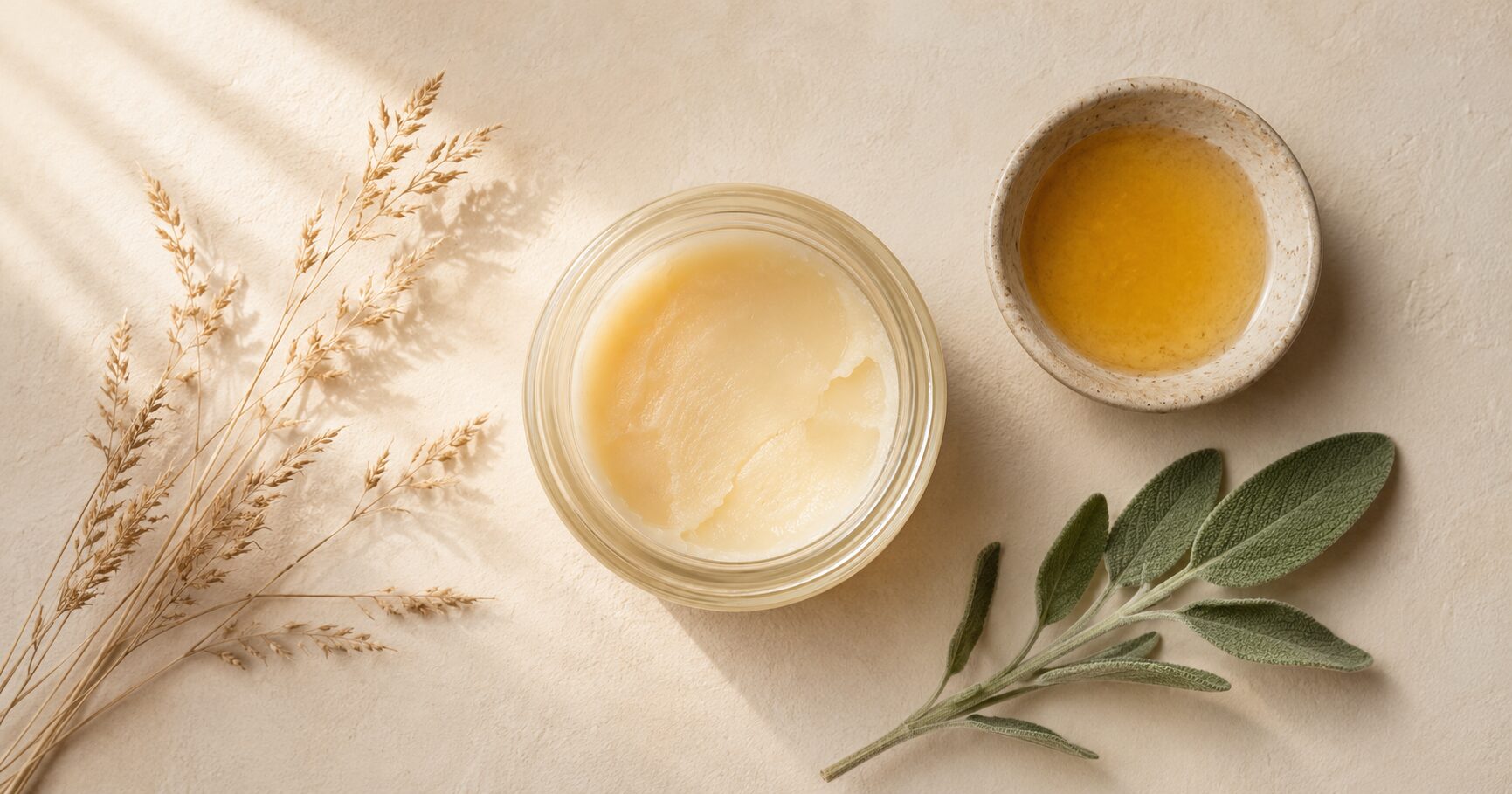
- In the container, nose right up to it: a faint, clean, fatty-waxy note. People variously describe it as “like nothing,” “faintly like a plain candle,” or “slightly buttery.” Nobody describes fresh, well-made tallow as meaty.
- In a blended balm: the other ingredients contribute their own soft undertones — beeswax brings a whisper of honey; coconut-based products bring coconut. In our tallow line the honest summary is “faint beeswax over near-nothing.”
- At arm’s length: nothing. Tallow balm has no projection — it is not a scent experience for anyone who isn’t actively sniffing the tin.
Context helps: every natural fat has some native scent. Unrefined shea smells nutty-smoky, virgin coconut oil smells like coconut, lanolin smells woolly, olive oil smells like olives. Neutral-rendered tallow sits at the quiet end of that spectrum — quieter than virgin coconut, far quieter than raw shea. “Scentless” would be overclaiming; “the least scented thing on your shelf after water” is about right.
04 Rendering: where smell is won or lost
Everything about tallow’s smell is decided before it ever reaches a formula, in the rendering pot. Rendering is slow, low-heat melting that separates pure fat from everything that isn’t fat — and each step either removes future smell or bakes it in:
- Starting material: quality rendering starts with suet — the clean, dense fat — not scraps. Cleaner in, cleaner out.
- Low and slow: gentle heat melts fat out without scorching it. High heat browns proteins and toasts the fat itself — that’s where “roasty” off-notes are born, and they never leave.
- Thorough filtering: the melted fat is strained — often multiple times — to remove every last solid. Leftover particles are leftover smell, and they also age badly.
- Sometimes a wet render or purification passes further pull out impurities, taking the result even closer to neutral.
The finished grade matters too: cosmetic-grade tallow is rendered and filtered to a stricter standard than the tub of drippings at a butcher counter — which is exactly why DIY experiments with kitchen tallow so often produce the beefy results that scare people off the whole category. The full journey from pasture to balm — including what “grass-fed” adds — is in what grass-fed really means for beef tallow.
05 Does grass-fed change the smell?
A fair follow-up, since grass-fed is what we use: does pasture-raising make tallow smell stronger? The honest, slightly nerdy answer:
Diet genuinely influences fat — grass-fed tallow differs a bit in fatty-acid balance and carries more of the pigments and nutrients of pasture (it often runs slightly more golden). Before rendering, grass-fed fat can have marginally more character than grain-fed.
After proper rendering and filtering, the difference in smell is minimal to undetectable. The rendering process that removes the beefiness removes most of the pasture character along with it. What survives into a finished balm is the composition difference — the fatty-acid profile — not a scent difference worth planning around.
Why we still choose grass-fed
Not for the nose — for the sourcing. Pasture-raised fat from known supply chains is a traceability decision: we’d rather build on an ingredient whose origin we can explain in one sentence. The fat’s makeup — and the fuller case — lives in 7 beef tallow skincare benefits.
06 On skin: the five-minute fade
The container sniff is the wrong test, because you don’t wear the container. What matters is the on-skin timeline, and it runs like this:
- Minute 0: as you apply, skin warmth softens the balm and briefly lifts its faint note — this is the most scent you will ever experience, and it’s still subtle.
- Minutes 1–5: the light volatile part of the scent dissipates. What’s left is fat sitting quietly on skin, which has almost no smell at all.
- Minute 5 onward: functionally nothing. Press your nose to your forearm and you might find a whisper; nobody at conversational distance ever will.
Two honest asterisks. First, lip balm lives under your nose, so you’ll notice its first minutes more than a body balm’s — after which the same fade applies. Second, warmth amplifies briefly: post-shower application or a hot day gives the first minute slightly more presence, then the same fade. Neither changes the conclusion; both are worth knowing so nothing surprises you.
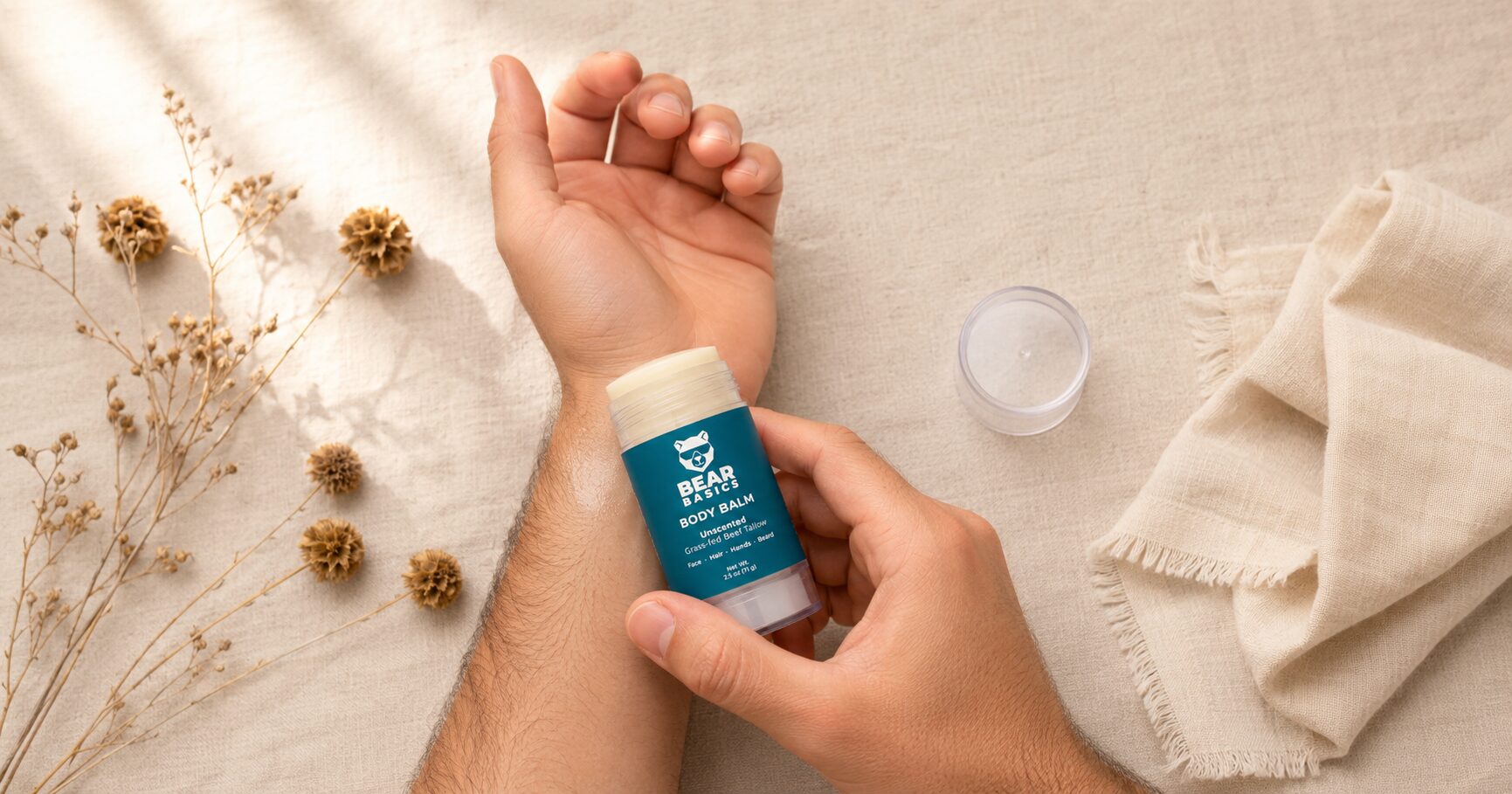
This fade is also why we tell people to judge a tallow balm at minute five, not second five — the five-minute version is the one you actually live with, a principle that applies to the whole application routine in how to use a tallow balm.
Smell it for yourself — risk-free.Our tallow body balm and lip balm are rendered clean and left unscented on purpose. Run the nose test yourself — minute five is the one that counts. 07 Why we stay unscented instead of masking
Plenty of tallow brands answer the smell question with lavender. We think that’s solving the wrong problem, and it’s worth explaining because it’s a real fork in the category:
- There’s barely anything to mask. Perfuming a well-rendered balm is painting over clean drywall — the fragrance is 100× more present than the note it covers.
- Fragrance is the most common cosmetic irritant. For the sensitive skin, babies, and eczema-prone kids that draw many families to tallow in the first place, added fragrance reintroduces the exact variable they came to avoid — the full reasoning is in fragrance-free vs unscented and essential oils in skincare.
- Scent can’t be shared. One person’s cedarwood is another’s headache. An unscented balm is the only version a whole household can agree on.
- And candidly: fragrance hides quality. An unscented product has nowhere to hide — if the rendering were poor, you’d smell it immediately. Staying unscented keeps us honest in a way perfume never could.
So our answer to “does it smell?” is rendering, not rosemary. If a brand’s answer is heavy fragrance, it’s fair to wonder what’s underneath.
08 When tallow DOES smell beefy
Now the other side of the honesty ledger: sometimes tallow products really do smell beefy, and the reviews aren’t lying. When that happens, one of these is usually the culprit:
- Incomplete rendering — proteins and tissue residues left in the fat. This is the classic “smells like broth” failure, common in home renders and shortcut products.
- Scorching — rendered too hot or too fast; the browned, roasty note is permanent.
- Under-filtering — visible cloudiness or particles that carry smell now and turn rancid early.
- Aging and oxidation — fat past its prime smells sharp, sour, or crayon-like (more in the next section).
- Food-grade shortcuts — butcher-counter drippings pressed into cosmetic service without cosmetic-grade purification.
The takeaway isn’t “those brands are villains” — rendering well is genuinely harder and costlier than rendering fast. The takeaway is that a beefy-smelling tallow product is giving you accurate quality information. Believe it, and shop accordingly. It’s the same lesson as everywhere else in this category: the ingredient is only as good as the process behind it.
09 Rancidity: the other smell question
There’s a second smell question hiding behind the first: not “does it smell like beef” but “will it smell like beef eventually?” That’s a rancidity question, and it deserves a straight answer too.
All natural fats oxidize with time, heat, light, air, and contamination — and oxidized fat announces itself with a sharp, sour, old-crayon smell. Tallow is actually on the sturdier end of natural fats here: its heavily saturated makeup gives oxidation fewer footholds than fragile liquid oils offer. Three things keep a balm fresh through its whole life:
- An antioxidant in the formula — this is vitamin E’s actual job in our products, protecting the fats rather than your skin, as we explain in vitamin E in skincare.
- An anhydrous formula — no water means no microbial playground, one less aging pathway; the format’s whole logic is in anhydrous skincare, explained.
- Boring storage habits — lid on, out of the sun, away from heat, clean fingers. Room temperature is fine; a July car is not.
Used normally, a balm is long gone before oxidation is a factor. And the failure mode is self-announcing: if a balm ever develops a sharp off-smell, it’s aged out — replace it. Your nose is the quality-control department, and it works for free.
10 First-timer tips for sensitive noses
If you’re scent-sensitive — pregnancy nose, migraine triggers, or just particular — here’s the low-risk on-ramp:
- Start with the container sniff, calibrated: you’re smelling the maximum the product will ever be. It only fades from there.
- Do a one-patch trial: back of one hand, thin layer, timer for five minutes. Judge at five minutes, not five seconds — that’s the version you live with.
- Start with a body product, not lip balm, if you’re nervous — distance from the nose makes the first impression gentler, and you can graduate upward.
- Consider starting with the coconut line — our coconut oil body balm leads with coconut’s familiar note instead, if that reads friendlier to you (coconut allergy is rare but real — allergy families, patch test and check with your doctor).
- Warm-day note: apply before you’re hot, not while you’re sweating — the first minute is quieter that way.
In practice, the most common report from scent-sensitive first-timers is mild anticlimax: they braced for something, and the something never arrived. That’s the correct outcome. Skincare should be felt, not smelled.
11 How it compares to other natural bases
Useful context for calibrating expectations — how neutral-rendered tallow compares to the other natural bases you might be weighing, purely on scent:
- vs. virgin coconut oil: coconut is more scented — pleasantly so, but unmistakably coconut. Refined coconut goes neutral. Tallow sits near refined-coconut territory. (The fuller matchup: beef tallow vs coconut oil.)
- vs. unrefined shea butter: raw shea is one of the most scented natural fats — nutty, smoky, polarizing. Tallow is far quieter. (beef tallow vs shea butter covers the rest.)
- vs. lanolin: lanolin’s woolly note is distinct and persistent; tallow’s note is fainter and fades faster.
- vs. beeswax: a near-tie — beeswax’s honeyed whisper is arguably more noticeable than tallow’s note in the same balm.
The pattern worth noticing: the animal-origin fats aren’t the smelly ones — processing level is what predicts scent, in every family. Refined anything is quieter than unrefined anything. Tallow’s reputation problem is that people compare well-refined plant products against badly rendered tallow and blame the species.
Want the free family bundle?Two Color & Grow coloring books, our Fam Jams family music, and a plain-English skincare guide — free. Grab the bundle — instant download. 12 The smell test you can run in-store (or at home)
Whether you’re holding our product or anyone else’s, here’s the sixty-second quality check your nose can run:
- Open and sniff at one inch. Pass: faint, neutral, waxy, or lightly honeyed. Fail: broth, barn, roast, or anything you’d name after food.
- Look at it. Pass: uniform color, smooth surface. Fail: cloudy layers, specks, or graininess that suggests under-filtering (harmless texture graininess from temperature swings is a different thing — see whipped vs hard tallow).
- Apply a little and wait five minutes. Pass: scent flattens toward nothing. Fail: the note persists or grows.
- Check the list. If a “natural” tallow balm leads with heavy fragrance, ask yourself what it’s answering for.
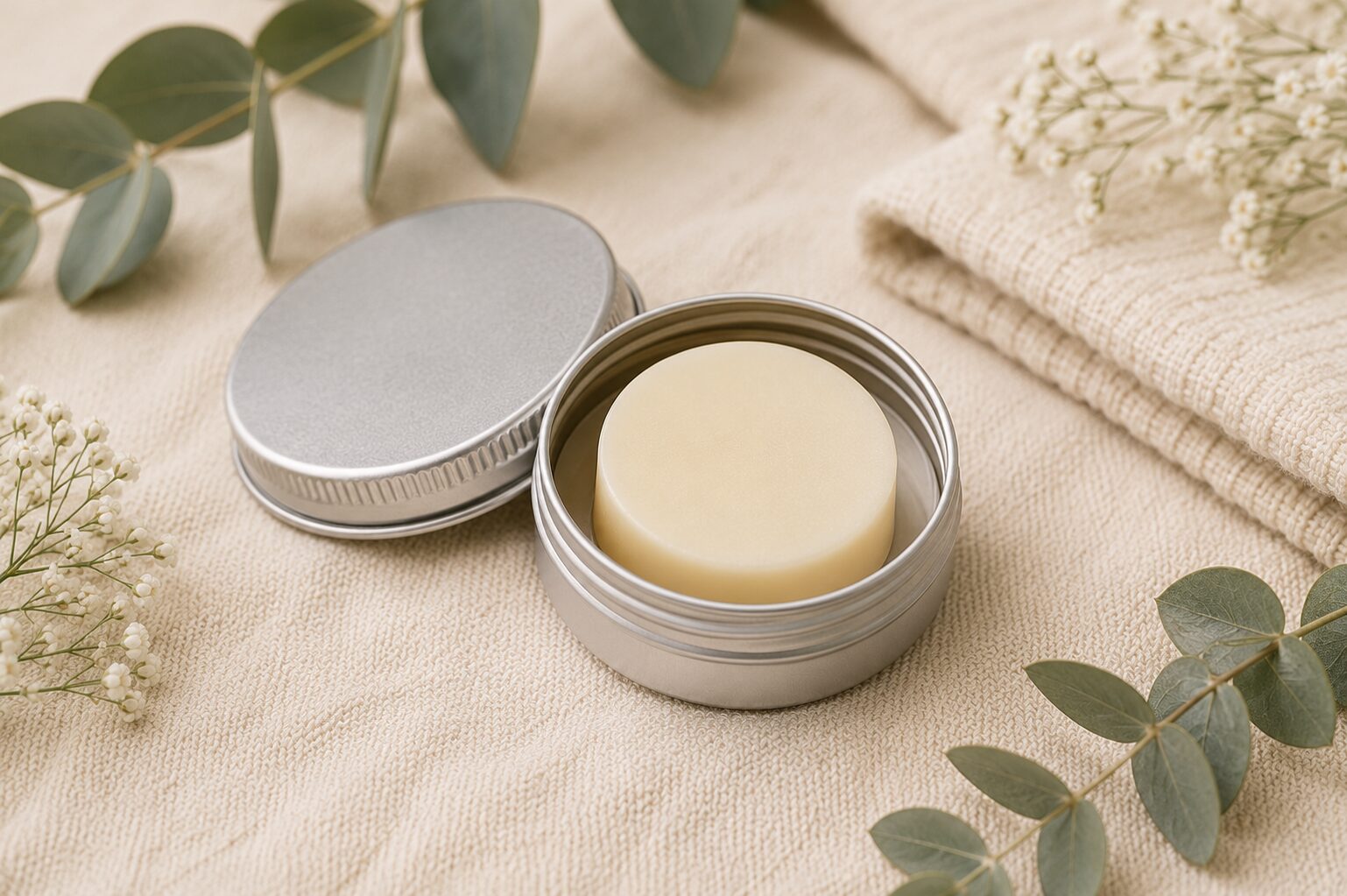
Any product that passes all four is rendered well, fresh, and formulated straight — and will live on your shelf without ever reminding you where tallow comes from. We built ours to pass this test on your counter, not just in our copy: run it on the body bar or any tin we make.
13 The bottom line
Does tallow balm smell like beef? No — not when it’s made well. Well-rendered tallow is faint, neutral, and quieter than most natural fats; on skin, even that whisper fades inside five minutes. When a tallow product does smell beefy, it’s telling the truth about its manufacturing — incomplete rendering, scorching, poor filtering, or age — and you should listen.
The deeper point is one your nose can verify without trusting anyone’s marketing, ours included: in natural skincare, smell is a process report. Clean process, quiet product. That’s the whole reason we render carefully and skip the fragrance — not because we have something to mask, but because we don’t.
"The beefiness was never the fat — it was the passengers. Rendering is just the process of asking them to leave."— The honest verdict
The 6 things to remember
- Well-rendered tallow balm does not smell like beef — faint, neutral, waxy at most.
- On skin, the note fades to essentially nothing in ~5 minutes; it never projects.
- Beefy smell = process failure: incomplete rendering, scorching, under-filtering, or age.
- Grass-fed changes the fat’s makeup, not meaningfully the finished smell.
- We stay unscented because fragrance irritates — and because unscented can’t hide poor rendering.
- Sharp, crayon-like smell later = oxidized; store cool and dark, and replace it.
Frequently asked
Does tallow balm smell like beef?
Well-rendered tallow balm does not smell like beef. Properly rendered and filtered cosmetic tallow has a faint, neutral, slightly fatty scent in the container — closer to unscented candle wax than to anything from a kitchen — and it fades within minutes of applying to skin. A strong beefy or gamey smell is a sign of poorly rendered or aging tallow, not a property of tallow itself.
What does tallow balm actually smell like?
Fresh, well-made tallow balm smells faint and neutral: a mild, clean, slightly waxy-fatty note you mostly notice with the container right at your nose. On skin it’s barely perceptible after the first few minutes. In an unscented balm you may also pick up soft undertones of the other ingredients, like beeswax’s light honey note.
Why does some tallow smell bad?
Smell problems come from process, not from tallow as an ingredient: incomplete rendering that leaves meat proteins and impurities behind, high-heat scorching, poor filtering, or oxidation as the fat ages. Carefully rendered, well-filtered, fresh tallow stored away from heat and light stays neutral.
Does grass-fed tallow smell stronger?
Grass-fed tallow can start with slightly more character before rendering, because pasture diets influence the fat. After proper rendering and filtering, the finished difference is minimal — a well-made grass-fed tallow balm is just as neutral on skin as any other. Sourcing shows up far more in the fat’s makeup than in the smell of the finished balm.
Will I smell like tallow after applying it?
No — the faint scent flattens to near nothing within a few minutes of application. Skin warms the balm, the light volatile notes dissipate, and what remains is essentially scentless. People around you will not detect it; most users stop noticing it themselves after the first use or two.
Why not add a fragrance to cover the scent?
Because there’s barely anything to cover, and fragrance is the most common irritant in cosmetics. Adding perfume to mask a faint, fleeting note trades a non-problem for a real one — especially for sensitive skin, babies, and anyone sharing one balm across a family. We’d rather render well and stay unscented.
Does tallow balm go rancid, and does that change the smell?
Like any natural fat, tallow can oxidize over time, and oxidized fat smells sharp or crayon-like. Good formulas slow this with antioxidants like vitamin E, and simple storage — cool, dark, lid on, clean fingers — keeps a balm fresh through normal use. A balm that develops a sharp off-smell has aged out; that’s your cue to replace it.
I’m sensitive to smells — will tallow balm bother me?
Most scent-sensitive people do fine with a well-made unscented tallow balm, precisely because there’s no added fragrance — the faint natural note fades quickly. If you’re unsure, smell the open container first, apply to a small patch on the back of a hand, and give it five minutes. The five-minute version is what you’ll actually live with.
Megan Smith
Co-Founder, Bear Basics
Megan co-founded Bear Basics and leads design. As a mom, she writes our gentlest, most practical guides — on ingredients, sourcing, and simple family skincare — with an emphasis on honest, well-sourced, and simple. Read the full story →