What makes water hard?
Calcium and magnesium, dissolved.

Hard water may play a part in dry skin, but the evidence is mixed and it is rarely the main cause. Here is what the research shows, and what helps whatever comes out of your tap.

Hard water may contribute to dry, reactive skin for some people, but the evidence is genuinely mixed. It helps soap leave residue on skin, and studies link hard-water areas with slightly more eczema-prone skin in children, yet a large trial of home water softeners found no measurable difference. Shower filters mostly reduce chlorine, not hardness. Using less soap, rinsing longer, and moisturizing afterward help with any water.
Hard water probably plays some part in dry, reactive skin for some people, but the evidence is genuinely mixed, and it is rarely the main cause. Lab work shows hard water and soap together can leave residue on skin and make it more sensitive to irritation. Population studies find a modest link between hard-water areas and more children with eczema-prone skin. Yet the one large trial that installed water softeners in family homes found no measurable difference in children’s skin.
That leaves a practical middle ground. You do not need to spend thousands on a whole-house softener because a website said your water is ruining your skin. You also do not need to dismiss the squeaky, tight feeling after a shower as imaginary, because soap does behave differently in hard water.
The steps that help most are the same whatever comes out of your tap: use less soap, rinse longer, keep showers lukewarm, and put a simple balm on afterward. This post explains what hard water is, how to find out if you have it, what the research does and does not show, and what filters and softeners actually do.
Hard water is water carrying a lot of dissolved calcium and magnesium, picked up as it moves through rock and soil. Rainwater starts out nearly free of minerals. As it soaks into the ground and flows through limestone, chalk, and similar rock, it dissolves small amounts of those minerals and carries them into wells, rivers, and eventually your pipes.
The U.S. Geological Survey uses a simple scale, measured in milligrams per liter of calcium carbonate:
| Classification | Milligrams per liter | Roughly, in grains per gallon |
|---|---|---|
| Soft | 0 to 60 | Up to about 3.5 |
| Moderately hard | 61 to 120 | About 3.5 to 7 |
| Hard | 121 to 180 | About 7 to 10.5 |
| Very hard | More than 180 | Above about 10.5 |
Water reports and softener sales materials often use grains per gallon instead. One grain per gallon is about 17.1 milligrams per liter, so the two numbers can look very different while describing the same water.
Hardness is not a safety issue for drinking water, and it is not dirt or pollution. Calcium and magnesium are ordinary minerals. The practical effects are scale on fixtures, spots on dishes, and the way soap behaves.
The easiest way to find out is to look up your water utility’s annual water quality report, which most utilities post online. Community water systems in the United States are required to publish one every year, and many list hardness even though it is not a regulated contaminant.
Search for your city or water district name plus “water quality report” and look for a line labelled hardness, total hardness, or calcium carbonate. If it is not listed, the utility will usually tell you if you call or email.
If you are on a private well, the utility report does not apply, and well water is often harder than city water drawn from rivers and reservoirs. Inexpensive hardness test strips from a hardware store give a quick reading, and a full lab test of a well is worth doing every so often for other reasons anyway.
White crust on faucets and shower heads, cloudy spots on glasses after the dishwasher, a ring in the tub, and soap that takes a lot of rubbing to lather all point toward harder water. None of these tells you the exact number, but together they are a decent hint.
Knowing the number matters because it puts any skin concern in proportion. Moderately hard water and very hard water are not the same conversation.
Traditional soap reacts with the calcium and magnesium in hard water to form an insoluble film, the same soap scum that coats a shower door, and some of that film ends up on your skin. That is why soap lathers poorly in hard water and why skin can feel squeaky or tight after rinsing.
The chemistry is straightforward. Soap molecules are meant to grab oils and rinse away in water. In hard water, part of the soap binds to the minerals instead, forming a waxy residue that does not rinse off easily. You use more soap to get the same lather, and more of it stays behind.
Synthetic cleansers behave a little differently, but they are not immune. A lab study from researchers at King’s College London and the University of Sheffield, published in 2017, found that the minerals in hard water bind to sodium lauryl sulfate, a common foaming ingredient, so that it settles onto the skin rather than rinsing away. In that study, hard water combined with the cleanser made skin more sensitive to irritation than softened water did.
This is the most solid part of the hard-water story. The residue is real, you can see it in your shower, and it is reasonable to think some of it lingers on skin. What is less clear is how much that matters day to day for most people, which is where the research gets more complicated.
Several studies have found that children living in hard-water areas are somewhat more likely to have eczema-prone skin than children in soft-water areas. The link shows up often enough to take seriously, though it is modest and comes with important caveats.
A 2021 review that pooled earlier studies concluded that children in hard-water areas were slightly more likely to have eczema-prone skin, particularly through primary school age. The authors were careful to describe this as an association rather than proof that hard water causes the difference.
The lab work described above offers a plausible explanation. If hard water helps soap and cleanser residue cling to the skin, and that residue makes skin more reactive, you would expect to see more dry and irritated skin in hard-water areas. Hard water also tends to be more alkaline, and skin generally prefers to stay slightly acidic on its surface, which our post on the skin barrier touches on.
Hard-water areas can differ from soft-water areas in many ways, including climate, housing, and how often people bathe. Studies comparing regions try to account for these, but they cannot rule everything out.
Plenty of people also describe their own skin feeling different after moving between hard- and soft-water homes, which counts for something even if it is not a controlled experiment.
When researchers actually installed water softeners in family homes and measured the results, they did not find the difference that the population studies suggested. That result is the main reason this question is still open.
The Softened Water Eczema Trial, run in the United Kingdom and reported in 2011, followed 336 children aged six months to 16 years with eczema-prone skin. Half had an ion-exchange water softener installed at home, and half did not. After 12 weeks, the children’s skin had improved about equally in both groups when assessed by researchers who did not know which homes had softeners.
Parents in the softener group did report slightly more improvement than parents in the other group. Because parents knew whether they had a softener, that difference is hard to interpret. It might reflect a real change that the researchers’ measurements missed, or it might reflect expectation. Many families liked the softeners enough to keep them afterward, for reasons that went beyond skin.
Twelve weeks is not a long time, and the trial looked at children who already had reactive skin rather than at whether softened water prevents dryness in the first place. Even so, it is the most direct test available, and it did not find the effect many people expected.
The most honest summary is that hard water is likely one small factor among many, not the main driver of dry skin for most people. It probably matters more for some people than others, and more when combined with a lot of soap.
The mechanism is plausible and supported by lab work. The population link exists but is modest. The one direct trial did not find a measurable benefit from softening. Put together, that points to hard water being worth knowing about without being worth panicking over.
For most families, the factors in the right-hand column do more to dry out skin than the minerals in the water. Our post on what sensitive skin actually means is a good reminder of how many things can make skin feel reactive.
That is useful because the everyday habits that reduce soap residue and moisture loss help whether hard water is part of your picture or not.
Water hardness across Colorado and the rest of the Mountain West varies a great deal, sometimes between neighboring towns, depending on where each system gets its water. There is no single answer for the region.
Many Front Range cities draw much of their supply from mountain snowmelt held in reservoirs, and surface water like that has spent less time in contact with rock than groundwater has. Towns and rural homes relying on wells can have much harder water, depending on the geology underneath them. The same is true across Utah, Wyoming, Idaho, and Montana, so the only reliable way to know is the report for your own system or a test of your own well.
What the region does have in common is dry air. High elevation, low humidity, strong sun, and long heating seasons pull moisture out of skin quickly, and our guide to high-altitude winter dry skin covers that in detail. For many people here, the climate is a much bigger factor than the water.
If your skin feels tight within minutes of stepping out of the shower, look at shower length, water temperature, and how much cleanser you use before buying equipment. Those three are easier and cheaper to change than your water supply.
Most shower filters are designed to reduce chlorine, not hardness, and they do not meaningfully remove calcium and magnesium. That distinction gets lost in a lot of marketing.
The common filter types use activated carbon, a copper and zinc medium often sold as KDF, or vitamin C. These are aimed mainly at chlorine, the disinfectant many utilities add to city water, and some reduce chloramine and certain metals as well. Some people notice their skin or hair feels better with less chlorine, and that is a reasonable thing to try.
Removing hardness minerals is a different job. Softening water requires ion exchange, a process that swaps calcium and magnesium for another mineral using a resin that has to be recharged. A small cartridge in a shower head is not built to do that at shower flow rates for long.
A shower filter advertised as softening water or removing hardness deserves a close look. Check what the filter medium actually is and what it is tested to reduce, and be skeptical of vague promises about softer skin.
If chlorine is what bothers you, a filter can help. If hardness is the concern, a shower filter is unlikely to change it.
A whole-house water softener removes most of the calcium and magnesium from water entering the home by swapping them for sodium or potassium. It does what a shower filter cannot, at a much higher cost.
Water passes through a tank of resin beads that hold sodium or potassium. As it flows through, the beads trade those minerals for the calcium and magnesium in the water. Every so often the system flushes the resin with a salt solution to recharge it, which is why softeners need bags of salt added regularly.
The effects are easy to notice. Soap lathers more readily, scale builds up much more slowly on fixtures and in water heaters, and dishes come out with fewer spots. Many people describe softened water as feeling slippery on the skin, which mostly reflects soap rinsing off differently rather than extra moisture.
| Shower filter | Whole-house softener | |
|---|---|---|
| Removes calcium and magnesium | No | Yes |
| Reduces chlorine | Usually | Not its job |
| Upfront cost | Low | High |
| Ongoing upkeep | Replace cartridges | Add salt, service |
| Measured skin benefit in trials | Not studied well | None found in the main trial |
Softeners are a reasonable choice for very hard water if scale, appliance wear, or soap use bother you. Skin alone is a weaker reason to buy one, given the trial results.
The habits that reduce soap residue and moisture loss help with any kind of water, and they cost nothing. Start here before considering equipment.
Use less soap. Most of the body only needs water. Save cleanser for underarms, groin, feet, and anywhere visibly dirty, and use a small amount. Less soap means less of it binding to minerals and staying on the skin.
Rinse longer. An extra twenty or thirty seconds of rinsing takes more residue off, especially in hard water. Pay attention to the places soap collects, like the back of the neck and behind the knees.
Keep water lukewarm and showers short. Hot water and long showers strip oil whether the water is hard or soft. For children, fewer and shorter baths are often enough, as our post on how often kids should bathe explains.
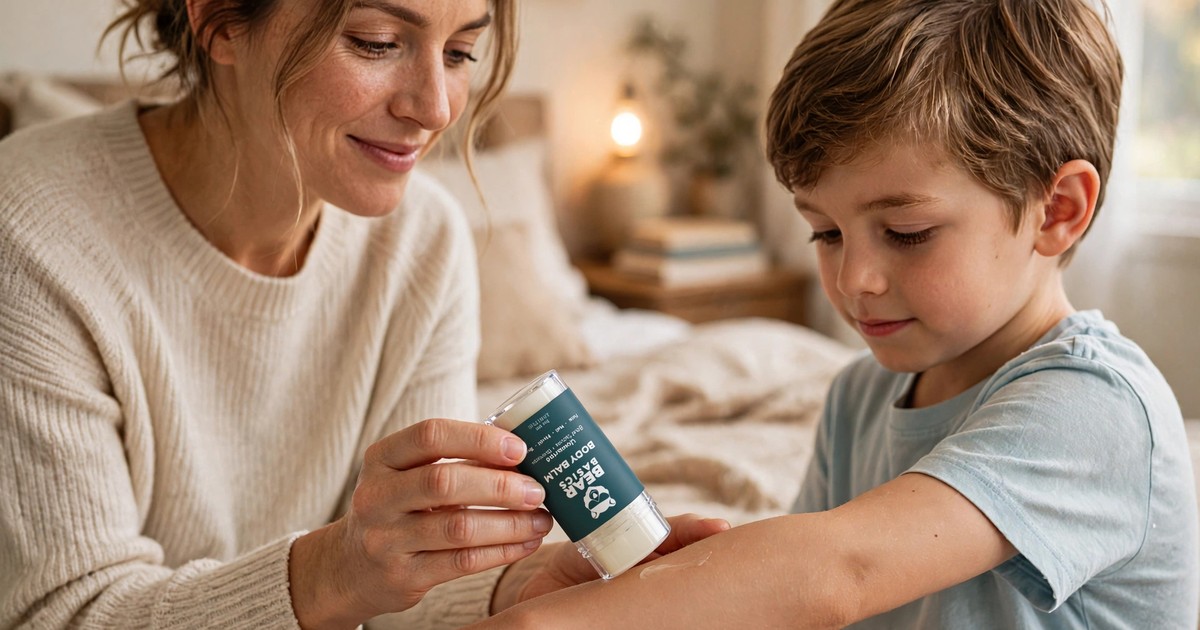
Moisturize afterward. The timing and reasoning are laid out in our everyday routine for dry skin. A plain, water-free balm on skin that is still slightly damp is all it takes.
A balm cannot undo mineral residue, and it does not need to. Rinsing takes care of residue. What a balm does is slow the moisture loss that follows any shower, and that part of the routine works the same in hard or soft water.
Water-free balms have a small practical advantage here. Because there is no water in the formula, there is nothing for your tap water to interact with, and nothing in the product that depends on what comes out of your pipes. You apply it to clean, slightly damp skin and it stays put.
Our beef tallow body balm is the richer choice for very dry skin and dry climates. The coconut oil body balm feels lighter and melts faster on contact. Both are unscented and made with a handful of ingredients, which matters if your skin is already reacting to something and you want fewer variables to sort through.
If your family includes a child with eczema-prone skin, our gentle daily rhythm for eczema-prone kids fits around whatever water you have, and is a better place to start than a new appliance.
Hard water may contribute to dry, reactive skin for some people, but the evidence is mixed, and for most families it is a smaller factor than soap, hot water, and dry air.
Look up your water report so you know whether your water is soft, moderately hard, or very hard. If it is hard, use less soap and rinse longer, and do the same if it is soft, because those habits help either way. Keep showers lukewarm and short, and put a simple balm on afterward.
Shower filters mostly reduce chlorine rather than hardness. Whole-house softeners do remove hardness and have real benefits for fixtures and appliances, but the best trial so far did not find that they measurably changed children’s skin. Buy one for the right reasons, not because of a promise about your skin that the evidence does not yet support.
The research may get clearer with time. In the meantime, the simple habits are cheap, easy, and worth starting tonight.
Megan co-founded Bear Basics and leads design. As a mom, she writes our gentlest, most practical guides — on ingredients, sourcing, and simple family skincare — with an emphasis on honest, well-sourced, and simple. Read the full story →