How long is the window?
About three minutes after the water.

A balm holds water in rather than putting water on, so it is worth the most when there is water underneath it. What damp means, how much to use, and the order to do things in.

Apply your moisturizer to damp skin within about three minutes of getting out of the water, before the surface water evaporates off you. A balm slows water leaving your skin rather than adding any, so it is worth the most when there is still water underneath it. Applied damp it keeps the shower on you; applied twenty minutes later it keeps whatever you already had. Test it tonight with one shin damp and one dry, and compare them in the morning.
Put your moisturizer on while your skin is still damp, within about three minutes of getting out of the water, before the surface water has evaporated off you. That is the whole technique. It costs nothing, adds no time, and for most people it changes the result more than switching products does.
The reason it works is that a balm does not put water into your skin. It slows water leaving. When you apply it to skin that is still wet, you are holding onto water that is already there. When you apply it twenty minutes later, that water is in the air and the balm has nothing left to hold.
The three minutes is not a precise measurement and nothing dramatic happens at the end of it. It is a usable approximation of how long surface water lasts on skin in an ordinary room, and it is short enough to be a real constraint on the order you do things in the bathroom.
You can test this tonight on yourself. One arm damp, one arm fully dry, the same product on both, and compare them in the morning. Very little else in skincare settles an argument that fast.
People spend a lot of attention on which moisturizer to buy and almost none on when to apply it, which is backwards given how much each one affects the outcome.
Occlusive products work by slowing evaporation from the surface of your skin. They are a lid. A lid is useful in proportion to what is underneath it, and the amount of water underneath it depends entirely on whether you were wet when you applied it.
Think about what happens in the ten minutes after a shower. You step out with a film of water on you. Some soaks in slightly, most sits on the surface, and the room's air starts taking it. In a heated house in winter, where the air is running in the teens or twenties, it goes fast. By the time you have dried your hair you are back to baseline and the shower contributed nothing.
The same balm, the same amount, the same skin. Applied damp it keeps the water from the shower on you for hours. Applied dry it keeps nothing that was not already there. One of those is a different product in effect, and it is the same product.
This is also why the expensive-moisturizer upgrade so often disappoints. A better formulation applied to fully dry skin is competing against a basic one applied at the right moment, and the timing usually wins.
Everything that matters fits into four steps, and they are the spine of the rest of this post.
Hot water removes the surface oils that slow water loss, which is why hot showers leave skin feeling tight and squeaky as it dries. Comfortably warm and ten minutes instead of twenty gives you a surface still worth sealing. If the mirror is completely fogged and your skin is pink, the water is hotter than this technique wants.
A towel is efficient at removing exactly the water you are trying to keep. Press the towel against your skin and lift it instead of dragging it, and stop when you are no longer dripping. Damp is the target and it should feel slightly cool, not slippery.
Start at the areas that dry out first — shins, forearms, elbows, the backs of your hands — and work toward the ones that hold moisture better. If you have to choose because you are short on time, the dry areas are the ones that benefit, and the rest can wait until tomorrow.
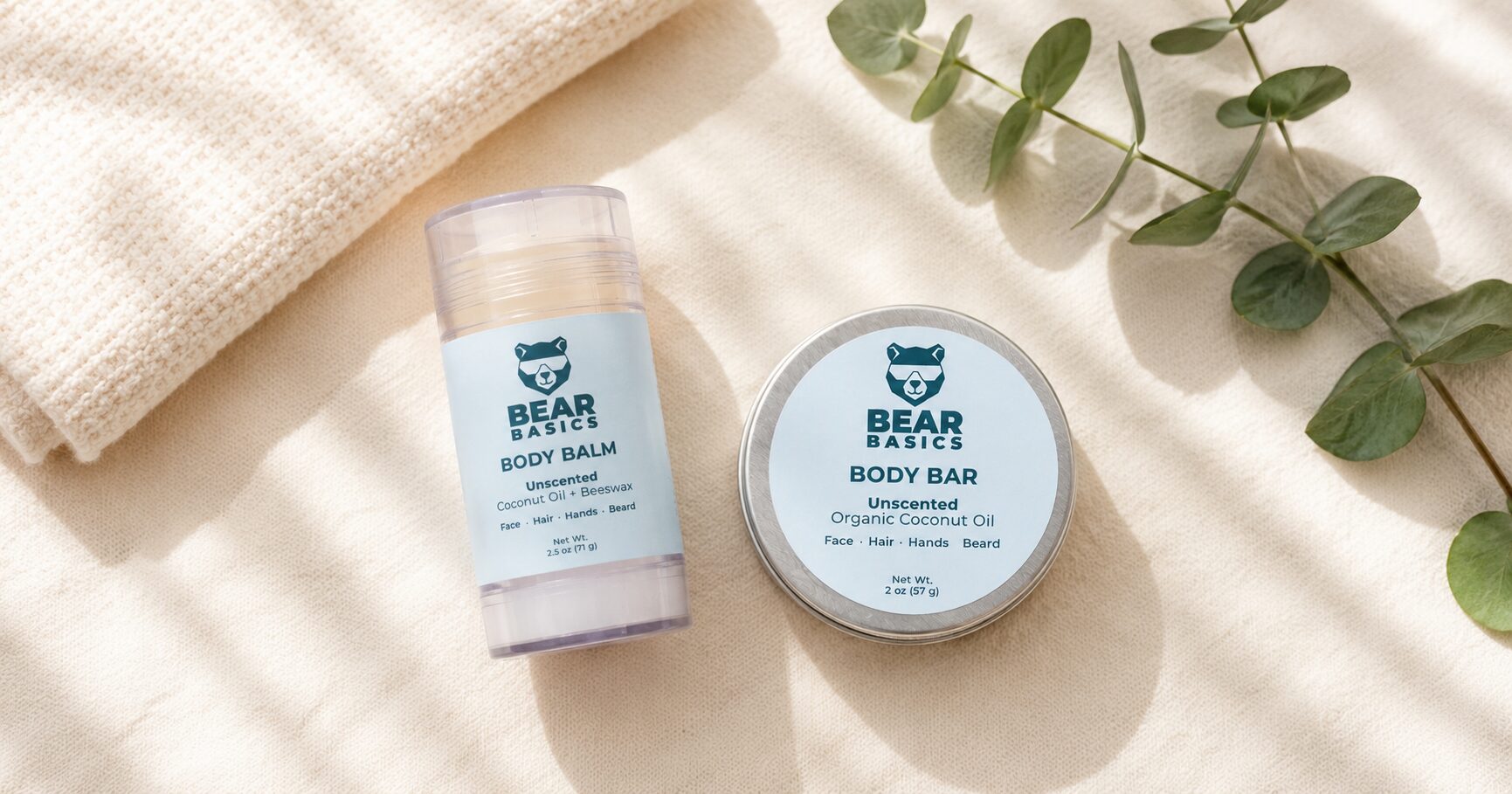
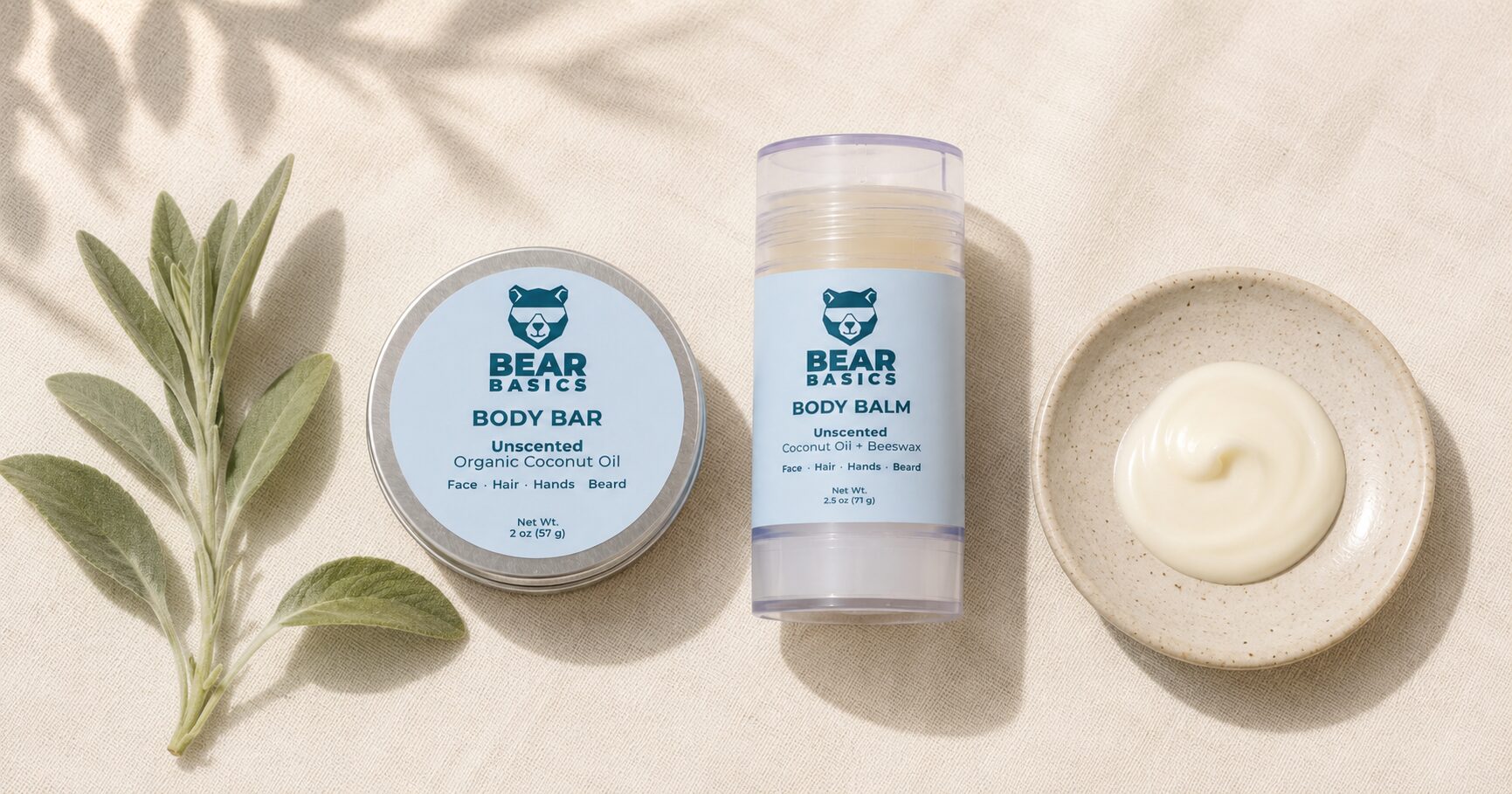
A solid balm or a body bar needs a few seconds of friction to soften. Rub it between your palms until it goes glossy, then press it onto damp skin instead of scrubbing it in. On wet skin it spreads much further than it does on dry skin, which is why people consistently use too much on their first try.
That is the entire method. Nothing in it requires a new product, and the only genuinely new habit is deciding to apply something before you get dressed instead of after.
Damp is the word doing the most work here and the one people get wrong in both directions, so it is worth describing by feel rather than by definition.
Too wet is when water is still running or beading. Product applied to genuinely wet skin slides around instead of staying put, and a tallow or coconut oil balm will bead off instead of spreading. You will be able to tell immediately, because it feels like it is not going on.
Too dry is when your skin has stopped feeling cool. That cool sensation is evaporation happening, so when it stops, the surface water is gone. In a dry heated room this takes a couple of minutes. In a steamy bathroom with the door shut it takes considerably longer, which is a small advantage worth using.
Right is when the skin looks matte but feels cool, and a hand pressed against it comes away faintly damp and not wet. You are no longer dripping and you are not yet dry. Most people hit this about sixty to ninety seconds after stepping out of the shower, which is less time than it sounds like.
Towel your hair and your feet, skip the rest, and put the balm on while the bathroom is still warm. Keeping the door closed slows evaporation and buys you a wider window, which makes the whole thing less of a race.
The most common mistake after mistiming is using too much, and damp skin changes the maths considerably.
Water helps a balm spread. The amount that covers one shin on dry skin will usually cover both legs on damp skin, because the surface water carries it. People who are used to applying a balm dry tend to take the same scoop out of habit and then find themselves greasy for twenty minutes.
A practical starting point for a body balm stick: two or three passes per limb, then spread with your hands. For a body bar, a slow pass over the area and then spread. For a tin, something between a pea and a small coin for a whole leg. Add more only if an area still looks dry after you have spread what you took.
The result should absorb in a few minutes, not sit on you. If you are still shiny when you have finished getting dressed, you used too much. If your skin feels tight within ten minutes, you used too little or you were already dry when you started. Those two signals are enough to calibrate within three or four days.
Faces want considerably less than bodies, and this is where people most often overdo it with a rich balm. A very small amount pressed in is the method — we went into it in how to use a tallow balm.
The reason this habit fails is almost never disagreement with the principle. It fails because the balm is in a cupboard and the three-minute window closes while you are doing something else.
Reorder the routine so the balm comes before anything else. Shower, pat dry, apply, then hair, then teeth, then dressed. Most people currently run that sequence in reverse and apply a moisturizer last, as a finishing step, which is precisely the wrong slot for it.
| Step | Why it goes there |
|---|---|
| Shower, warm not hot | Leaves surface oils more intact than hot water does |
| Pat dry, stop at damp | Keeps the water you are about to seal in |
| Balm on body, within three minutes | The window is short and it starts the moment you step out |
| Lip balm | Lips have no oil glands and dry fastest of anywhere |
| Hair, teeth, get dressed | None of these are time-sensitive and all of them eat the window |
| Deodorant last, on dry underarms | The one product that wants dry skin, not damp |
Deodorant is the deliberate exception and worth calling out. Underarms should be dry before a stick goes on, both because it applies more evenly and because a balm-style deodorant on wet skin is more likely to transfer onto a shirt. We covered the technique in how to apply natural deodorant.
The technique works with anything occlusive, and it works best with a product that contains no water of its own. The reasoning follows directly from what you are trying to achieve.
Most lotions are largely water, held with oils by an emulsifier and kept stable by a preservative system. Applying a mostly-water product to damp skin means a lot of what you just applied is going to evaporate within a few minutes, and in a dry heated room it takes some of the surface water with it on the way out.
A balm is anhydrous — water-free. Ours is tallow or coconut oil, beeswax, vitamin E, and castor oil, with nothing in the tin that can evaporate. Everything you apply stays on your skin doing the occlusive job. The full explanation is in water-free skincare, explained.
A plain oil is a legitimate alternative if a balm feels too rich, though it tends to need reapplying sooner. The comparison between the formats is in body bar vs balm vs lotion.
The improvement is not evenly distributed. A few areas respond dramatically and a few barely notice, which is useful to know when you are deciding where to spend your ninety seconds.
Shins and forearms. Fewer oil glands than most of the body and generally the first places to get itchy in a dry season. These benefit more from correct timing than from any particular product, and the difference between damp and dry application here is usually obvious within two days.
Hands and knuckles. The same rule applies after every hand wash, not only after showers. Damp hands plus a small amount of balm is far more effective than dry hands plus a large amount, and it is the single most repeatable version of this technique because you wash your hands all day. More in hand care for frequent washers.
Heels and elbows. Thick skin that cracks instead of flaking. These want the damp application plus patience, because thick skin takes weeks and not days. We wrote about them in cracked heels and rough elbows.
Where it matters least. Oily areas of the face, and anywhere that has never felt dry. If your back is fine, timing your back better will not produce a noticeable result. Spend the window where the problem is.
This is one of the rare skincare claims you can check in a single night with no equipment, and it is worth doing instead of taking on trust.
Set it up before you shower. Put the balm within arm's reach of where you dry off. Take a warm shower and not a hot one, then pick the two areas you will compare — shins work best because they dry out reliably and you can see both at once.
Do one side damp. Step out, pat the left shin until it is no longer dripping, and apply the balm within a minute while the skin still feels cool. Use a small amount and spread it until it is gone.
Do the other side dry. Leave the right shin alone. Dry your hair, brush your teeth, do whatever you normally do, and come back in fifteen or twenty minutes. Apply the same amount of the same product to skin that is now completely dry.
Compare in the morning. Look at both and touch both. Most people find the damp side still feels supple while the dry side feels ordinary, and the gap widens if you repeat it for three or four nights. If you cannot tell the difference, your indoor air is probably humid enough that this matters less for you, which is a genuine result and not a failed test.
Four failure modes account for most of the people who try this and report no difference.
The balm lives in the bedroom. If you have to walk somewhere to get it, the window closes before you are back. Keep it within reach of the towel, and keep a second one by the kitchen sink for hands.
The shower was too hot. Hot water removes the surface oils this technique depends on, so you are sealing in water onto a surface with less of its own defence. The timing still helps, and it helps considerably less than it would after a warm shower.
Too much product. Damp skin spreads a balm much further than dry skin does, so the usual amount leaves you shiny and convinced the product is too heavy. Halve it and judge again.
Expecting it to fix a dry house. Timing holds onto water that is already on you. It does not change how hard the air is pulling. If your rooms are running in the teens all winter, this technique plus a humidifier is the pair that works, and the dry-air problem is worth addressing on its own — see winter dry skin at altitude for the version that bites hardest.
The technique transfers to every situation where skin meets water, which is more of them than a shower.
After a bath, with a child. This is the easiest version to build into a routine, because there is already a sequence and the balm simply slots in before pajamas. Lift them out, pat with the towel, apply quickly while they are still damp, then dress. A water-free balm goes further on small bodies than most people expect. There is a fuller walkthrough in a gentle daily rhythm for eczema-prone kids.
After swimming. Chlorinated water and a long rinse afterward leave skin particularly stripped, and the poolside version of this is the same: towel to damp, apply, dress. A stick format travels better than a tin for this.
After hand washing. The highest-frequency version. You do not need to be perfect about it; even catching half of them makes a visible difference by February.
Skin that is sore to touch, splitting and bleeding, widening week by week, or unchanged after a few weeks of doing everything above is not a timing problem. No technique and no balm resolves that. Get it looked at by someone who can see it in person.
One note on product choice for a household: all of our balms contain beeswax, which means they are not vegan products, and we would rather be upfront about that.
Being clear about the limits is part of why the rule is worth trusting on the things it does do.
It does not add water to your skin. Nothing applied on top of skin pushes water inward. The entire effect is slowing what leaves. If you were not wet when you applied it, there was nothing to slow.
It does not replace fixing the air. In a house running at 18 percent humidity, you are holding water against a very strong pull. The technique is worth doing and a humidifier is worth having, and they do different jobs.
It does not work the same for everyone. People in humid climates notice less, because the air is not taking much anyway. People in dry winters, at altitude, or in heated houses notice the most. If you run the overnight test and see nothing, that is information about your air and not about the method.
It does not make a thin product behave like a thick one. Timing improves whatever you are using. It does not turn a fast-absorbing gel into an occlusive layer, and on genuinely dry skin the format still matters.
Apply your balm to damp skin, within about three minutes of getting out of the water, before the surface water evaporates. That is the whole rule, and it is free.
The reasoning is simple enough to check: an occlusive product holds water in rather than putting water on, so it is worth the most when there is water underneath it. Applied damp, it keeps the shower on you. Applied dry, it keeps whatever you already had.
Do the shin test tonight, one side damp and one side dry, and look at both in the morning. It takes no extra time and no extra product, and it will tell you more about whether this is worth doing than anything we could write here.
Megan co-founded Bear Basics and leads design. As a mom, she writes our gentlest, most practical guides — on ingredients, sourcing, and simple family skincare — with an emphasis on honest, well-sourced, and simple. Read the full story →