What is it?
A silicone polymer in most lotions.

The silicone behind the silky feel of most lotions. What it actually does, which of the common claims about it hold up, and how it compares with tallow and beeswax.

Dimethicone is a silicone polymer used in most lotions and many barrier creams for its silky feel and the light film it leaves to slow water loss. It sits on the surface, is barely absorbed, washes off with soap, and is not generally pore-clogging or skin-suffocating. The fair criticisms are that its film is lighter than a balm, some silicones build up on hair, and cyclic silicones raise environmental concerns. Our balms use tallow or coconut oil and beeswax instead.
Dimethicone is a silicone polymer used in most lotions and many barrier creams because it gives a smooth, silky feel and leaves a thin protective film on the skin that slows water loss. It sits on the surface, is absorbed very little, and is not the pore-clogging or skin-suffocating ingredient that many websites describe.
The fair criticisms are narrower. Its film is lighter than a fat or wax balm, so it can feel more cosmetic than protective on very dry skin. Some related silicones, the cyclic ones in particular, raise genuine environmental questions about persistence. And it is a manufactured ingredient, which matters to some people for reasons that have nothing to do with safety.
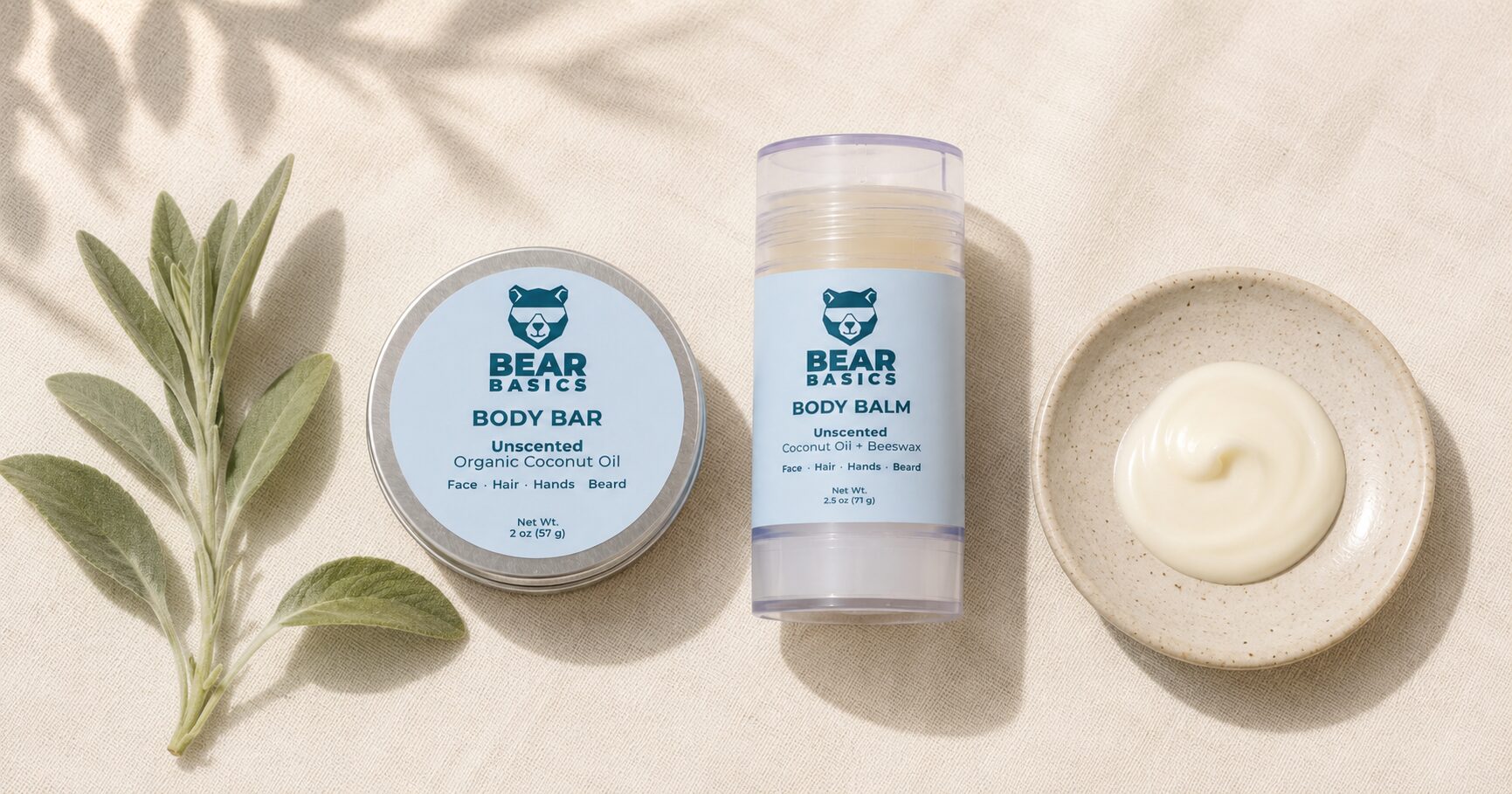
We do not use dimethicone in our products. Our balms are made from tallow or coconut oil and beeswax, which do a similar protective job with a different feel. That is a preference about how we want our products to work and what we want on the label. It is not a claim that dimethicone is harmful, and this post tries to explain what the ingredient actually does so you can judge it yourself.
Dimethicone is the cosmetic name for polydimethylsiloxane, a long chain of alternating silicon and oxygen atoms with small methyl groups attached along its length. It is a synthetic polymer, made from silicon that begins as quartz sand and is processed through several chemical steps.
The chain can be made short or long, and its length decides what the ingredient feels like. Short chains give a thin, watery fluid that spreads instantly and evaporates slowly. Longer chains give a thicker, honey-like liquid, and very long chains approach a gel or gum. Formulators choose the grade by viscosity, which is why two products listing only “dimethicone” can feel completely different.
Dimethicone is a liquid silicone. It does not dissolve in water, it barely reacts with anything, it has no smell, and it forms a thin, slippery layer wherever it is spread.
That chemical inertness is one of the reasons it is used so widely. Dimethicone does not oxidize the way plant and animal oils eventually do, it does not go rancid, and it holds up across a wide range of temperatures. It is also used far outside cosmetics, in medical devices, cookware coatings, and as an anti-foaming agent, which tells you something about how stable and unreactive it is. None of that makes it good or bad for skin on its own. It simply describes the material.
Dimethicone solves several texture problems at once: it makes a lotion glide, removes the sticky or greasy feel other ingredients leave behind, and adds a light protective film. Very few ingredients do all three at such low levels.
Many lotions rely on glycerin and other humectants to draw water into the skin, and those ingredients can feel tacky on their own. A small amount of dimethicone cuts that tackiness. In creams with heavier oils, it reduces the greasy, shiny finish. And when you rub a lotion in and it turns briefly white and foamy, an effect formulators call soaping, dimethicone helps prevent that too.
It makes a product spread easily and evenly with little pressure, which matters on large areas such as legs and arms.
It leaves skin feeling smooth and powdery rather than oily, which is why it is so common in face products and primers.
It forms a thin layer on the surface that slows some water from evaporating out of the skin.
It does not oxidize or spoil, so it does not shorten a product’s shelf life the way some oils can.
That last point explains a lot about its popularity. Dimethicone is inexpensive, consistent from batch to batch, and pleasant on the skin from the first second, and in a product that has to look and feel the same after a year on a shelf, those properties count for a great deal.
Dimethicone is one member of a large family of silicones, and most of them are easy to recognize because their names end in -cone, -conol, or -siloxane. They differ in structure and feel, and they are not all equal in the environmental debate.
| Name on label | Type | What it is used for |
|---|---|---|
| Dimethicone | Linear silicone | Slip, finish, and a light protective film |
| Dimethiconol | Linear silicone with end groups | Similar to dimethicone, often in hair care |
| Amodimethicone | Modified silicone | Conditioners; clings to damaged hair |
| Cetyl dimethicone | Silicone with a fatty chain | Richer feel, blends with oils |
| Phenyl trimethicone | Modified silicone | Shine in hair and makeup |
| Cyclopentasiloxane | Cyclic silicone | Evaporates, leaving a silky finish |
| Cyclohexasiloxane | Cyclic silicone | Same role, slower to evaporate |
The cyclic silicones at the bottom of that table, sometimes abbreviated D4, D5, and D6, behave differently from dimethicone. They are volatile, meaning they evaporate after application, which is how a product can feel wet going on and dry and silky a minute later. They are also the silicones with the most significant environmental questions, which we come back to below.
The practical point is that “silicones” is too broad a word for most of the claims attached to it. If a claim about silicones bothers you, it is worth checking which one it is about before you apply it to every -cone on your shelf.
Dimethicone does not suffocate skin, because the film it forms is thin and allows water vapor and gases to pass through, unlike a sheet of plastic wrap. This is the most common claim about it and the least accurate.
Skin does not breathe in the way lungs do. The outer layer of skin gets oxygen mostly from the blood supply beneath it, and a small amount from the air. What matters at the surface is water: skin is constantly losing a little water to the air, and anything that slows that loss helps the outer layer stay softer and more flexible. Our explainer on what the skin barrier really is covers that process.
A dimethicone film slows water loss partially rather than stopping it, because silicone films are known for being permeable to gases and water vapor. That is one reason it is used in so many products people wear all day. A heavier occlusive such as petrolatum blocks more water loss than dimethicone does, and we compare those two in our post on petrolatum.
Any occlusive layer, whether silicone, petrolatum, or a fat balm, will hold in whatever was on the skin when you applied it. If sweat, sunscreen, or makeup is sitting there, it stays there. That is a reason to apply products to clean skin, not a property unique to dimethicone.
Dimethicone itself is not generally considered pore-clogging; its molecules are large, it sits on the surface, and it appears in many products made for acne-prone skin. The more realistic concern is what gets trapped beneath it.
Because a film holds in what lies under it, applying a dimethicone product over oily, unwashed skin can contribute to breakouts in someone who is already prone to them. That effect comes from the oil and debris underneath, not from the silicone acting on the pore. The same reasoning applies to heavier balms, which is why clean skin before application matters for any occlusive.
Some people do find that particular products with silicones break them out, and that experience is real. When it happens, the cause is often another ingredient in the formula, such as a heavy oil, a thickener, or fragrance, and it is very hard to isolate in a product with twenty-five entries on the label. If you want to know how much weight to give the ratings you see online, our post on comedogenic ratings covers their limits.
If you suspect a silicone product is the problem, try a week with a simpler alternative and watch what happens. Your own skin gives a more useful answer than any rating, and it takes only a little patience to get it.
On skin, dimethicone washes off with ordinary soap and does not accumulate in a meaningful way, but on hair some silicones can build up, particularly with gentle shampoos. The claim is mostly about hair and gets applied to skin by mistake.
Skin sheds its outer layer constantly, and normal washing removes surface films along with sweat and oil. Dimethicone does not dissolve in water, so a plain rinse may leave a little behind, but soap or a cleanser lifts it. There is no good evidence that dimethicone layers up on skin over weeks of use.
Hair is different, because hair does not shed its surface. Silicones in conditioners are designed to cling to the hair shaft, and amodimethicone in particular is built to bind to damaged areas. People who use sulfate-free or very mild shampoos sometimes notice hair becoming heavy, limp, or coated over time, and an occasional clarifying wash clears it.
So if your hair feels coated, silicones are a reasonable suspect. If your skin feels fine, dimethicone buildup is not a problem you need to solve.
Dimethicone does make skin feel smoother immediately, partly as a surface effect, but it also works as a light occlusive that slows water loss, so it is doing real work as well as cosmetic work. The claim is partly fair.
The instant silky feel after a dimethicone lotion is mostly the film itself, which fills in fine texture on the surface and reduces friction. That sensation can make skin feel better hydrated than it actually is in the first few minutes. On mildly dry skin, the light occlusion is often enough. On very dry or cracked skin, it may not hold in enough water to make a lasting difference.
Most moisturizers combine three kinds of ingredients that do different jobs, and dimethicone falls into the occlusive group, the ones that slow water loss. We explain the three categories in our guide to occlusives, humectants, and emollients, so I will not repeat it here.
Where the criticism lands is in the comparison. A dimethicone lotion is mostly water, with a little silicone, so the amount of occlusive actually left on your skin after the water evaporates is modest. A balm made entirely of fats and waxes leaves much more behind. Neither is wrong; they suit different levels of dryness.
The strongest case against silicones is environmental, not about skin, and it is aimed mainly at the cyclic silicones D4, D5, and D6, which are persistent and can accumulate in living things. Linear dimethicone has a different profile, though it is not without questions.
Cyclic silicones wash down drains and evaporate into the air from products people use daily. European chemical regulators classified D4, D5, and D6 as very persistent and very bioaccumulative, and the EU has restricted D4 and D5 in rinse-off cosmetics since 2020 and will restrict all three in leave-on cosmetics at 0.1 percent or more from June 2027. That is a significant step and reflects real concern about what happens once these compounds leave the bathroom.
Linear dimethicone is not covered by those restrictions. It is far less volatile, and in wastewater it tends to bind to sludge and sediment and break down slowly over time rather than remaining intact indefinitely. It is still a synthetic polymer that does not readily biodegrade in the way a fat or wax does, and commercial dimethicone can contain small traces of cyclic silicones left over from manufacturing.
If the environmental side matters to you, avoiding names ending in -siloxane, especially cyclopentasiloxane, has the clearest basis. Dimethicone is a smaller concern. Fat and wax balms avoid the question because they break down the way food fats do.
Dimethicone, tallow, and beeswax all leave a protective layer on skin, but they feel very different, come from different places, and suit different kinds of dryness. Here is the side-by-side without marketing on either side.
| Dimethicone | Beef tallow | Beeswax | |
|---|---|---|---|
| Origin | Synthetic silicone polymer | Rendered beef fat | Made by honeybees |
| Feel | Silky, dry, powdery | Rich, softens with warmth | Waxy, adds structure |
| Protective film | Light | Moderate | Heavier, more durable |
| Spoils over time? | No | Slowly, as fats oxidize | Very slowly |
| Breaks down in nature | Slowly | Yes, like food fats | Yes |
| Vegan | Yes | No | No |
Tallow is a fat made of fatty acids that resemble those found in skin’s own oils, and it melts into the skin gradually with body warmth; our post on beef tallow covers what the research does and does not say. Beeswax adds a more durable film and holds a balm together, and we explain it in our beeswax explainer.
The honest trade-off is feel. Dimethicone disappears into a light, dry finish that many people prefer on the face or under makeup. A tallow and beeswax balm leaves a richer layer that holds up better on very dry hands, heels, and elbows but takes a few minutes to settle in. Our products are not vegan because they contain beeswax, and anyone who avoids animal ingredients will find dimethicone fits that requirement.
Dimethicone shows up in far more of a family bathroom than most people expect, from body lotion and face cream to diaper cream, conditioner, primer, and anti-chafe sticks. Knowing where it appears makes the debate feel less abstract.
It is listed as an active ingredient in some over-the-counter skin protectant products, which is why certain diaper creams and hand creams show dimethicone in a drug facts box rather than in the regular ingredient list. In those products it is there specifically for its protective film. In ordinary lotions it is usually listed among the inactive ingredients for slip and feel.
Hair conditioners and leave-in products use it for detangling and shine. Makeup primers rely on it to smooth texture before foundation. Anti-chafe sticks use it for friction protection on thighs and feet. Many sunscreens include it to improve spreading. A quick look at a few labels in your own cabinet usually turns up several examples.
None of that means you need to clear your shelves. It means that if you decide to avoid silicones, you will find them in many more places than your body lotion, and it is worth deciding in advance which ones actually matter to you.
Our balms and bars do not contain dimethicone because they are built entirely from fats and waxes, and those ingredients already provide the protective layer a silicone would add. It would be a second ingredient doing the first one’s job.
A lotion needs dimethicone partly to compensate for being mostly water, so that it leaves enough of a film behind once the water evaporates, and partly to fix the texture of its other ingredients. A balm made from grass-fed tallow or coconut oil and beeswax has no water to evaporate and no tacky humectants to correct, so neither problem exists. If you want to see how the formats compare, our comparison of body bars, balms, and lotions lays it out.
There is a cost to our approach, and it is the feel. A fat and wax balm is richer and takes longer to settle than a silicone lotion, and some people simply prefer the silicone finish, especially on the face. That preference is legitimate. We would rather explain the trade-off than pretend there is none.
Leaving out dimethicone also keeps our labels at four or five ingredients, which matters to us for reasons we explain elsewhere. It is not a claim that dimethicone is dangerous, and we do not put “silicone-free” on our products as a warning about anyone else’s.
Dimethicone is a stable, inert silicone that gives lotions a silky feel and leaves a light film that slows water loss, and the popular claims that it suffocates skin or clogs pores do not hold up. It sits on the surface, washes off with soap, and is very little absorbed.
The fair criticisms are that its film is lighter than a fat or wax balm, that some silicones can build up on hair, and that cyclic silicones such as cyclopentasiloxane raise real environmental questions. Linear dimethicone is a smaller environmental concern, though it does not break down as readily as natural fats and waxes.
We use tallow or coconut oil and beeswax instead because they do the protective job on their own and keep our labels short. If a dimethicone lotion suits your skin, there is no scientific reason to throw it out. If you want something richer and simpler, a balm gives you that.
Megan co-founded Bear Basics and leads design. As a mom, she writes our gentlest, most practical guides — on ingredients, sourcing, and simple family skincare — with an emphasis on honest, well-sourced, and simple. Read the full story →