How many total?
Five entries on the panel.

Five entries on the panel, each doing one job, in the order that tells you how the stick is built. Plus everything we left out on purpose, and what to check on any deodorant label.

Five ingredients: a grass-fed beef tallow or coconut oil base, beeswax, magnesium hydroxide, vitamin E, and cold-pressed castor oil. The base carries the stick, beeswax holds its shape, magnesium hydroxide is the only odor-control active, vitamin E keeps the fats fresh, and a small amount of castor oil smooths the glide. No baking soda, aluminum, fragrance, water, preservatives or starches. Beeswax means neither version is vegan, and anyone with a known coconut allergy should choose the tallow stick.
Turn the tube over and the back reads: Bos taurus tallow or Cocos nucifera oil, cera alba, magnesium hydroxide, tocopherol, Ricinus communis seed oil. In plain English that is grass-fed beef tallow or coconut oil, beeswax, magnesium hydroxide, vitamin E, and cold-pressed castor oil. Five lines, and no sixth line standing in for a blend of things we did not name.
We have written a full post on nearly every one of those ingredients already, so this one does something different. It explains why each of the five sits where it does on the panel, what job it does inside this particular stick, and what happens to the product if its share goes up or down. It also walks through the ingredients we left out on purpose, which is a longer list than the one we kept, and it ends with a short checklist you can use on any deodorant in any store.
Two disclosures belong at the top rather than in a footnote. Beeswax comes from bees, so neither version is vegan. Castor oil is pressed from a seed, and we use it deliberately. If anyone in your house has a known coconut allergy, the tallow version is the one to pick.
Every solid deodorant needs three things: something to carry it, something to hold it in a shape, and something to control odor. Our formula is those three jobs plus two small supporting ones, and each line on the panel maps to exactly one job.
The base fat carries everything and makes up most of the stick. The wax gives that fat a shape it can hold in a twist-up tube. The mineral is the active, the only line on the panel doing odor control. Vitamin E keeps the fats fresh over the months the stick sits in your bathroom, and castor oil smooths the glide and keeps the mineral powder spread evenly through the fat.
When each ingredient has exactly one role, a problem with the stick points to exactly one place. Drag on the skin is a wax or castor question. Odor coming back by mid-afternoon is a mineral or application question. An old-crayon smell is a vitamin E and storage question.
A conventional stick does the same three jobs with more lines. It usually uses a soap-based gel or a blend of silicones as the carrier, several emulsifiers and solvents to hold the gel together, a fragrance to cover the base, and often a preservative because of the water in it. None of that is a scandal. It is simply a longer route to the same three jobs, and each extra line is one more thing a reactive underarm has to put up with.
Building it this way also limits what we can claim. Five lines cannot make a deodorant work better than a well-made twenty-line one. They make it easier to read, easier to troubleshoot, and easier to choose between our two versions.
The base is most of the product, so switching it changes how the stick behaves more than any other single choice on the panel. The other four ingredients are the same in both versions; the base is the only difference between the two tubes.
The tallow stick is denser and slightly waxier going on. It needs a touch more warmth from the skin before it glides, so the first pass of the day can feel a little slow, and it leaves a thinner film once it settles. Held right under the nose, tallow has a faint warm character that most people stop noticing within a week and some never notice at all. People who wear it through long days often say it feels like nothing by afternoon.
The coconut stick turns soft at a lower temperature, so it glides with less pressure and feels lighter and slicker on the first pass. It also reads as cleaner to people who are wary of an animal fat. Because it spreads so easily, it is the one where people tend to over-apply, and over-applying is the main cause of marks on dark fabric.
Coconut used to be grouped with tree nuts on US allergen lists and no longer is; what changed and what it means for coconut allergies is covered separately. Anyone with a known coconut allergy should choose tallow.
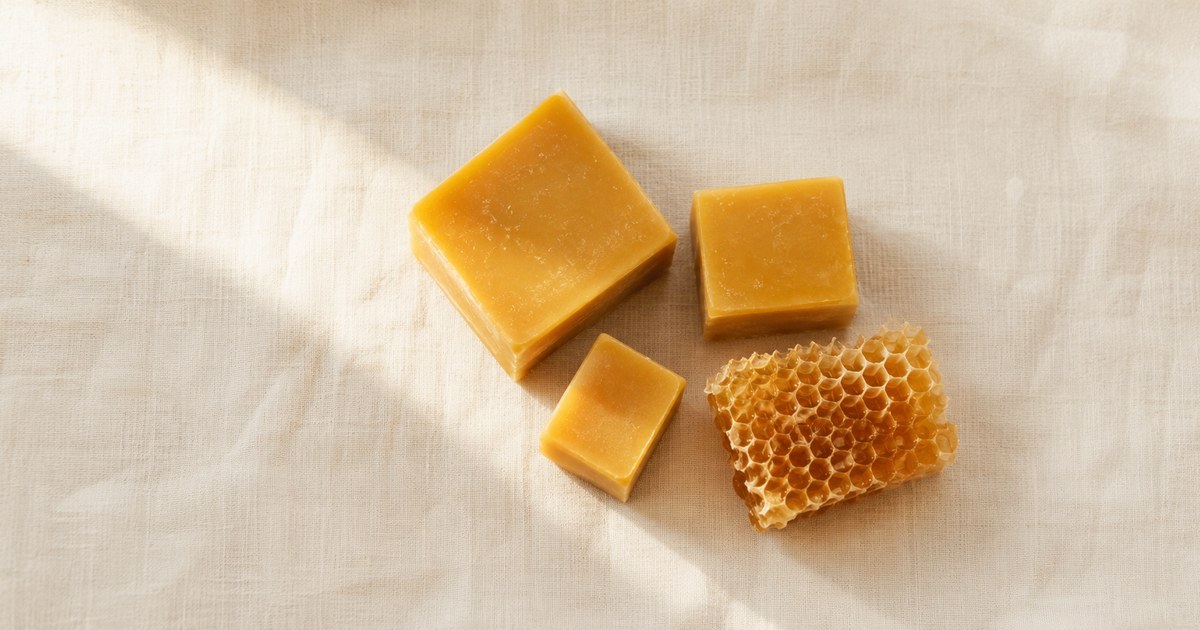
Beeswax is what turns a soft fat into a stick that holds its shape. It is collected from honeybee comb, which makes it animal-derived and means neither version of this deodorant is vegan. Why beeswax is not vegan, and why we chose it anyway, has its own post.
What is specific to this formula is the balance between wax and fat. Wax sits second on the panel because it needs to be a large share of the stick to do its job, and the exact amount decides how the deodorant feels. Push the wax share up and the stick holds up well in the tube but drags across the skin, which matters a great deal on an underarm that was shaved that morning. Pull it down and the stick glides like a balm but smears, wears down fast, and leaves more behind on fabric.
The two bases also ask different things of the wax. Tallow already brings density of its own, while coconut oil softens much more easily, so the same wax has to keep both versions upright in the tube and both versions moving across the skin. Getting one formula to behave well in both bases is a large part of why the wax line took the longest to settle.
Beeswax leaves a light film on the skin as well, which is part of why the stick does not feel stripping. That is a side effect of its structural job rather than the reason we put it in, and we would not dress it up as a skin benefit on the front of the box.
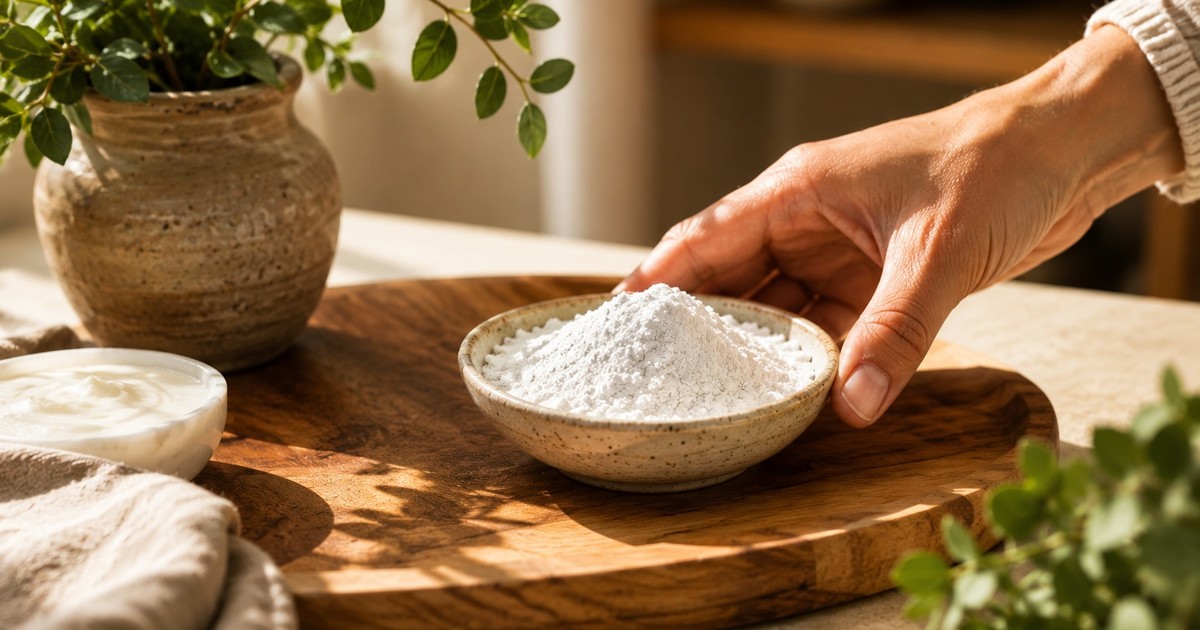
Magnesium hydroxide controls odor, and it is the only ingredient on the panel doing that job. It is a mineral compound, best known as the active ingredient in milk of magnesia, and more people tolerate it than tolerate baking soda. The full profile of magnesium hydroxide covers the rest.
What matters here is its form and its place. It arrives as a fine white powder, and a powder has to be suspended evenly in the fat or it settles toward one end of the stick. That is why it sits third: enough of it to do the job across a full day, and not so much that the stick turns chalky.
Overloading a stick with mineral powder is one of the easiest mistakes in this category, and you can feel it when it happens. The stick drags, it leaves a white line on the skin and on dark shirts, and it can feel gritty on freshly shaved skin. Underloading it gives you a pleasant stick that stops working by lunch. The share we use is the one that held up through a full day of ordinary life in our own house without leaving a visible white cast.
It also has no scent of its own, which is why it fits an unscented product. And it leaves sweating alone, because this is a deodorant and not an antiperspirant. Sweating is how the body cools itself, and nothing on this panel is trying to change that.
Vitamin E is in the stick to keep the fats from going rancid, and it does that at a very small share. It is an antioxidant, which is a different job from a preservative, and what vitamin E does and does not do in skincare is explained in its own post.
It sits fourth because the amount needed to protect the fats is small. Adding more would not make the stick better for skin; it would make it slightly tackier and cost more without changing anything you would notice. A low position on the panel is the correct position for an ingredient doing a protective job.
In this formula it is guarding three fats at once: the base, the beeswax, and the castor oil. The base is the one most likely to change over time, and the sign is a smell rather than a look. A stick that has started to oxidize picks up a stale, crayon-like note when you hold it close, usually at the exposed top first.
You can help it along. Keep the cap on, keep the tube off a sunny windowsill, and use it within a reasonable stretch after opening rather than keeping a half-used stick in a drawer for a year. Vitamin E slows the process down. It does not stop it, and no honest label would claim it does.
Castor oil is a seed oil, it is in the formula on purpose, and it sits last because a little of it changes the glide a lot. Our criticism of seed oils has always been about high-heat, solvent-extracted, refined processing rather than about seeds, and why castor oil passes our own test is the full argument.
Inside this stick it does two things. First, it is a thick, cushiony oil that stays liquid at room temperature, so it smooths the transition between a dense wax-and-fat stick and your skin. Without it, the first pass of the day drags, especially on the tallow version. Second, its thickness helps keep the mineral powder spread evenly through the stick instead of settling, so the last few weeks of a tube work like the first few.
The reason it stays at a small share is that castor oil is famously sticky in larger amounts. Raise it much past where we use it and the underarm feels tacky for several minutes after application, and the chance of a mark on a dark shirt goes up. At the level we use, it disappears into the glide and you would only notice it by its absence.
Ours is cold-pressed, meaning the seeds are mechanically pressed rather than run through solvent extraction. That production path is the line we draw for every oil, including our own.
Ingredients are listed in descending order of how much is present, so reading our panel top to bottom tells you roughly how the stick is put together. Here is the whole formula with the consequence of getting each share wrong.
| Panel entry | Plain name | Job | Too much | Too little |
|---|---|---|---|---|
| Bos taurus tallow or Cocos nucifera oil | Tallow or coconut oil | Carries everything | Soft, greasy, smears | Stiff and chalky |
| Cera alba | Beeswax | Holds the shape | Drags on skin | Wears down fast |
| Magnesium hydroxide | Magnesium hydroxide | Odor control | White marks, gritty | Fades by midday |
| Tocopherol | Vitamin E | Keeps fats fresh | Slightly tacky | Stale smell sooner |
| Ricinus communis seed oil | Castor oil | Glide, even spread | Sticky, marks fabric | Slow first pass |
The Latin names trip people up, so the translations are worth remembering. Cera alba is the Latin for white wax. Tocopherol is vitamin E. Ricinus communis seed oil is castor oil, with the word seed right there in the name.
This is also why a five-line panel is a working tool rather than a slogan. If your underarm ever objects, there are five candidates, and the table above tells you what each one is there to do. If the stick starts behaving differently, the right-hand columns usually point at the cause, and more often than not the cause turns out to be a warm bathroom or a heavy hand rather than the formula.
The two most familiar actives in the deodorant aisle are both absent from this stick, for different reasons. One we replaced, and the other never belonged in a deodorant at all.
Baking soda is effective and cheap, and it gives a real share of people red, itchy underarms a week or two into use. Why we make our deodorant baking-soda-free covers that in full. In this formula its slot went to the mineral, so leaving it out did not mean adding anything to compensate.
Aluminum salts are the active in antiperspirants, a different product built to plug sweat ducts, and natural deodorant versus antiperspirant explains that split in full. The research does not support the claim that aluminum causes cancer, so leaving it out here is a preference about shirt stains and sweat ducts, not an escape from danger.
What the swap changed in this stick is easy to feel once you know to look for it. The mineral arrives as a soft, very fine white powder, and at the share we use it disappears into the fat and wax instead of sitting as grains, which is why the stick can go on an underarm shaved that morning without a scratchy first pass. It is also the same active at the same share in both versions, so choosing between tallow and coconut changes the glide and the feel and never changes the odor control.
With one active and nothing added to back it up, the tube behaves the same from the first week to the last.
There is no fragrance in either version, including no essential oils, and no water, which is why there is no preservative. All three decisions are connected and all three are explained at length elsewhere, so this section sticks to what they mean for this particular stick.
Fragrance is the most common cause of reactions in personal care, and why we only make unscented products is the long version. In a deodorant it has a second cost: a scent tells you nothing about whether the active is working. With no fragrance on the panel, the only thing you smell at the end of the day is the honest result.
Water would have turned the stick into a cream or a gel, and any product with water in it needs a preservative system to stay safe on a shelf. Why water-based products need preservatives covers that in detail. Leaving out water removed the need for one entirely, which is a property of the format rather than a clever claim.
The practical side for you is simple. A water-free stick does not need refrigeration, it does not separate, and the only aging you need to watch for is the oxidation that vitamin E slows down. It also means the stick is concentrated: what touches your skin is the five ingredients, not a mixture that is mostly water carrying them.
Many natural deodorants add arrowroot, cornstarch, tapioca, kaolin clay or a similar powder, and we chose not to. This is the omission we get asked about least and think about most, because it is the one that most changes how a stick feels.
Those powders are there to give a stick a powdery, matte finish on the skin. They are absorbent, and on a label they appear as names like Maranta arundinacea root powder, Zea mays starch, tapioca starch or kaolin. In a formula built around them, the powder can be a large share of the stick.
We left them out for three reasons. First, a heavy powder load makes a stick drag, which on a shaved underarm is the difference between comfortable and not. Second, starch mixed into a warm, damp underarm can go pasty and ball up by the end of the day, leaving little crumbs in the crease and on fabric. Third, every powder added is one more line on the panel and one more thing to rule out when skin reacts, and the mineral already gives the stick all the powder it needs.
The trade is honest. A starch-heavy stick feels more powdery right after you put it on, and some people love that feel. Ours goes on smoother and feels more like a balm. If a powdery finish is what you want, a stick that includes one will suit you better, and we would rather say so here than have you find out from a tube you do not enjoy.
The habit that matters is reading the panel, not the front of the package. These checks take about thirty seconds and work on every stick in the aisle, ours included.
In the United States an antiperspirant is regulated as a drug and carries a Drug Facts panel listing its aluminum compound as the active ingredient. A plain deodorant has an ordinary ingredient list. That box tells you which category you are holding before you read anything else.
That is baking soda. Near the top means a large share and near the bottom means a small one. If baking soda has bothered you before, its position tells you how much of a risk the stick is.
Fragrance can stand for many components under one word, and essential oils appear as entries like Lavandula angustifolia oil. Both are scent, whatever the front of the box says.
If aqua or water leads the panel, the product is a cream or gel, and a preservative will appear further down.
Starch and clay names tell you how powdery the stick will feel. The base oil tells you whether an allergy or an animal-derived ingredient applies to your household.
None of these checks makes a product good or bad on its own. They tell you what you are buying, which is the whole point of a panel.
Five ingredients: a grass-fed beef tallow or coconut oil base, beeswax, magnesium hydroxide, vitamin E, and cold-pressed castor oil. Each one does a single job, and the order on the panel is a rough map of how the stick is put together.
The base decides how the stick feels, the wax decides whether it holds its shape without dragging, the mineral is the only active, vitamin E keeps the fats fresh, and a small amount of castor oil makes the glide work. Everything we left out, from baking soda and aluminum to fragrance, water, preservatives and starches, was a deliberate decision with a cost we accepted.
Beeswax means the products are not vegan, castor oil is a seed oil we use on purpose, and the tallow version is the one to pick if coconut is a problem in your house. Five lines are not a promise of better results than a longer list. They are a promise that you can read the whole thing, understand every entry, and know where to look if your skin ever disagrees.
Megan co-founded Bear Basics and leads design. As a mom, she writes our gentlest, most practical guides — on ingredients, sourcing, and simple family skincare — with an emphasis on honest, well-sourced, and simple. Read the full story →