Quick answer
No — coconut is not a tree nut. Botanically it’s a drupe (a stone fruit, like a peach or an olive), and as of January 2025 the FDA no longer classifies coconut as a tree nut for food allergen labeling, ending roughly twenty years of it being regulated as one. Coconut must still be named in ingredient lists, but it no longer triggers the mandatory “Contains: tree nuts” declaration. Two things remain true after the change: coconut allergy is real (just rare, and distinct from tree-nut allergy), and anyone managing a nut allergy should still clear coconut with their allergist and patch test new products — because lists change, and your immune system doesn’t read guidance documents.
Answers at a glance6 quick questions
A nut?
No — a drupe (stone fruit).
FDA status?
Off the tree-nut list since Jan 2025.
Still labeled?
In ingredients, yes — allergen flag, no.
Coconut allergy?
Real but rare — and its own thing.
Nut-allergic & coconut?
Often fine — ask your allergist.
Skincare impact?
Unchanged: read lists, patch test.
01 The short answer
Few food-classification questions have generated more genuine confusion than this one, because for twenty years every authority seemed to disagree with every other: botanists said fruit, the dictionary said the word “nut” is right there in the name, allergists said it rarely behaves like a nut, and the FDA — the answer that governed every “Contains” statement in the grocery store — said tree nut.
As of January 2025, the answers finally align: coconut is botanically a drupe — a stone fruit — and the FDA’s updated allergen guidance removed it from the tree-nut list, narrowing that list to twelve true tree nuts and dropping coconut along with several other misfits it had accumulated over the years.
For a brand whose entire coconut line rests on this ingredient, we’ve followed this question closely and told customers the cautious version for years. This post is the full, current accounting: the botany, the regulatory history, what the change does and doesn’t mean — and why our practical advice to allergy families barely changes at all, which might be the most important section here.
02 What a coconut actually is (hello, drupe)
Start with the botany, because it’s the part that was never actually in dispute. A drupe is a fruit built in three layers: a smooth outer skin (the exocarp), a fleshy or fibrous middle (the mesocarp), and a hard stony shell (the endocarp) wrapped around a seed. Peaches, cherries, olives, mangoes — all drupes. You eat the middle layer and discard the stone.
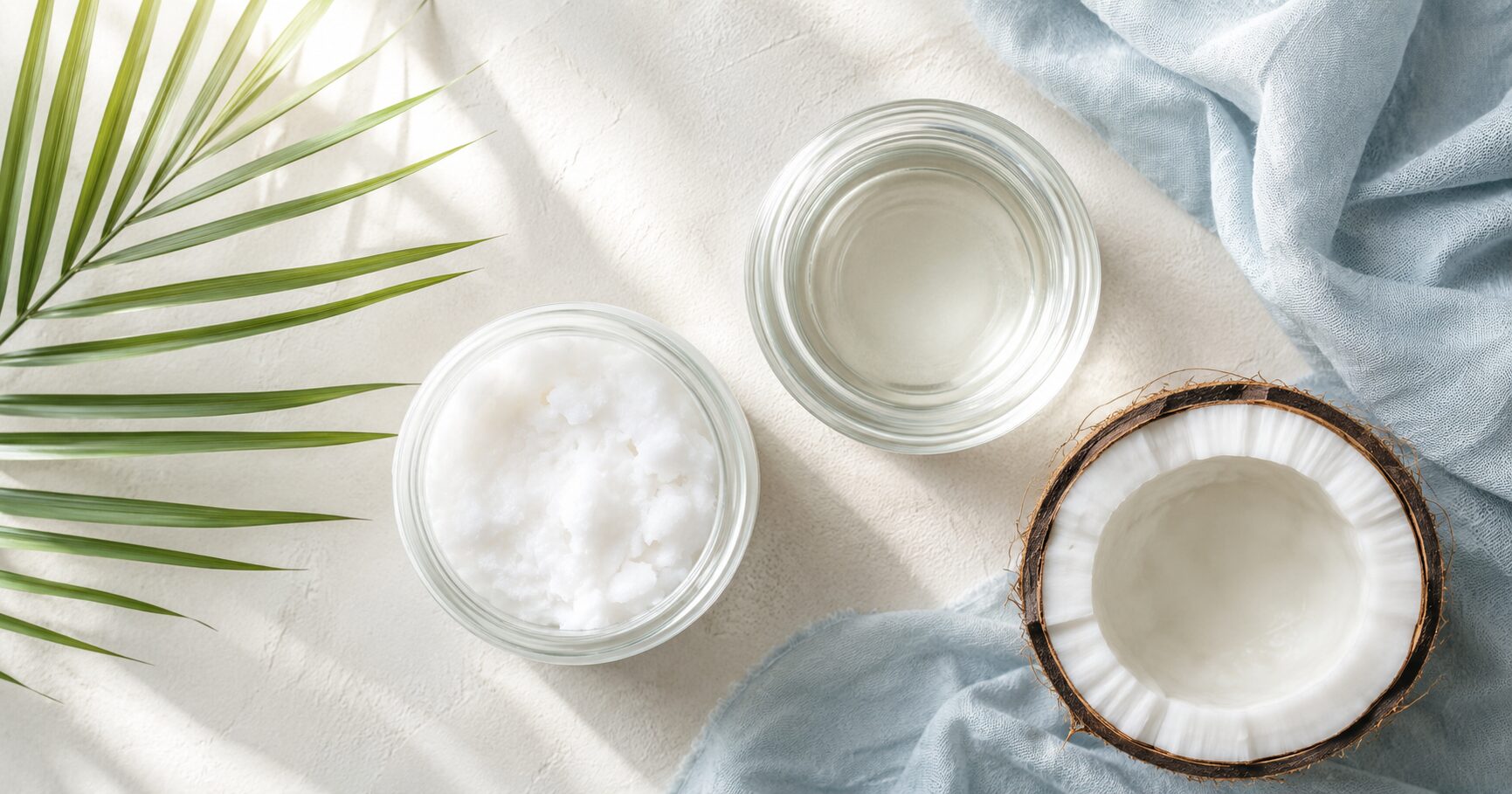
A coconut is exactly this structure at palm-tree scale — you’ve just never seen the whole fruit. On the palm, a coconut is a smooth green-to-brown ovoid the size of a rugby ball: skin, then a thick fibrous husk (that’s the mesocarp — the source of coir fiber), then the hard brown “coconut” of the produce aisle, which is the stone. The white meat and water inside are the seed’s tissues.
The sentence that reframes everything
The hairy brown sphere at the grocery store isn’t the fruit — it’s the pit. Coconut is, structurally speaking, the world’s largest peach stone, with the peach removed before shipping. Once you see it that way, the “nut” framing never quite recovers.
True botanical nuts — hazelnuts, chestnuts, acorns — are a different construction entirely: a dry fruit whose ovary wall itself hardens into the shell, no fleshy layers involved. Coconut never qualified. Case closed on the botany; the interesting story is why the law disagreed for so long.
03 Why everyone thought it was a nut
If coconut was never a nut, how did everyone — including federal regulators — come to treat it as one? Three honest reasons:
- The name. “Coconut” contains “nut” the way “peanut” does — and peanuts aren’t nuts either (they’re legumes). English food names are a botanical crime scene, and law inherited the vocabulary.
- The resemblance. Hard brown shell, white interior, sold next to the almonds — coconut presents as a giant nut to every intuition a shopper has.
- Precaution. When food-allergen labeling law arrived in the mid-2000s, regulators building the tree-nut list erred toward inclusion — coconut allergies existed, coconut looked nutty, and adding it seemed safer than omitting it. Understandable at the time; increasingly awkward as the science matured.
The result was two decades in which the “Contains: tree nuts” warning lumped coconut with almonds and cashews — leading many tree-nut-allergic families to avoid coconut unnecessarily, and muddying everyone’s mental model of what the warning even meant. Which is exactly the confusion the 2025 revision set out to clean up.
04 The FDA years: coconut on the list
The regulatory chapter, briefly and accurately: when the food-allergen labeling framework (FALCPA) took effect in the mid-2000s, “tree nuts” became one of the major allergens requiring declaration — and FDA guidance interpreting the law included coconut on its tree-nut list, alongside genuine outliers like shea nut and kola nut that would eventually raise the same eyebrows.
For twenty years, that inclusion had real consequences:
- Food makers using any coconut ingredient had to flag tree nuts in the Contains statement, whatever the botany said.
- Allergy families reasonably read those warnings as “this is dangerous if you’re tree-nut allergic” — even as allergists increasingly advised that most tree-nut-allergic patients tolerate coconut fine.
- Careful brands — ours included — repeated the official classification in their customer guidance, because when regulators and allergists disagree, a family brand quotes the stricter one. We told that cautious version for years, and we’d make the same call again with the same information.
Meanwhile the scientific case kept accumulating: coconut allergy is uncommon, its allergenic proteins are distinct from tree-nut proteins, and cross-reactivity is the exception rather than the rule. The gap between the label and the science became one of the food world’s better-known oddities — until January 2025 closed it.
05 January 2025: what changed
In early January 2025, the FDA published the final edition of its food-allergen guidance — the document that tells industry how the allergen-labeling law applies in practice — and it contained the quiet bombshell: the tree-nut table was narrowed to twelve true tree nuts, and coconut was no longer on it. Also removed: shea nut, kola nut, palm nut, and several other botanical misfits the old list had accumulated.
- The rationale tracked the science that had been building for years: coconut is botanically a drupe, coconut allergy is relatively rare, and it’s biologically distinct from true tree-nut allergy.
- The mechanism is worth understanding: this is agency guidance — the FDA’s official reading of the law and its enforcement posture — rather than a rewritten statute. In practice, guidance is what industry follows.
- The company it kept: the same guidance cycle tightened other allergen definitions too — this was a general cleanup of the framework, not a coconut-specific lobbying win.
For label-readers, it’s a rare and instructive event: an official category you’ve seen on thousands of packages just changed underneath you — a good reminder that labels encode decisions, not eternal truths, which is the founding idea of our whole label-reading approach.
06 What the change means on food labels
What actually changes on a food package, precisely — because the details matter to families who navigate by these labels:
- Ingredient lists: unchanged. Coconut, coconut oil, coconut milk — whenever they’re used, they must still be named in the ingredients. Transparency about what’s in the food never depended on allergen status.
- The Contains statement: changed. Coconut alone no longer obligates a “Contains: tree nuts” declaration. Over time, coconut-containing products will shed tree-nut warnings they only carried because of coconut.
- The transition: gradual. Old packaging cycles through slowly, and some manufacturers may keep voluntary warnings. Expect years of mixed shelves — a product with a tree-nut flag might contain coconut only, or real tree nuts; the ingredient list, as ever, is the ground truth.
- Cross-contact advisories (“made in a facility with…”) remain voluntary and unchanged — they were never part of the mandatory framework.
Net effect for most shoppers: labels get more accurate. Net effect for coconut-allergic shoppers: your job actually gets harder — the warning that flagged your allergen (however imprecisely) is disappearing, which makes the next two sections the most important in this article.
07 Coconut allergy: rare, real, and its own thing
Nothing about January 2025 changed a single immune system. So let’s say the unglamorous part clearly, because delisting an allergen from a category is exactly the moment misinformation blooms:
- Coconut allergy is real. People are allergic to coconut — to its proteins, in food and occasionally in skin products — and reactions can range from mild to serious. Rarity is not immunity.
- It’s just uncommon — genuinely rare compared with peanut, milk, egg, or true tree-nut allergy, which is a big part of why the FDA concluded mandatory flagging wasn’t warranted.
- It’s its own allergy. Coconut allergy isn’t a subtype of tree-nut allergy; the proteins differ, and having one doesn’t imply the other in either direction.
- Diagnosed coconut-allergic people change nothing: avoid coconut as before, in food and on skin, and lean on ingredient lists now that Contains statements won’t flag it. Your allergist’s plan outranks every list revision ever published.
This is also our standing note to customers, unchanged by the news: our coconut products are made of coconut — prominently, proudly, and stated plainly — and anyone with a coconut allergy should enjoy our tallow line instead. The right product for an allergic customer is a different product, and we’d rather lose the sale than the trust.
08 Tree-nut allergy & coconut: the practical question
The question the old labels created, now answerable cleanly: “My child has a tree-nut allergy — is coconut off-limits?”
- What the science says: most people with tree-nut allergies tolerate coconut. Allergy organizations said this for years even while the labels lumped them together; the proteins are distinct, and cross-reactivity is uncommon.
- What the science doesn’t say: that it’s zero-risk for everyone. Individual sensitization patterns vary, multi-allergy kids exist, and population statistics don’t diagnose your specific child.
- So the operative answer is: probably fine — and it’s your allergist’s call, not a label’s, a blog’s, or ours. One appointment settles what no guidance document can: whether coconut belongs in your family’s rotation. Many allergists test for coconut specifically when families ask.
If that sounds like the same “ask your allergist” advice we gave under the old classification — it is, and that’s the point. Good caution was never about which list coconut sat on; it was about letting the professional who knows your child’s immune system make the individual call. Lists change. That advice doesn’t.
09 What this means for skincare
Now the lane we actually live in. What does a food-labeling revision mean for coconut in skincare? Three clarifications worth having straight:
- Cosmetics were never under the food-allergen rules. The Contains-statement framework is food law; skincare follows its own ingredient-labeling requirements, naming coconut-derived ingredients (cocos nucifera oil, and cousins) in the list. Nothing about cosmetic labeling changed in January 2025 — the ground truth for skincare was always the ingredient list, and still is.
- Skin exposure differs from eating. Allergic responses to coconut in skincare are their own (uncommon) phenomenon — typically contact reactions rather than food-allergy responses — and refined coconut oil is a further step removed from the proteins involved (the processing details are in virgin vs refined coconut oil).
- The practical guidance is delightfully stable: read the list, patch test new products, and route allergy questions to your doctor — the same three habits we’ve attached to every coconut product since day one, from baby skin to hair.
In other words: the news is genuinely significant for grocery labels and for the accuracy of public understanding — and it changes approximately nothing about how a careful family should approach a coconut balm. Stability like that is what good caution is supposed to buy you.
10 How we handle it on our labels
Where this leaves our own shelf, stated as plainly as we’d want any brand to state it:
- Coconut is named outright on everything that contains it. Front of pack, ingredient list, product page — our coconut line is named after the ingredient. Nobody encounters our coconut oil by surprise, which is the entire disclosure job as we see it.
- Our customer guidance updates with the facts: we no longer describe coconut as an FDA-classified tree nut — because it isn’t one anymore — and we now tell you what this article tells you: botanically a fruit, delisted in 2025, allergy rare but real, allergist’s call for allergy families.
- The precautionary habits stay. Patch-test advice and ask-your-doctor notes remain on our coconut guidance permanently — not because a list requires them, but because families with sensitive skin are our actual customers and honest care is the product behind the product.
That’s the standard we’d want from anyone: name the ingredient loudly, update the facts promptly, keep the caution voluntarily. Two of those three are just reading; the third is a choice.
Want the free family bundle?Two Color & Grow coloring books, our Fam Jams family music, and a plain-English skincare guide — free. Grab the bundle — instant download. 11 Patch testing: the habit that outranks lists
If this article has one takeaway that outlives every future guidance revision, it’s this household habit: patch test new skincare, and let your own skin cast the deciding vote. The two-minute version:
- Pick a small, forgiving spot — inner forearm for adults, and for kids a patch on the arm or leg per your pediatrician’s preference.
- Apply a small amount of the new product and leave it alone — no washing, no layering over it.
- Wait a day or two. Contact reactions can be slow; a 24–48-hour window catches what a five-minute check misses.
- Read the result: nothing = proceed normally. Redness, itching, bumps = stop, wash, and mention it to your doctor — especially if allergies already run in the family.
We fold this habit into everything we write for parents — it’s baked into the kids’ routine guide and all our baby-skin content — because it’s the one allergy safeguard that requires no regulatory framework, no news cycle, and no trust in anyone’s list, including ours. Guidance documents get revised; the back of your forearm is always current.
12 When to bring in the allergist
Finally, the honest triage list — the situations where this topic leaves blogs and labels behind entirely and belongs with an allergist or your pediatrician:
- Any suspected reaction to coconut — food or skincare, mild or not. One observed reaction is worth a hundred articles.
- A tree-nut-allergic family member and coconut questions — the “probably tolerant” statistics from section 8 deserve to be confirmed for your person, and testing exists precisely for this.
- Multiple food allergies in the house — cross-reactivity patterns get individual fast; a professional map beats guesswork.
- Babies with significant eczema or existing food allergies — introduce new foods and new skincare under medical guidance generally; this is standard pediatric advice and coconut is no exception.
- Anaphylaxis history of any kind — every new-ingredient decision routes through your allergist, full stop, and carries whatever emergency plan they’ve prescribed.
None of these are alarm bells about coconut specifically — they’re the ordinary boundaries of what any ingredient article can responsibly cover. We’ll keep the botany and the regulatory news current; the individual medicine was never ours to practice.
13 The bottom line
Is coconut a tree nut? No — and now every authority finally agrees. Botanically it’s a drupe, the overgrown cousin of the peach pit; as of January 2025 the FDA’s allergen guidance says so too, removing coconut from the tree-nut list after two decades and letting food labels catch up to the science.
What survives the news is everything that actually protects people: coconut allergy is rare but real; ingredient lists still name coconut everywhere it appears; tree-nut-allergic families get their coconut answer from an allergist, not a category; and a patch test remains the cheapest second opinion in skincare. Categories got cleaner this year. Caution never needed a category — and around here, it keeps its job regardless.
"The grocery store’s giant nut was a giant peach pit all along. The label finally agrees — your allergist still gets the last word."— The honest verdict
The 6 things to remember
- Coconut is a drupe — a stone fruit — not a botanical nut.
- As of January 2025, the FDA no longer lists coconut as a tree nut for allergen labeling.
- Ingredient lists still name coconut everywhere; the mandatory “Contains: tree nuts” flag is what changed.
- Coconut allergy is real but rare — and distinct from tree-nut allergy.
- Tree-nut-allergic? Most tolerate coconut — but that’s your allergist’s call, not a label’s.
- Cosmetic labeling was never part of this; for skincare: read the list, patch test, ask your doctor.
Frequently asked
Is coconut a tree nut?
Botanically, no — coconut is a drupe, a stone fruit in the same botanical family of structures as peaches and olives, from a palm that isn’t a true tree in the botanical sense either. And as of January 2025, the FDA no longer classifies coconut as a tree nut for food allergen labeling purposes, reversing roughly two decades of regulatory practice.
Why did the FDA remove coconut from the tree nut list?
In January 2025 the FDA published final food-allergen guidance that narrowed its tree-nut list to twelve true tree nuts, removing coconut along with several other items (like shea nut and kola nut). The change reflected the scientific case that coconut is botanically a fruit, that coconut allergy is relatively rare, and that coconut allergy is biologically distinct from tree-nut allergy.
Can you be allergic to coconut?
Yes — coconut allergy is real, it can be serious, and it exists independently of tree-nut allergy. It’s just uncommon compared with major allergens like peanuts or true tree nuts. Anyone with a diagnosed coconut allergy should continue avoiding coconut in food and skincare regardless of how labels categorize it, and should follow their allergist’s guidance.
If I have a tree nut allergy, can I eat or use coconut?
Many people with tree-nut allergies tolerate coconut — the allergies are biologically distinct, and allergy organizations have long noted that most tree-nut-allergic individuals do not react to coconut. But “many” and “most” are not “you”: that determination belongs to your allergist, not to a label, a blog, or a brand.
Do food labels still have to declare coconut?
Coconut must still appear in the ingredient list whenever it’s used — that never changes. What changed is the allergen declaration: coconut no longer has to be flagged in the “Contains: tree nuts” statement on food labels. Ingredient transparency stays; the mandatory tree-nut warning goes.
Does the FDA change affect skincare labels?
Skincare was never governed by the food-allergen declaration rules in the first place — cosmetics follow their own ingredient-labeling requirements, which list coconut-derived ingredients by name. The 2025 change is a food-labeling update; for skincare, the practical takeaway is unchanged: read the ingredient list, and patch test if allergies run in your family.
Is coconut oil safe for people with nut allergies?
For most people with tree-nut allergies, coconut and coconut oil are tolerated — and highly refined oils are a further step removed from allergenic proteins. But individual cases vary, coconut allergy itself exists, and anyone managing a nut allergy should clear coconut products with their allergist first and patch test new skincare. That’s the answer whether or not any list includes coconut.
What is a drupe?
A drupe is a fruit with three layers: an outer skin, a fleshy or fibrous middle, and a hard inner shell around a seed. Peaches, olives, cherries, mangoes — and coconuts — are all drupes. What you buy as a “coconut” is the inner shell and seed of the fruit; the fibrous husk was removed. So the thing that looks most like a giant nut is, structurally, closest to a giant peach pit.
Megan Smith
Co-Founder, Bear Basics
Megan co-founded Bear Basics and leads design. As a mom, she writes our gentlest, most practical guides — on ingredients, sourcing, and simple family skincare — with an emphasis on honest, well-sourced, and simple. Read the full story →
Named loudly. Explained honestly.Our coconut line puts the ingredient in the product name — and the caution in writing. Prefer Amazon? Find us there too.Shop coconut oil