Quick answer
No — beeswax is not vegan. It’s secreted by honeybees to build their comb, which makes it an animal product under any standard definition of veganism, and every Bear Basics product contains it — so nothing we make is vegan, and we’d rather tell you in the first sentence than the fine print. The fuller picture: beeswax is harvested from surplus comb during hive maintenance, its welfare impact depends almost entirely on the beekeeper’s practices, plant waxes like candelilla and carnauba are genuine (if different-feeling) alternatives, and our reasons for choosing beeswax anyway are structural, historical, and honestly arguable — which is exactly why we argue them in the open below.
Answers at a glance6 quick questions
Vegan?
No — bee-made = animal product.
Vegetarian?
Yes — no animal is eaten.
Hurts bees?
Depends on the keeper — surplus harvest done right doesn’t.
Why use it?
Structure — it’s why a balm is a stick.
Vegan swaps?
Candelilla & carnauba — harder, different feel.
Our products?
All contain beeswax — none vegan.
01 The short answer
Some ingredient questions have genuinely complicated answers — we wrote three thousand words on whether coconut is a nut because the truth needed them. This one doesn’t: beeswax is made by bees, bees are animals, and animal products aren’t vegan. No.
What deserves the three thousand words is everything around that answer, because it’s where most brands get evasive and most readers get curious: How is the stuff actually harvested, and does it hurt the hive? What do the vegan alternatives really offer, and what do they cost in feel? Does buying beeswax help pollinators or exploit them — and who’s right in that argument?
And the question underneath all of it, which we owe you directly: knowing all this, why does every product we make still contain beeswax? That answer is coming in section 8, unhedged. A brand that puts “honest” in its values doesn’t get to skip the chapters where honesty costs something.
02 What beeswax is (a bee-made building material)
To weigh the ethics you need the biology, and the biology is genuinely wonderful: beeswax is a building material that worker bees secrete from their own bodies.
- The source: young worker bees have eight wax glands on their abdomens. During their comb-building career phase, they convert honey into tiny translucent wax scales — flakes smaller than a pinhead — extruded from these glands.
- The cost: wax is expensive for the hive. Producing it consumes many times its weight in honey, which is why bees recycle comb religiously and why wax represents concentrated colony labor.
- The product: workers chew the scales, work them soft, and sculpt the hexagonal comb — nursery, pantry, and architecture in one material, engineered by evolution to be strong, light, and stable across a hive’s temperature swings.
That last property list should sound familiar — strong, light, heat-stable — because it’s precisely the résumé that makes beeswax irreplaceable in balms (full profile: what is beeswax in skincare?). The qualities we borrow are the qualities bees built it for. Which is the whole ethical rub, stated fairly: this ingredient is not a byproduct lying around — it’s the hive’s work. Whether taking some of it is defensible depends entirely on how, and how much — the next two sections.
03 How beeswax is harvested
So how does comb become an ingredient? In responsible practice, beeswax harvest is a byproduct of work the beekeeper does anyway:
- Cappings wax — the main skincare-grade source. When bees finish ripening honey, they seal each cell with a thin fresh wax lid. Harvesting honey requires slicing these cappings off; that sliced wax — new, clean, light-colored — is collected, melted, and filtered. The comb itself goes back to the hive intact for refilling.
- Retired comb — beekeepers rotate old, darkened comb out of hives on a schedule for colony health regardless of wax demand; it’s rendered down as a secondary, darker grade.
- Surplus and burr comb — the odd extra structures bees build in inconvenient places, removed during routine inspection.
Notice the pattern: in a well-run apiary, wax harvest rides along with hive management rather than driving it — the colony keeps its brood comb, its stores, and its structure. Then the honest counterweight: not every operation is well-run. Aggressive harvesting that strips too much, or treats colonies as disposable inputs, exists in commodity supply chains — and pretending otherwise would be exactly the greenwashing we teach readers to catch in how to spot greenwashing. The practice is defensible; the practice is not automatic. Sourcing is where the difference lives.
04 Why that isn’t vegan — the definition, respected
Now the definitional part, done with respect rather than lawyering. Veganism excludes animal products and animal labor — not just animal deaths. The standard vegan position, held consistently for decades: if it comes from an animal’s body or work, it’s not vegan, regardless of whether the animal was harmed.
- Beeswax is secreted from bees’ bodies — about as literally “from an animal” as an ingredient gets.
- It represents the hive’s labor — the honey consumed, the building done.
- Therefore: not vegan. The same logic that excludes honey, and it’s coherent all the way down.
You’ll occasionally see brands market beeswax products as “vegan-friendly” on the theory that bees aren’t harmed — and whatever the welfare facts, that’s a redefinition vegans didn’t agree to, and we won’t play it. Vegetarian-compatible? Yes, genuinely — no animal is eaten or killed for beeswax in responsible practice, and most vegetarians use it without conflict. But the vegan line sits where vegans drew it, not where marketing would prefer it. Words mean things — it’s the entire thesis of what does “natural” really mean? — and “vegan” means beeswax is out.
05 The vegan case, taken seriously
Before we defend our choice, the other side deserves its strongest form — not a strawman we can knock over. The serious vegan case against beeswax:
- Consent doesn’t exist here. The hive can’t agree to the arrangement; “they don’t mind” is unknowable and convenient.
- Commercial incentives cut against welfare. Where wax and honey are commodities, pressure exists to maximize extraction — and some industrial practices (heavy harvesting, colony stress, treating hives as replaceable) follow that pressure.
- “Byproduct” reasoning can launder anything. Every animal industry defends itself as using what exists anyway; at some point, the argument says, you’re just declining to be the demand.
- Alternatives exist. Candelilla and carnauba do the structural job. If the swap is feasible, keeping the animal ingredient is a preference, not a necessity — and preferences are exactly what ethics asks us to examine.
We think this case is coherent, seriously held, and — on its own premises — correct: if animal use itself is the line, beeswax crosses it, full stop. Our disagreement isn’t with the logic; it’s with the premises, and we’ll show our work in sections 8 and 10 rather than pretending the argument doesn’t exist. Readers who find the vegan case convincing will find our honest product guidance in section 12 — no hard feelings, genuinely.
Want the free family bundle?Two Color & Grow coloring books, our Fam Jams family music, and a plain-English skincare guide — free. Grab the bundle — instant download. 06 The bee-welfare question, honestly
The empirical question under the ethical one: does beeswax harvesting actually harm bees? The honest answer has a shape we’ve drawn before — for tallow rendering and lanolin refining alike — and it applies here exactly: the practice isn’t the villain or the hero; the operator is.
- Done well: cappings-based harvest with sensible comb rotation takes what the colony’s workflow surrenders anyway. Managed colonies under good keepers routinely thrive for years under this arrangement — the keeper’s livelihood depends on it.
- Done badly: over-harvesting comb forces colonies to spend precious honey rebuilding at the worst times; rough handling, neglect, and extraction-first economics stress and lose hives. This exists, particularly at commodity scale, and no honest article omits it.
- The structural truth: beekeepers have skin in the game — dead colonies produce nothing — which aligns incentives toward welfare more than in many animal industries. But alignment isn’t guarantee, and “the keeper needs the bees alive” sets a floor, not a standard.
Where does that leave a conscientious buyer? Precisely where every ingredient in this series leaves you: the question isn’t “is beeswax ethical?” but “whose beeswax?” — which makes sourcing the entire ballgame, and the next section the practical one.
07 What responsible sourcing looks like
What separates beeswax worth buying from beeswax worth questioning — the standard we apply when we buy, and the one you can apply to any brand including us:
- Beekeeping-first suppliers. Wax from operations whose center of gravity is healthy hives — honey producers, pollination apiaries — rather than anonymous commodity brokers aggregating wax of unknown provenance.
- Cappings-grade wax. The fresh, clean harvest that rides along with honey extraction — the grade whose collection is least invasive by design, and the one suited to skincare anyway.
- Practices a brand can describe in a sentence. Ask how the wax is harvested; a real answer sounds like this article’s section 3. Vagueness is an answer too — the same tell we flagged for tallow and for every ingredient with a quality spread.
- Certifications where they exist. Organic beeswax certification constrains hive treatments and forage; it’s not a welfare guarantee, but it’s a real constraint, and constraints beat vibes.
We hold our own purchasing to this list — and we’ll be straight that beeswax supply chains are harder to see into than a single ranch or grove, which is exactly why the standard matters. A brand that can’t tell you anything about its wax is telling you something about its wax.
08 Why we use beeswax anyway
So: an animal ingredient, a coherent case against it, alternatives on the table — why does every product we make still contain beeswax? Three reasons, in descending order of weight:
- It does structural work nothing else quite matches. Beeswax is why a balm is a stick and not a puddle — it sets our fats into forms that twist up cleanly, survive a backpack, apply without mess, and hold together across seasons. Its combination of hold, flexibility, and skin-feel sits in a Goldilocks zone the harder plant waxes bracket but don’t occupy (the head-to-head is next section). In an anhydrous format built on exactly four ingredients, the structural ingredient carries enormous weight — and beeswax carries it best.
- It contributes beyond structure. A light occlusive film (its role in the three-job system), a trace of honeyed warmth in an otherwise unscented line, and centuries of continuous skin-use history — the longest safety record an ingredient can offer.
- Its supply chain, done right, is one we can stand behind. Surplus-based harvest from keepers whose living depends on thriving hives — an animal partnership with aligned incentives, held to the sourcing standard above. That’s a considered position, not a loophole: we’re a family brand that uses animal ingredients deliberately (tallow being the loudest example) and tells you so in plain type.
Could we reformulate around it? Genuinely, partially, yes — and section 10 explains why we haven’t. But the summary is already visible: we didn’t keep beeswax because we couldn’t imagine the alternative; we kept it because we compared them.
09 The plant-wax alternatives, fairly graded
The comparison, then — fairly, because the plant waxes are real ingredients, not punchlines. The full three-way breakdown lives in beeswax vs candelilla vs carnauba; the decision-relevant summary:
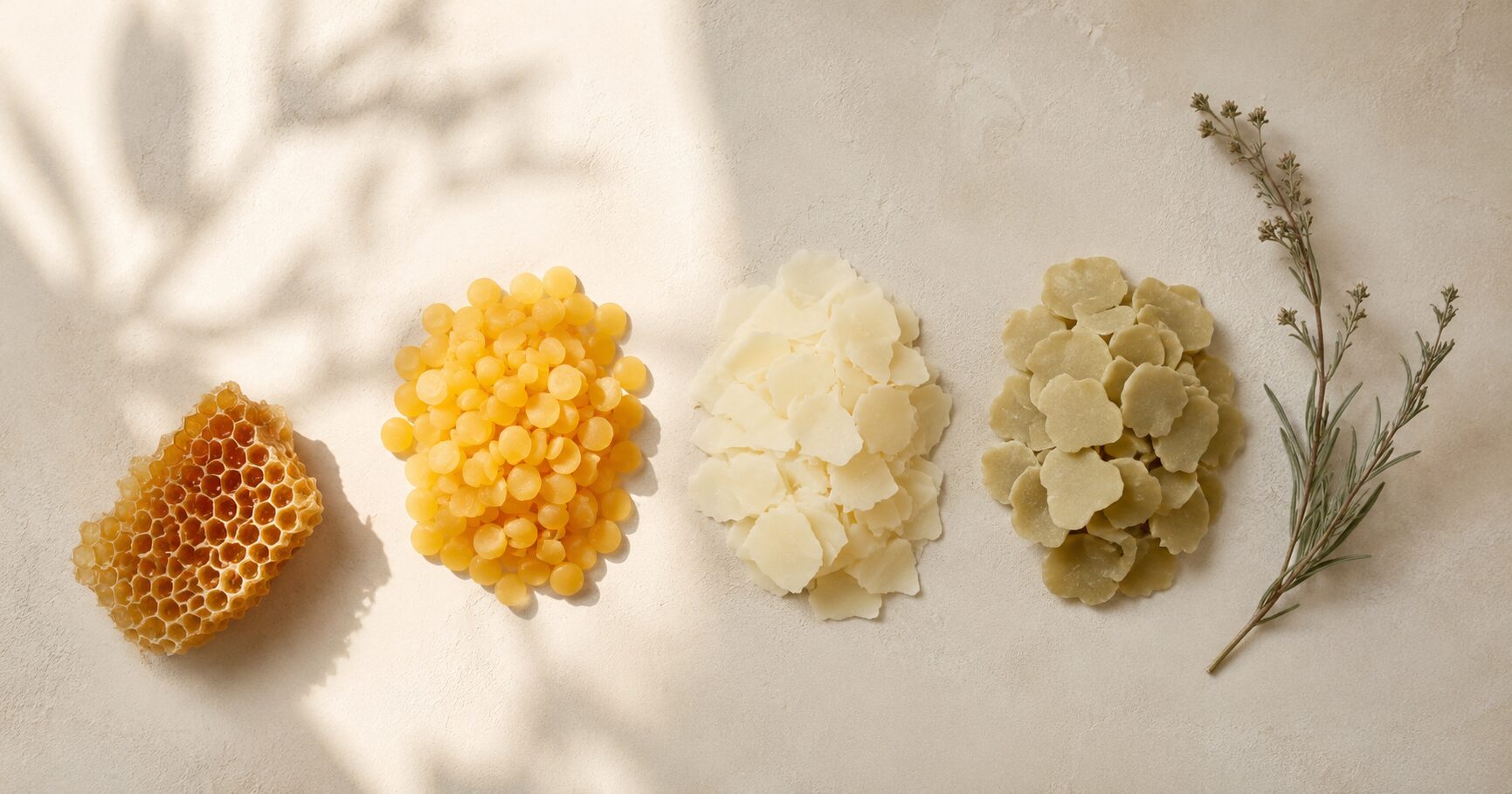
- Candelilla (a Mexican desert shrub’s coating): roughly twice beeswax’s stiffness, so formulas use about half as much — glossier, harder-setting, fully vegan. The most practical beeswax substitute, with a supply chain concentrated in one arid region and its own harvest-sustainability questions worth asking.
- Carnauba (Brazilian palm-leaf wax): the hardest natural wax known — brilliant for gloss and rigidity, used in small doses, also vegan, also single-region, with documented labor-conditions concerns in parts of its harvest that ethical buyers scrutinize.
- The formulating reality: both make excellent products in skilled hands — and both trade beeswax’s supple, skin-warm set for a harder, glassier one. Vegan balm makers earn their results with more formulation work; the results are different, not deficient.
The honest meta-point: swapping beeswax exchanges one set of ethical questions (animal use, hive welfare) for another (regional monocultures, harvest labor) — it doesn’t exit the questioning business. Every ingredient has a supply chain; every supply chain deserves the same squint. Anyone who tells you the plant option is automatically the clean option hasn’t looked at either closely.
10 Why we haven’t swapped
Given workable alternatives, why haven’t we reformulated? Because when we run the comparison against what this brand exists to be, beeswax wins on every axis we actually weigh:
- Feel, for families. The supple beeswax set — solid in the tube, melting on skin contact — is what makes our balms work for toddler cheeks and grandad knuckles alike. The harder plant-wax set is a different product; a fine one, but not ours.
- Coherence. We’re openly an animal-ingredient brand — tallow is on the front of half our labels. Swapping the wax while keeping the fat would be ethics theater: the vegan customer still couldn’t use the line, and the label would just be quieter about why. We’d rather be loudly what we are.
- Sourcing confidence. We can hold beeswax to the section-7 standard. Building equivalent visibility into candelilla or carnauba chains — single-region, labor-scrutinized — is possible but not freer of homework, per section 9.
- The four-ingredient promise. Our formulas fit in one breath. Reformulating the structural ingredient reopens every other choice — and simple, explainable, unchanged formulas are the actual product.
Could that calculus change someday? Sure — positions held honestly stay revisable, and this one gets revisited whenever the facts do (as this week’s coconut update proved we’re willing to do in public). For now: beeswax stays, stated plainly, reasons attached.
11 The pollinator argument (both sides)
One argument deserves its own section because both sides of it are routinely oversold. Does buying beeswax products help bees?
- The case that it does: wax and honey demand is what funds beekeeping; beekeepers maintain millions of managed colonies, provide the pollination modern agriculture depends on, and form the loudest constituency for pollinator-friendly policy. On this view, the beeswax buyer is a patron of the one industry structurally committed to bee thriving.
- The case that it doesn’t: managed honeybees aren’t the pollinators in crisis — wild native bees are, and dense commercial hives can compete with them for forage. Funding honeybee agriculture, critics argue, is conservation-flavored, not conservation. And “our purchase helps them” is the oldest self-serving story in animal use.
Our read: both contain real substance, and neither settles the ethics on its own. The pollinator argument is a genuine point in beeswax’s favor and an insufficient one — which is why our actual position (section 8) rests on structure, sourcing, and coherence, with the pollinator case as color rather than foundation. Beware any brand — ours included, if we ever slip — leaning on “buying this saves the bees” as a complete answer. It isn’t one.
12 If beeswax is a no for you
If you’ve read this far and the answer for your household is “no beeswax” — a position this article has tried to treat as fully respectable — here’s the genuinely useful guidance rather than a shrug:
- What to look for: balms and sticks structured on candelilla or carnauba (labels: euphorbia cerifera, copernicia cerifera), typically paired with plant butters — the wax comparison tells you what feel to expect from each.
- What to still check: everything else on the list — vegan structure doesn’t vet the rest of the formula, and the two-minute label method applies with full force. “Vegan” on the front is a wax-and-fat statement, not a quality one.
- What to expect from us: a straight answer — we don’t have a vegan product, and rather than sell you a compromised version of your own standard, we’d honestly rather you find a well-made plant-wax brand and hold it to the same sourcing scrutiny this article applied to beeswax. Trust travels; come back for the articles.
And for the vegetarians, the flexitarians, and the simply curious who’ve concluded well-sourced beeswax clears their bar: sections 7’s standard is your shopping list, and our whole shelf meets the disclosure half of it by design.
13 The bottom line
Is beeswax vegan? No — it’s the secreted work of animals, veganism excludes it by definition, and every product we make contains it. The interesting truth was never the classification; it’s the chain of questions behind it: harvest done as surplus versus extraction, keepers versus commodity brokers, plant alternatives that trade animal-use questions for labor-and-monoculture ones, and a pollinator argument that’s half-right on both sides.
Our position, restated one last time without hedging: we use beeswax deliberately — for structure nothing matches, from sourcing we can defend, in a brand that puts its animal ingredients on the front of the label. If your ethics land elsewhere, this article tried to be the most useful thing a beeswax brand could hand you anyway. That’s the deal here: we’ll always tell you what’s in the tin and why — and the deciding is permanently yours.
"The question was never ‘is beeswax ethical?’ It’s ‘whose beeswax?’ — and that answer lives in the sourcing, not the species."— The honest verdict
The 6 things to remember
- Beeswax is bee-secreted comb material — an animal product, and not vegan. (Vegetarian: yes.)
- Responsible harvest takes cappings and surplus during normal hive work; bad operators exist — sourcing decides.
- All Bear Basics products contain beeswax; none are vegan, and we say so plainly.
- Candelilla and carnauba are real vegan alternatives — harder-setting, with their own supply-chain questions.
- We keep beeswax for structure, feel, sourcing confidence, and brand coherence — a considered, revisable choice.
- “Buying beeswax saves the bees” is half an argument — treat it as color, never as the whole case.
Frequently asked
Is beeswax vegan?
No. Beeswax is produced by honeybees — secreted from glands on their bodies to build honeycomb — which makes it an animal product by any standard definition of veganism. Vegetarian-friendly, yes (no animal is eaten); vegan, no. Any product containing beeswax, including all of ours, is not vegan.
Does harvesting beeswax hurt bees?
It depends entirely on the beekeeper. Responsible harvesting takes surplus comb and capping wax during normal hive maintenance, leaving colonies with the stores and structure they need — managed hives routinely thrive under this practice. Careless or industrial-scale shortcuts can stress or harm colonies. Like every ingredient we cover, the practice isn’t inherently good or bad; the operator is the variable.
Why do skincare brands use beeswax?
Because it does structural work almost nothing else matches: beeswax gives balms their solidity, lets sticks twist up without crumbling, keeps formulas stable in heat, and adds a protective occlusive film on skin. In simple anhydrous formulas it’s the difference between a balm and a puddle. It also carries a faint honeyed scent and centuries of skin-use history.
What are vegan alternatives to beeswax?
The main plant waxes are candelilla (from a desert shrub) and carnauba (from a Brazilian palm). Both are harder than beeswax — candelilla roughly twice as stiff, carnauba the hardest natural wax known — so formulas use less of them and pair them with softer ingredients. They’re genuine alternatives with their own trade-offs in feel, and their own supply chains worth scrutinizing.
Is beeswax vegetarian?
Yes — vegetarianism excludes eating animals, and beeswax involves no animal being killed for the ingredient in responsible practice. Most vegetarians use beeswax without conflict. Veganism’s stricter standard — no animal products or animal labor at all — is where beeswax is excluded.
Are Bear Basics products vegan?
No — every product we make contains beeswax, and our tallow line adds rendered beef fat, so nothing on our shelf is vegan. We’d rather say that in the first sentence than let anyone discover it in the fine print. For vegan-committed readers we’re happy to point at the plant-wax category, trade-offs and all.
Does buying beeswax products help or hurt bees?
There’s a real argument that demand for beeswax and honey funds beekeeping, and beekeepers maintain and advocate for the managed honeybee population. Critics counter that commercial beekeeping is still animal use and that wild pollinators matter more than managed hives. Both points have substance; we lay them out in the article rather than pretending the question is settled.
How can I tell if beeswax is sourced responsibly?
Look for brands that name their sourcing at all (silence is information), favor beekeeping-first suppliers over commodity brokers, and can describe harvest practices in a sentence. Certifications exist for organic beeswax, which constrains hive treatment. As with tallow rendering or coconut refining, a brand that talks about process in specifics usually has one.
Megan Smith
Co-Founder, Bear Basics
Megan co-founded Bear Basics and leads design. As a mom, she writes our gentlest, most practical guides — on ingredients, sourcing, and simple family skincare — with an emphasis on honest, well-sourced, and simple. Read the full story →
Animal ingredients, on the front of the label.Beeswax-structured, tallow-rich, plainly disclosed — simple products with nothing to hide. Prefer Amazon? Find us there too.Shop the line