Quick answer
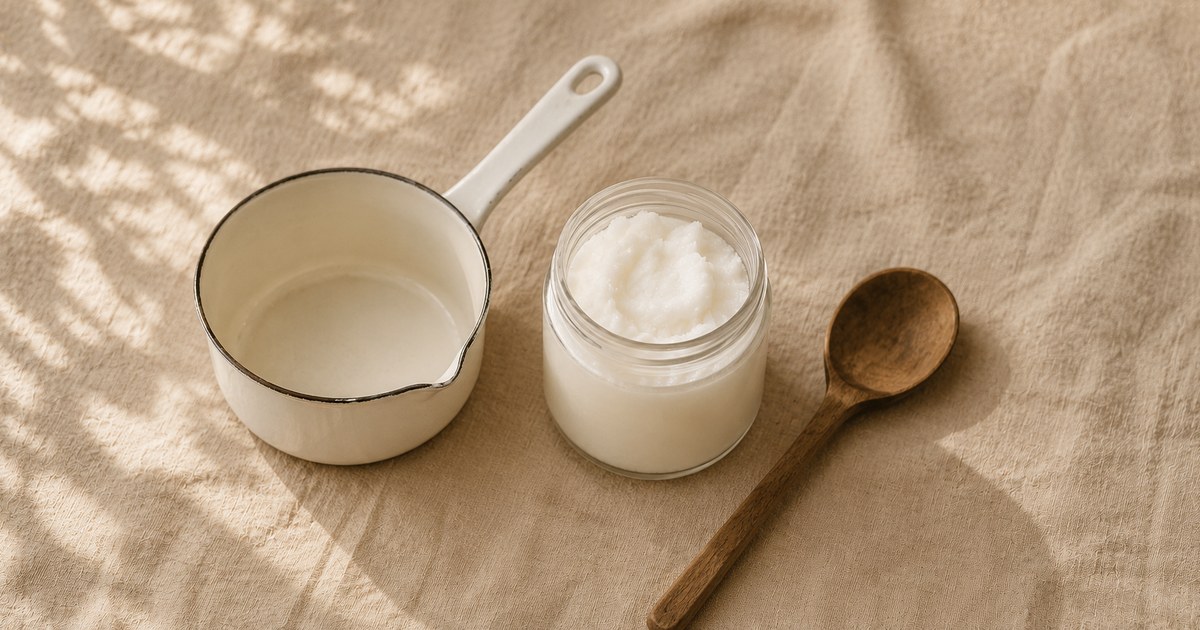
Tallow is rendered beef fat — a true fat whose fatty acids closely resemble skin’s own, with a rich, buttery feel and a faint scent that fades in minutes. Lanolin is the protective wax sheep secrete onto their wool — one of the strongest natural moisture-sealers, with a heavier, tackier feel, a persistent woolly scent, and a documented sensitivity track record (it’s a standard fixture on dermatology patch-test panels). Both are superb occlusives for dry skin. Choose tallow for comfortable, low-scent daily all-over use; lanolin earns its keep as a targeted, thick-layer specialist — if your skin tolerates it. Patch test either.
Answers at a glance6 quick questions
What are they?
Beef fat vs wool wax.
Better seal?
Lanolin, narrowly — both excellent.
Nicer feel?
Tallow — buttery, not tacky.
Scent?
Tallow fades; lanolin lingers.
Sensitivities?
Lanolin’s are documented; patch test both.
01 The short answer
If natural skincare had a heavyweight division, these would be the two names on the card. Tallow and lanolin are the animal kingdom’s great moisturizers — both centuries-deep in traditional skin care, both rich occlusives that modern formulating never really improved on, and both enjoying a renaissance as people turn back toward ingredients with biographies.
The quick scouting report: they tie on the job that matters most — sealing moisture into dry skin — and separate on everything you feel and smell. Tallow behaves like a rich butter: it melts on contact, absorbs to a comfortable finish, and its faint scent disappears in minutes. Lanolin behaves like the wax it is: dense, tacky, extraordinarily persistent — a virtue when you want a thick layer to stay put all night, a drawback when you want to put a shirt on.
And one genuine asterisk hangs over lanolin that doesn’t hang over tallow: a long, well-documented sensitivity track record, which we’ll handle carefully in section 8. The rest of this guide earns those verdicts one round at a time.
02 Two animals, two very different substances
Start with what makes this comparison interesting: these two ingredients solve the same problem from opposite ends of the barnyard, and neither one required inventing anything — both are recovered, not created.
Tallow is the interior story: the dense fat an animal builds around its organs, rendered into skincare’s service as a byproduct of the food supply. Lanolin is the exterior story: the waterproofing grease a sheep’s skin secretes onto its own wool to shed rain and weather — essentially the sheep’s built-in barrier balm, collected when shorn wool gets its wash.
The poetic detail
Lanolin’s day job is literally the job we hire it for: it exists to waterproof and condition the fiber growing out of skin. Tallow’s claim is different but just as neat — its fatty-acid profile happens to echo the composition of human skin’s own surface lipids. One ingredient does for us what it did for the sheep; the other simply speaks our skin’s native language.
Different origins, different chemistry — and that chemistry, more than anything else, predicts every practical difference between them.
03 What lanolin actually is
Lanolin deserves a fair introduction, because it’s a genuinely remarkable substance with an image problem on both ends — beloved by some, blacklisted by others, understood by few.
- What it is: the wax coating raw wool — sheep secrete it continuously, and shorn fleece carries a meaningful fraction of its weight in the stuff. Wool processors wash it out, then refine it into cosmetic grades.
- What it does: seals like almost nothing else in nature. Lanolin is famously among the strongest natural occlusives, and it’s slightly humectant too — a rare double. It’s the traditional backbone of nipple balms for nursing mothers, overnight lip masks, and salve-style products where a thick layer needs to survive hours of wear.
- Its grades matter: raw lanolin is heavy, sticky, and strongly scented; highly purified grades are gentler and milder. Product quality varies enormously with refinement — a familiar theme if you read how tallow is made, because it’s the same lesson: process, not species, determines quality.
Its weaknesses are the flip sides of its strengths: the tack, the tenacity, the woolly scent — and the sensitivity record we’ll get to. Lanolin is a specialist’s tool that got marketed as an everything-tool, and much of its mixed reputation comes from that mismatch.
04 What tallow actually is
Tallow’s full biography is already on this blog, so here’s the comparison-relevant summary with the receipts linked:
- What it is: beef suet, gently rendered and filtered into pure, shelf-stable fat — the whole process in from suet to skincare.
- Why skin likes it: its fatty acids — palmitic, stearic, oleic — substantially overlap with the lipids in skin’s own barrier, part of why it absorbs and wears so comfortably; the evidence-grounded case is in is beef tallow good for your skin?
- How it behaves: emollient on contact, occlusive as it sets — both jobs from the three-job taxonomy in one ingredient.
- Its scent: faint and fleeting when rendered well — the honest details in does tallow balm smell like beef?
Tallow’s weaknesses, stated just as plainly: it’s not vegan, quality varies wildly with rendering care, and it lacks lanolin’s humectant side entirely — a pure fat holds no water of its own, which is why tallow balms belong on damp skin.
05 Fat vs wax: the chemistry that explains everything
One chemistry paragraph, and every practical difference in this matchup falls out of it. Bear with us — it’s worth it.
Tallow is a fat: triglycerides — three fatty acids on a glycerol backbone, the same architecture as skin’s own sebum and the fats in the barrier’s mortar. Skin has been metabolizing and living alongside this exact molecular shape forever. Lanolin is a wax: esters — long fatty acids bonded to long fatty alcohols, the same architecture as beeswax and, well, earwax. Waxes are stiffer, stickier, and far more resistant to absorption and breakdown — that’s their whole evolutionary point: persistence.
- Fat architecture → melts near body temperature, spreads and absorbs readily, feels like it becomes part of skin. That’s tallow.
- Wax architecture → sits on the surface, resists everything (water, wear, time), feels like a coating. That’s lanolin.
Neither architecture is “better” — they’re different tools. Interestingly, our tallow balms borrow a little of the wax strategy on purpose: a minority share of beeswax gives the fat some staying power and structure — the reasoning behind that partnership is in what is beeswax in skincare? Lanolin, being wax through and through, needs no such help — and offers no such moderation.
06 Feel on skin: butter vs tack
Put both on skin and the chemistry lesson becomes immediately, physically obvious:
- Tallow melts as you rub it in, glides like a dense butter, and settles within minutes into a soft, conditioned finish. You feel moisturized rather than coated; clothes can go on shortly after. All-over daily use is exactly its lane — technique notes in how to use a tallow balm.
- Lanolin drags rather than glides — dense, honey-thick, tacky — and the finish stays tacky more or less indefinitely. That persistence is intentional and, for its specialist jobs, valuable: a thick lanolin layer on cracked heels or lips at bedtime is still standing guard at dawn. As a daily all-over body moisturizer it’s a commitment few people renew.
A fair scoring: for feel, tallow wins for anything you do while dressed and awake; lanolin wins for stay-put, thick-layer, overnight duty. Most complaints about either ingredient are really lane violations — lanolin drafted into daily duty, or a thin tallow layer asked to survive a night of heel-grade cracking that wanted something heavier (our approach to that job: the cracked-heels protocol).
07 Occlusion: how well each seals
The headline event: which one actually keeps moisture in dry skin better?
Honest answer: lanolin seals marginally harder; both seal excellently; technique matters more than the margin. Lanolin’s wax architecture makes it one of the most occlusive natural substances known — in the same conversation as petrolatum — and its slight humectant streak adds a small bonus tallow can’t match. Tallow is a strong occlusive in its own right, especially formulated with beeswax, and covers the emollient job simultaneously.
But here’s the part the spec-sheet comparison misses: occlusion only seals what’s there. Either ingredient applied to damp skin outperforms the other applied to dry skin, every time. The water is the payload; the fat or wax is just the door. (The full mechanics are in the skin barrier explainer — TEWL section.)
The practical scoreboard
Daily dryness, applied to damp skin: functionally a tie — pick by feel. Extreme targeted duty (heels, overnight lips, weathered knuckles): lanolin’s tenacity earns the nod — if your skin tolerates it, which brings us to the question that decides this matchup for a lot of people.
08 The sensitivity question, handled honestly
This section needs precision, because sensitivity claims are where natural-skincare writing usually goes wrong in one direction or the other. The facts, carefully:
- Lanolin has a long, documented sensitivity track record. It has appeared for decades on the standard patch-test panels dermatologists use to identify contact allergens — that’s not fringe opinion; it’s mainstream allergology furniture. People with eczema-prone or otherwise compromised skin report reactions at higher rates.
- Context cuts the other way too: reactions are the exception, not the rule; many researchers argue lanolin’s allergy reputation is inflated by testing methods and by impurities in less-refined grades rather than lanolin itself; and highly purified modern grades appear gentler. Lanolin is not a villain — it’s an ingredient with a genuine, quantified asterisk.
- Tallow’s record is quieter — it holds no comparable seat on standard patch-test panels, and many lanolin-reactive people tolerate it well. Quieter, however, is not the same as zero: any substance can bother somebody, individual skin varies, and we’d rather you patch test our products too than take our word on faith.
What we won’t say: that tallow is “hypoallergenic” or that lanolin is dangerous — neither claim survives honest scrutiny. What’s fair to say: if you have sensitive or eczema-prone skin and are choosing between the two, tallow’s cleaner track record is a rational tiebreaker — applied with the same patch-test-first discipline you’d give anything new. Reactions to either, especially on broken or inflamed skin, are a stop-and-see-a-professional situation, full stop.
09 The smell comparison
The nose test, since it decides more purchases than any spec sheet:
- Lanolin smells like what it is — wool. A distinct waxy, faintly animal, unmistakably “sheepy” note that purification mutes but rarely erases, and that persists on skin for hours. Lanolin devotees stop noticing it; everyone else notices it immediately.
- Tallow, rendered well, opens faint and neutral and fades to essentially nothing within five minutes — the full sensory tour, including when tallow does smell and why, is in the tallow smell deep-dive.
Both categories share one rule: refinement quality is destiny. Badly rendered tallow can out-stink modest lanolin; beautifully purified lanolin can approach quiet. But comparing well-made against well-made — the only fair fight — tallow is the decisively quieter ingredient, which matters most for lip products (worn under your nose), for scent-sensitive users, and for anyone sharing products across a family with veto-wielding children.
10 Sourcing & ethics: two byproduct stories
Both ingredients are animal-derived, neither is vegan, and the two byproduct stories are worth telling straight because people weigh them differently:
- Lanolin’s story: sheep are shorn (which wool sheep require for welfare regardless), and lanolin is recovered from the wash water — the animal is unharmed and keeps producing. For many people this makes lanolin the gentler-conscience option among animal ingredients, and that’s a fair position.
- Tallow’s story: tallow comes from cattle raised for food — the animal does not survive the process, and pretending otherwise would insult everyone. The case for it is full use: the meat supply exists at scale, suet is produced whether skincare uses it or not, and rendering it into something valuable honors the whole animal rather than wasting part of it. Sourcing quality — pasture-raised, traceable — is where that ethic becomes more than a slogan, as we detail in the grass-fed explainer.
We’re a tallow house, obviously — but we won’t pretend the lanolin story lacks appeal, and anyone for whom either story is a dealbreaker has our respect and, for what it’s worth, our coconut oil line (itself non-vegan via beeswax, with coconut’s own rare-but-real allergy note — the honest caveats never stop coming, and shouldn’t).
Want the free family bundle?Two Color & Grow coloring books, our Fam Jams family music, and a plain-English skincare guide — free. Grab the bundle — instant download. 11 Who should pick which
The decision tree, condensed from everything above:
- Pick tallow if: you want one rich moisturizer for comfortable daily all-over use; scent matters (or a lip product is involved); you or your kids run sensitive and lanolin’s track record gives you pause; you value the skin-mimicking fatty-acid story.
- Pick lanolin if: your use case is targeted heavy duty — overnight lips, cracked heels, thick protective layers that must survive hours — your skin demonstrably tolerates it, and the woolly note doesn’t bother you. It remains a traditional favorite for nursing mothers, though anything involving nursing, pregnancy, or babies is squarely a talk-to-your-provider decision, not a blog decision — our gentler general thoughts live in postpartum skincare.
- Pick neither if: animal ingredients are off your list entirely — plant butters and waxes cover these jobs adequately, if not quite identically.
Notice what’s not on the tree: price-per-ounce, influencer allegiance, or which one is having a moment. Feel, scent, sensitivity, and job description settle this matchup completely.
12 Using both: the two-tier routine
Quietly, the best answer for some households is both, in different lanes — a two-tier system that plays each ingredient to its architecture:
- Tier one, daily: tallow balm on damp skin after washing — face, body, hands, lips — the comfortable, low-scent, get-dressed-afterward tier. (The routine version: the simple nighttime routine.)
- Tier two, targeted: a thick lanolin-style layer reserved for the occasional extreme job — heels before socks at bedtime, lips before a ski day — where tenacity outranks comfort.
Rules of engagement: introduce them on separate weeks so any reaction has one suspect, not two; patch test each; and if you’re sensitivity-prone, run tier one solo for a while before auditioning tier two at all. Most people, honestly, discover tier one covers 95% of life and tier two’s jar outlives its welcome — but the system is sound for the households that need it.
13 The bottom line
Tallow versus lanolin is a genuinely close, genuinely interesting matchup between nature’s two great animal moisturizers: a fat that speaks skin’s native language versus a wax engineered by evolution for pure persistence. Lanolin seals a shade harder and clings all night; tallow feels better, smells like nearly nothing, absorbs into daily life, and carries the quieter sensitivity record.
Our verdict, with our bias on the table: for the daily, whole-family, all-over role — the role most people are actually shopping for — tallow is the better tool, and it’s the one we build on. Lanolin keeps our respect as the targeted specialist it always was. And both keep teaching the same lesson this whole category runs on: the ingredient is only ever as good as the refining behind it — and the honesty in front of it.
"A fat that speaks skin’s language, versus a wax built for persistence. Pick by the job — and patch test both."— The honest verdict
The 6 things to remember
- Tallow = rendered beef fat (triglycerides); lanolin = wool wax (esters). Architecture explains everything.
- Both seal excellently; lanolin narrowly harder, tallow far more comfortably.
- Lanolin’s sensitivity record is documented (standard patch-test panels); tallow’s is quieter — patch test either.
- Tallow’s faint scent fades in minutes; lanolin’s woolly note lingers for hours.
- Neither is vegan — two different byproduct stories, both worth stating plainly.
- Best split: tallow for daily all-over, lanolin (if tolerated) for targeted overnight duty.
Frequently asked
What’s the difference between tallow and lanolin?
Tallow is rendered beef fat — a true fat (triglycerides) whose fatty acids overlap notably with human skin’s own. Lanolin is the waxy coating sheep secrete onto their wool, recovered when wool is washed — chemically a wax (esters), not a fat. Both are rich, animal-derived, occlusive moisturizers; they differ in feel, stickiness, scent, and sensitivity track record.
Is tallow or lanolin better for very dry skin?
Both are excellent occlusives for very dry skin. Lanolin is one of the strongest natural moisture-sealers there is, with a heavier, tackier feel; tallow seals nearly as well while feeling more like a rich butter that absorbs cleaner. Many people choose by texture preference: lanolin for targeted thick-layer duty, tallow for comfortable all-over daily use.
Can you be allergic to lanolin?
Lanolin sensitivity is well documented — lanolin has long appeared in standard patch-test panels used by dermatologists, and some people with sensitive or eczema-prone skin react to it. Reactions are the exception rather than the rule, but the track record is real. As with any ingredient, patch testing is wise, and reactions to either ingredient mean stop and ask a professional.
Is tallow less likely to irritate than lanolin?
Tallow doesn’t carry lanolin’s documented place on standard allergy patch-test panels, and many people who react to lanolin tolerate tallow — but no ingredient is universally non-irritating and individual responses vary. The honest framing: lanolin has a known sensitivity track record; tallow’s is quieter. Patch test either one.
Does lanolin smell?
Lanolin has a distinct, persistent woolly-waxy scent that’s hard to miss and lingers on skin — purified grades are milder but rarely neutral. Well-rendered tallow is fainter and fades within minutes of application. If scent sensitivity drives your choice, tallow is the quieter option.
Which is better for chapped lips?
Both are classic lip-repair-aisle ingredients because both seal exceptionally well. Lanolin is a traditional favorite for thick overnight lip masks; a tallow lip balm covers daily wear with a lighter feel and no woolly note. Many people keep tallow for daytime and reserve heavy lanolin-style layers for occasional overnight duty.
Are tallow and lanolin vegan?
No — both are animal-derived. Tallow is rendered beef fat (the animal does not survive the process; it’s a byproduct of the meat supply). Lanolin comes from washing shorn wool (the sheep is unharmed, though lanolin remains an animal product and isn’t vegan). People draw their lines differently here, and both facts deserve to be stated plainly.
Can I use tallow and lanolin together?
Yes — they layer without conflict, and some routines use tallow as the daily all-over moisturizer with lanolin reserved for targeted thick-layer spots like heels or overnight lips. If you’re sensitivity-prone, introduce them separately so any reaction has a clear culprit.
Megan Smith
Co-Founder, Bear Basics
Megan co-founded Bear Basics and leads design. As a mom, she writes our gentlest, most practical guides — on ingredients, sourcing, and simple family skincare — with an emphasis on honest, well-sourced, and simple. Read the full story →