Quick answer
Tallow is made by rendering: beef fat — ideally suet, the clean, dense fat from around the kidneys — is heated gently until pure fat melts free of the connective tissue holding it, then strained and filtered until nothing but fat remains. Cooled, it sets into a solid, pale, shelf-stable ingredient. Every quality difference between tallow products traces back to three choices in that process: what fat you start with, how gently you heat it, and how thoroughly you filter it. Done carefully, the result is neutral, skin-ready fat; done carelessly, it’s beefy drippings in a nicer jar.
Answers at a glance6 quick questions
The process?
Render + filter — melt, strain, cool.
Best starting fat?
Suet — the clean kidney fat.
Key variable?
Low heat — slow is the secret.
Wet or dry render?
Wet runs whiter/neutral; dry is simpler.
Cosmetic-grade?
A process standard, not a stamp.
DIY-able?
For cooking, yes — skincare-neutral is harder.
01 The short answer
Tallow has exactly one manufacturing step that matters, and humans have been doing it since before recorded history: rendering — using gentle heat to melt pure fat out of the tissue that holds it, then separating the liquid fat from everything that isn’t fat.
That’s genuinely the whole recipe. No chemistry set, no solvent plant, no ingredient you can’t picture. Fat in, heat applied patiently, impurities strained away, pure fat cooled to a pale, solid block. It may be the most transparent supply chain in skincare: pasture → suet → pot → filter → balm.
But simple doesn’t mean quality is automatic — the gap between wonderful tallow and the beefy stuff that earns bad reviews lives entirely inside how those few steps are performed. Three decisions carry all the weight: the fat you start with, the heat you apply, and the filtering you finish with. This guide walks each one, so you can judge any tallow product — including ours — like someone who knows how the sausage isn’t made.
02 Suet: why the starting fat matters
Rendering can’t add quality — it can only reveal what the starting fat contained. Which is why serious tallow starts with suet: the dense, almost crumbly fat from around the kidneys and loins.
Why that fat specifically:
- It’s the cleanest fat on the animal — naturally low in blood vessels, muscle, and stray tissue, which means fewer impurities to remove and fewer off-notes to risk.
- It’s the most saturated — suet’s fatty-acid profile runs denser and more stable than softer trim fat, rendering into tallow that sets solid and resists oxidation.
- It renders pale. Clean input is most of why finished tallow can be nearly white instead of beige.
The alternative — rendering mixed trim fat — works fine for a fryer, but starts the skincare race with a handicap: more passengers to filter out, softer set, more scent character. When a tallow balm smells like the inside of a butcher shop, the story usually started here, before any heat was applied.
Worth knowing
Suet from grass-fed cattle carries the makeup of a pasture diet — the reasons we source it that way are covered in what grass-fed really means for beef tallow. Sourcing is genuinely step zero of manufacturing, and we’ll come back to it in section 10.
03 Rendering, in plain English
Strip the jargon and rendering is one sentence: hold fat at a low temperature long enough for the pure fat to melt out, while everything that isn’t fat stays behind.
Raw suet isn’t pure fat — it’s fat cells packed inside a web of connective tissue, with traces of moisture and protein throughout. Warm it gently and the fat liquefies and runs free; the tissue web shrinks into crisp bits (the “cracklings” of kitchen lore); water evaporates off. Pour the liquid through a filter and you’ve separated the fat from its history.
The single most important idea in the whole process: heat is the difference between melting fat and cooking it. Kept low and patient, heat is a solvent-free separator. Pushed high or fast, it starts browning proteins and toasting the fat itself — the same delicious chemistry that makes a roast smell like a roast, permanently written into fat that’s destined for your face. Scorched notes never filter out; they can only be prevented. Slow is the technique.
This is also why “does tallow smell like beef?” has the answer it does — the beefiness lives in the passengers and the browning, not the fat, as we unpacked in yesterday’s deep-dive on tallow’s smell.
04 Wet vs dry rendering
There are two schools of rendering, and knowing the difference tells you a lot about any tallow you meet:
- Dry rendering — fat and heat, nothing else. Simpler, faster, traditional; the fat melts in its own juices. It develops slightly more color and aroma character — fine for cooking tallow, a handicap for skincare.
- Wet rendering — the fat is melted with water, or simmered in it. The water caps the temperature (it can’t exceed boiling), buffers the fat from hot spots, and — the clever part — gives water-soluble impurities somewhere to go. When the pot cools, the fat sets in a clean layer on top of the water, leaving a surprising amount of residue behind in the liquid. The result runs whiter, milder, and more neutral.
For skincare, wet rendering (or a dry render followed by wet purification passes — remelting the tallow in fresh water, cooling, and lifting the cleaned fat off, repeated) is the road to genuinely neutral tallow. Each pass costs time and yield, which is exactly why shortcut products skip it and why they smell like they skipped it.
Neither method changes what tallow is — the fatty-acid profile that makes it interesting for skin (covered in is beef tallow good for your skin?) survives both. What changes is everything your senses will ever notice about it.
05 A careful render, step by step
Put it together and a careful render — whether in a farm kitchen or a commercial facility — follows the same arc:
- 1. Trim and chill. The suet is cleaned of any remaining tissue and chilled solid — cold fat cuts and grinds cleanly.
- 2. Reduce. Ground or finely chopped, maximizing surface area so fat melts out quickly at low heat instead of slowly at high heat.
- 3. Melt low and patient. Gentle heat — think barely-simmering territory, never frying territory — for hours, not minutes. The fat pools; the tissue web gives up its hold.
- 4. First strain. The liquid fat comes off the solids through a coarse strainer while warm.
- 5. Fine filtering. Then again through progressively finer filtration — this step gets its own section next, because it earns it.
- 6. Optional purification passes. Wet washes for makers chasing full neutrality.
- 7. Cool and set. Poured and cooled — ideally slowly and evenly, which sets a smooth, uniform texture rather than a grainy one (the same crystal behavior behind whipped vs hard tallow).
Nothing on that list requires exotic equipment — just discipline at every step where rushing would be cheaper. Which, honestly, is the entire quality story of this ingredient.
06 Filtering: the underrated step
Filtering is where good renders become great ones, and it’s the step most shortcut products visibly skipped. Every solid particle that survives filtering is a triple liability:
- It smells now — residual protein and tissue carry the aroma the rendering was supposed to remove.
- It spoils early — impurities oxidize and degrade far faster than pure fat, seeding rancidity from inside the jar.
- It shows — cloudiness, specks, and beige color are under-filtering announcing itself.
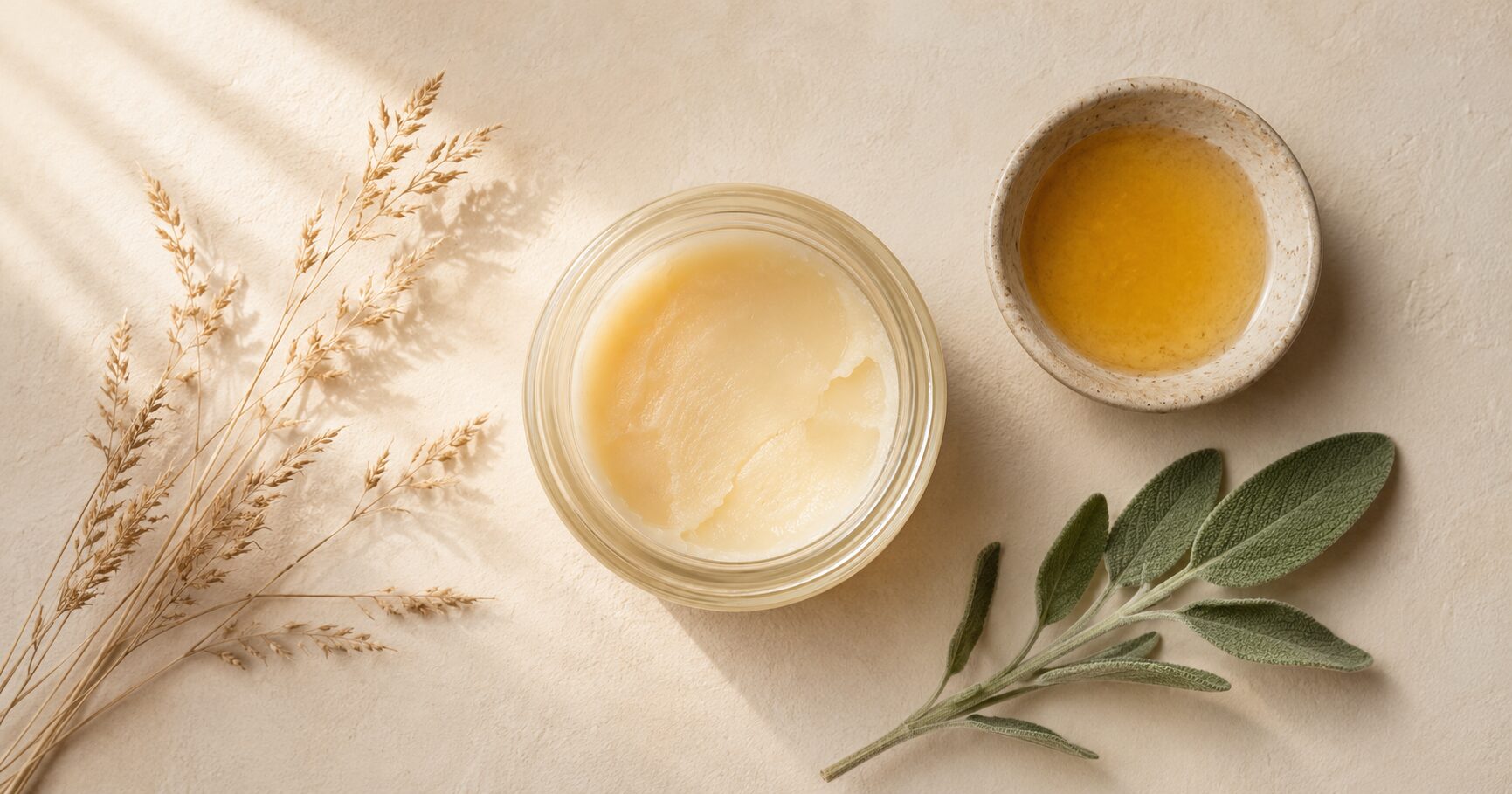
Careful makers filter in stages — strainer, then cloth, then fine filter media — while the fat is fully liquid, sometimes settling between passes so heavier particles drop out on their own. The visual endpoint is unmistakable: warm liquid tallow, filtered properly, is clear and golden like a lamp oil; cooled, it sets pale ivory and uniform.
Here’s the consumer-facing payoff: filtering quality is one of the few manufacturing steps you can audit from your side of the jar. Uniform pale color and a clean, faint smell = filtered well. Specks, cloud, beige, broth = you’re holding the shortcut. Your senses are a surprisingly complete lab.
07 What “cosmetic-grade” really means
“Cosmetic-grade tallow” appears on supplier sheets and product pages everywhere — including ours — so it’s worth saying plainly what the phrase does and doesn’t mean:
- What it means in practice: the tallow was produced for skin — clean suet input, controlled low-heat rendering, fine filtration, and supplier documentation on purity, color, and scent. It’s a description of process rigor and intended use.
- What it is not: a government-issued certification. There’s no federal “cosmetic tallow” stamp the way there’s a USDA organic seal — the phrase is only as trustworthy as the supplier’s actual process and paperwork behind it.
That’s not a scandal; it’s just how most cosmetic raw ingredients work — quality lives in supplier standards, specifications, and the brand’s willingness to verify them. It does mean the phrase alone shouldn’t end your evaluation. Pair it with the sensory checks from this guide and with a brand that talks about its process in specifics rather than vibes. (It’s the same skepticism-with-a-method we teach for every label claim in how to spot greenwashing.)
08 How good tallow looks, feels & smells
Time to give your senses the spec sheet. Well-made, fresh tallow presents like this:
- Look: pale — ivory to soft cream, sometimes faintly golden with grass-fed sourcing. Uniform throughout: no layers, no specks, no cloud. Surface smooth, not grainy.
- Feel: solid at room temperature with a buttery give; melts readily on skin contact — that low melt-near-body-temperature behavior is part of why it applies so well.
- Smell: faint, clean, mildly fatty-waxy — the full sensory tour is in does tallow balm smell like beef?, but the one-word answer is “quiet.”
- Over time: stable. Kept cool, dark, and sealed, tallow’s saturated makeup resists oxidation far better than fragile liquid oils; a sharp or sour turn means a batch has aged out.
One texture note that confuses people: graininess that appears after a melt-and-recool (a hot mailbox, a summer car) is a crystal-structure quirk of natural fats, not spoilage — annoying, harmless, and explained in the tallow texture guide. Spoilage announces itself to your nose, not your fingertips.
09 From tallow to balm: the last mile
Finished tallow is an ingredient, not a product — there’s one last mile from block to balm, and it’s short enough to describe completely:
- Blend: tallow is gently melted with its few partners — in our formulas, beeswax for structure, castor oil for glide, vitamin E as the antioxidant guarding the fats themselves (its real job, per vitamin E in skincare).
- Pour: the warm blend fills tubes, tins, and sticks.
- Cool: slowly and evenly, setting that smooth, uniform texture.
What’s absent from that last mile matters as much as what’s present: no water phase — which is why no preservative system is needed and why the format is called anhydrous — and no fragrance, for all the reasons in the smell post. A tallow balm is genuinely just the rendering story plus three supporting ingredients. Four things on the label, and now you know the biography of the first one.
10 Sourcing: the step before step one
Everything in this guide so far happens after a more consequential decision: whose fat, from what animals, raised how. Rendering is honest — it faithfully concentrates whatever the source provided. That cuts both ways:
- Fat reflects the animal. Diet and husbandry shape fatty-acid balance and micronutrient content — the grass-fed difference we detailed in the grass-fed explainer.
- Traceability is a real feature. Suet from known ranches with known practices is an auditable input; commodity fat of mixed origin is a shrug. For an ingredient this concentrated, we’d rather build on the auditable one.
- Sourcing is also where values live. Tallow is an animal ingredient — bovine, never vegan, and honesty requires saying so plainly. For many families, using a byproduct of an existing food chain, fully and respectfully, is precisely the appeal; for others it’s a dealbreaker, and our coconut line exists for exactly that reason (noting coconut allergy, though rare, is real, and beeswax keeps even that line non-vegan).
Our sourcing sentence, for the record: grass-fed suet from US suppliers whose rendering process and documentation we’ve verified. One sentence is all it should take — be suspicious of any tallow brand that needs a paragraph to avoid giving you one.
Want the free family bundle?Two Color & Grow coloring books, our Fam Jams family music, and a plain-English skincare guide — free. Grab the bundle — instant download. 11 Rendering at home: an honest take
Can you render tallow at home? Yes — and for cooking, you absolutely should try it once. A slow cooker on low, ground suet from a butcher, patience, and cheesecloth will produce genuinely good kitchen tallow and teach you more about this ingredient than any article.
The honest asterisk is skincare-grade neutrality, which is a taller order at home:
- Butcher suet varies in cleanliness; trimming it fully is tedious skilled work.
- Home heat control is coarse — slow cookers run hotter than “low” implies, and one scorched hour writes itself into the whole batch.
- Kitchen filtering (cheesecloth) stops at “pretty clean” — several grades coarser than fine filtration.
- Wet purification passes are messy, slow, and easy to under-do.
Result: most home batches land at “faintly beefy” — perfect for roasting potatoes, unwelcome an inch from your nose all day. If you do want to experiment on skin, patch test first, keep it to body use rather than lip products, and hold it to the same sensory standards as anything you’d buy. And if the experiment mostly teaches you why careful rendering costs what it costs — that’s a fair tuition.
12 The buyer’s quality checklist
Everything in this guide, compressed into the sixty-second evaluation you can run on any tallow product — ours included:
- Source named? Grass-fed claimed, supplier standards mentioned, one clear sourcing sentence available. Vague origin is an answer too.
- Process described? Brands that render carefully tend to say so in specifics — low heat, filtering, small batches — because it’s expensive and they’re proud of it.
- Looks right? Pale, uniform, smooth. No specks, layers, or cloud.
- Smells right? Faint and neutral at one inch; nothing you’d name after food. (Full test in the smell deep-dive.)
- Short list? Tallow plus a few recognizable partners — heavy fragrance in a “natural” tallow balm is usually answering for something. The two-minute method in how to read a skincare ingredient label finishes the job.
- Honest about what it is? Animal ingredient, not vegan, cosmetic not medicine. Brands straight about the awkward parts are usually straight about the rest.
Six checks, no lab required. An ingredient this simple deserves an evaluation this simple.
13 The bottom line
Tallow is made the way it’s been made for millennia: clean suet, patient low heat, thorough filtering — melt the fat out, leave everything else behind, cool it into a pale, stable block. Wet renders and purification passes push it fully neutral; care at each step is the entire difference between skincare-worthy tallow and the beefy shortcut that gives the category its occasional bad name.
What we love about this ingredient is that its manufacturing story fits in a sentence and survives scrutiny at every word: pasture, suet, pot, filter, balm. No step you can’t picture, no input you can’t trace, and a finished product your own eyes and nose can audit. In an industry that runs on unpronounceable mystery, tallow’s best feature might be that there’s nowhere for anything to hide.
"Rendering can’t add quality. It can only reveal — faithfully, permanently — the care that went into every step before the jar."— The honest verdict
The 6 things to remember
- Tallow = beef suet, gently rendered and filtered until only pure fat remains.
- Suet (kidney fat) is the clean, dense starting material serious tallow begins with.
- Low heat separates; high heat scorches — and scorched notes never filter out.
- Wet rendering / purification passes are the road to fully neutral, skincare-ready fat.
- “Cosmetic-grade” is a process standard, not a government stamp — verify with your senses.
- Pale, uniform, faint-smelling = made well. Specks, cloud, or broth = shortcut.
Frequently asked
How is tallow made?
Tallow is made by rendering: gently heating beef fat — ideally suet, the dense fat from around the kidneys — at low temperature until the pure fat melts out of the connective tissue, then straining and filtering the liquid fat to remove every solid. Cooled, it sets into solid, shelf-stable tallow. Careful low-heat rendering and thorough filtering are what separate neutral, skincare-worthy tallow from beefy-smelling kitchen drippings.
What is suet?
Suet is the dense, crumbly fat from around a cow’s kidneys and loins. It’s prized as the starting material for skincare tallow because it’s the cleanest fat on the animal — high in stable saturated fats, low in stray tissue — so it renders whiter, denser, and more neutral than general trim fat.
What’s the difference between wet and dry rendering?
Dry rendering melts the fat with heat alone; it’s simpler and develops slightly more flavor/aroma character. Wet rendering melts the fat with water (or simmers it in water), which keeps temperatures gentler and lets impurities separate into the water — typically yielding a whiter, more neutral result. Many makers of skincare tallow use wet rendering or multiple purification passes for exactly that reason.
What does cosmetic-grade tallow mean?
Cosmetic-grade means the tallow was rendered, filtered, and handled to a standard intended for skin rather than cooking: cleaner starting fat, controlled low-heat processing, finer filtration, and quality checks on color, scent, and purity. There’s no single government-issued “cosmetic tallow” certificate — the grade lives in the supplier’s process and documentation, which is why sourcing matters.
Can I render tallow at home?
Yes — home rendering with a slow cooker and cheesecloth genuinely works, and for cooking it’s great. Reaching cosmetic neutrality is harder: it usually takes suet (not trim), very low heat, multiple strains, and sometimes wet-render passes. Many home batches keep a faint beefy note that’s fine in a skillet and unwelcome in a lip balm.
Why does rendering temperature matter?
Heat is the difference between melting fat out and cooking it. Low, patient heat separates fat gently and keeps it pale and neutral. High heat browns leftover proteins and can scorch the fat itself, creating roasty off-notes and color that no amount of later filtering removes. Slow is the entire secret.
Is tallow shelf-stable?
Yes — rendered tallow is one of the sturdier natural fats because it’s predominantly saturated, which gives oxidation fewer footholds than fragile liquid oils. Kept sealed, cool, and dark, it stays fresh for a long time, and in finished balms an antioxidant like vitamin E extends that further. Sharp or sour smells signal a batch past its prime.
Is tallow vegan or vegetarian?
No — tallow is rendered beef fat, an animal ingredient (bovine). That’s a genuine dealbreaker for some people, and no framing changes it. For those who want a plant-only routine, our coconut oil line covers the same product formats without tallow — though note it still contains beeswax, which isn’t vegan either.
Megan Smith
Co-Founder, Bear Basics
Megan co-founded Bear Basics and leads design. As a mom, she writes our gentlest, most practical guides — on ingredients, sourcing, and simple family skincare — with an emphasis on honest, well-sourced, and simple. Read the full story →