Quick answer
A good kids’ hygiene routine is two short blocks — about five minutes in the morning, five in the evening — covering hands and face, teeth, hair as needed, bathing on the right rhythm for their age, and moisture for dry spots. Littles (3–6) do it with you, big kids (7–10) do it with reminders, and tweens (11+) take it over — usually adding a gentle deodorant for odor along the way. The products barely change with age; the ownership does. Keep the list short, anchor each step to something that already happens, and let a checklist do the reminding instead of you.
Answers at a glance6 quick questions
How long?
~5 minutes, twice a day.
Bathe daily?
Not until puberty nears — a few times a week is fine for most.
Deodorant when?
When odor shows up — often 8–12.
How many products?
4–5 total covers everything.
Kids’ versions?
Usually unnecessary — simple works for all ages.
Best trick?
Habit stacking + a picture checklist.
01 The short answer
Every kid, at every age, needs roughly the same short list handled twice a day: clean hands and face, clean teeth, hair that gets washed on its own schedule, a bath or shower at the right rhythm, and a little moisture where skin runs dry — lips, cheeks, knuckles, elbows. That’s the whole job. What changes as they grow isn’t the list; it’s who does it.
From about three to six, you do the routine with them. From seven to ten, they do it and you remind. From eleven up, they own it — and somewhere in there, underarm odor arrives and a gentle deodorant joins the lineup. If you keep each block to about five minutes and the product count to four or five, the routine survives real life: school mornings, sports nights, and the weeks when everyone is tired.
The rest of this guide walks the two daily blocks step by step, breaks the handoff down by age band, and covers the part most articles skip — how to make it stick without turning yourself into the hygiene police.
02 Why kids need a routine, not rules
There’s a reason “go wash up” fails and a routine works. A rule is a demand that gets renegotiated every single night. A routine is a track the day runs on — the same steps, in the same order, at the same anchor points — until it stops feeling like a demand at all.
Kids are pattern machines. The same brain wiring that lets them memorize every dinosaur or every level of a video game will happily absorb wash, brush, balm, bed if it happens the same way enough times. What they resist isn’t hygiene; it’s unpredictability — being yanked from something fun for a chore that lands at a different moment every day.
The mindset shift: you’re not enforcing cleanliness — you’re installing a pattern. Patterns take a few weeks of boring consistency up front and then run nearly free for years. Rules take enforcement forever.
A routine also does something a rule never will: it transfers. A rule always belongs to the parent. A routine, once it’s automatic, belongs to the kid — which is the entire goal. You’re not trying to raise a child who washes their face when told. You’re trying to raise one who does it when nobody’s watching, at a sleepover, at camp, and eventually in a dorm.
This is the same philosophy behind simple skincare for the whole family: fewer steps, done consistently, beat elaborate steps done occasionally — at every age.
03 The 5-minute morning routine
Mornings are hostile territory for routines — everyone’s racing the clock — so the morning block has to be short and mostly automatic. Here’s a five-minute version that works from preschool through middle school:
- Rinse the face with warm water — a splash-and-pat for littles, a quick gentle wash for tweens with oilier skin. Most kids don’t need cleanser every morning; water does the job.
- Brush teeth for two minutes. Anchor it to “right after breakfast” so it never floats.
- Fix the hair — brush or damp-pat. Wash days live in the evening routine, not here.
- Wash hands before heading out. It doubles as the sink check: if hands got washed, the routine happened.
- Balm the dry spots — lips before school (especially in dry climates and winter), plus cheeks or knuckles if they’re rough. A twist-up stick like our lip balm 4-pack (one per backpack, one for the bathroom) makes this a ten-second step kids do themselves.
For tweens, one addition: deodorant after the face rinse — our tallow deodorant and coconut oil deodorant are both unscented and tween-friendly. One or two swipes per underarm is plenty — more product doesn’t mean more odor control, it just means residue on shirts.
That’s it. No toner, no ten-step anything. If your child’s lips are chronically cracked no matter what, that’s usually a licking-and-picking cycle — we cover how to break it in how to fix chapped lips for good.
04 The evening routine
The evening block carries more weight because it’s where the washing actually happens — and because it doubles as a wind-down signal. Done consistently, the routine itself starts telling their body it’s bedtime.
- Bath or shower on your child’s rhythm — for most younger kids that’s a few times a week, not nightly (more on rhythm by age below). Lukewarm water, a mild cleanser where it’s needed: hands, face, feet, underarms, bottom. Kids don’t need head-to-toe suds every time.
- Non-bath nights: face wash, hands, and a washcloth pass anywhere that saw playground, sport, or sunscreen.
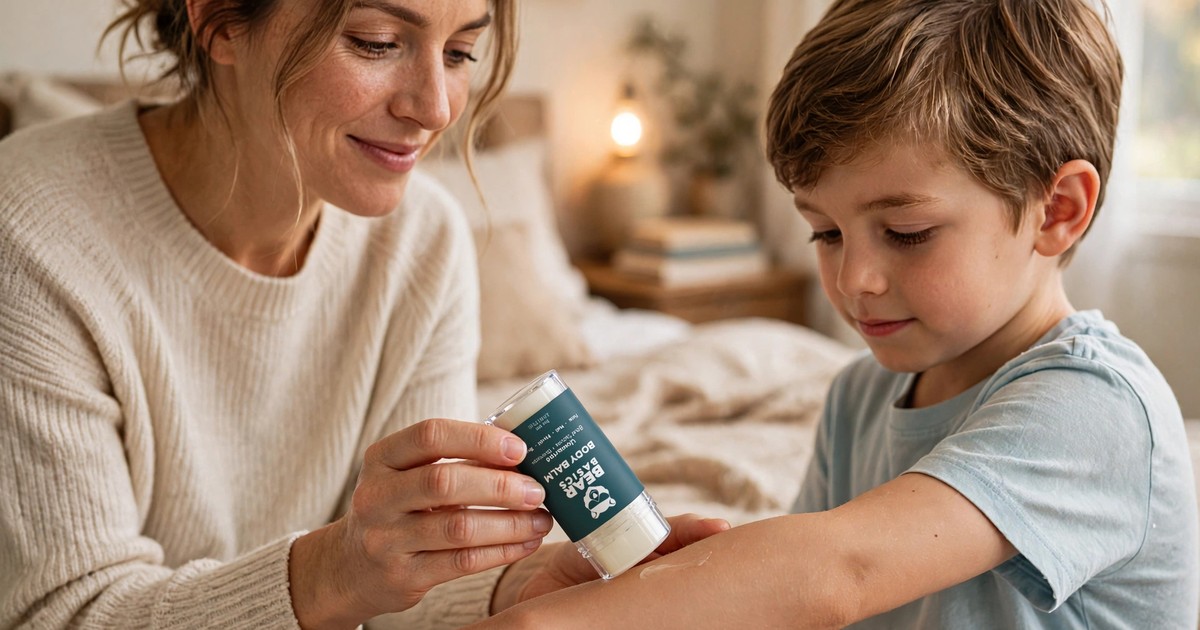
- Moisturize while skin is damp — this is the step that quietly prevents most winter dry-skin misery. A thin layer of a simple balm — like our tallow body balm or coconut oil body balm — on cheeks, hands, elbows, and any rough patches, pressed into skin that’s still slightly damp, seals water in.
- Brush teeth — the non-negotiable anchor of the whole night.
- Lip balm last, so it isn’t brushed or rinsed away.
The damp-skin moisture step deserves special emphasis if you live somewhere dry — the difference between balm on damp skin and balm on dry skin is the difference between preventing rough cheeks and chasing them. It’s the same principle we lean on in the best everyday routine for dry skin, and it works at every age.
For babies and toddlers, bath night has its own gentler rhythm — water temperature, timing, and the after-bath sequence — which we’ve covered in a gentle family guide to baby bathtime.
05 Ages 3–6: do it together
At three to six, “their routine” is really your routine, performed together. The goal isn’t independence yet — it’s familiarity. You want the steps to feel as fixed as a bedtime story, so that by the time they’re capable of doing it alone, the pattern is already installed.
What works at this age:
- Narrate as you go. “First we wash hands, then teeth, then balm.” The narration becomes the checklist they’ll eventually run in their own head.
- Give them one job they fully own — putting the cap back on, applying their own lip balm, picking the towel. Ownership starts with one step, not all of them.
- Same order every night. Littles will absolutely call you out if you swap steps — that’s the pattern taking hold. Let it.
- Keep bathing to a few nights a week unless they’re visibly grubby. Young skin runs dry, and daily hot baths strip the oils that keep it comfortable.
Skin note for littles: if your child’s skin is dry-prone or eczema-prone, this age band is where a boring, consistent routine matters most — lukewarm water, fragrance-free everything, moisture on damp skin. We’ve written a full rhythm for it in
eczema-prone kids: a gentle daily rhythm, and your pediatrician should lead on anything persistent.
Want the free family bundle?Two Color & Grow coloring books, our Fam Jams family music, and a plain-English skincare guide — free. Grab the bundle — instant download. 06 Ages 7–10: their routine, your reminders
Seven to ten is the sweet spot: old enough to do every step, young enough to still forget half of them. Your job shifts from performer to reminder system — and your actual goal is to make yourself unnecessary.
- Put a checklist where the routine happens. A simple picture list taped to the mirror — five icons, morning on one side, evening on the other. When they ask “am I done?”, point at the list, not at them. The list becomes the authority, and lists don’t nag.
- Trade reminders for questions. “Did you check your list?” lands completely differently than “go brush your teeth.” One builds self-checking; the other builds waiting-to-be-told.
- Let the natural consequences be small and real. Forgot lip balm before school in January? Chapped lips are a better teacher than a lecture, and a much cheaper lesson than the ones that come later.
- Start watching for the shift. Somewhere in this band, many kids begin running warmer and smelling like actual kids after soccer. That’s the cue that the tween routine — and possibly deodorant — is coming soon. It’s normal, and it’s not a hygiene failure.
Bathing usually steps up in this band too — sport nights become shower nights — but most kids still don’t need a daily scrub until the hormonal shift genuinely arrives.
07 Ages 11+: the handoff (and deodorant)
Eleven-plus is the handoff: the routine becomes theirs, and two new realities arrive with it — body odor and oilier skin. Both are chemistry, not carelessness. Hormones wake up the sweat glands that bacteria love, and skin starts producing more oil. The fix is an upgrade to the same routine, not a new one:
- Daily or near-daily showers now earn their place, with real attention to underarms and feet.
- An actual face wash morning and night replaces the water splash if skin is turning oily.
- Deodorant becomes a daily step — morning, after washing, one or two swipes per side.
On deodorant, one piece of vocabulary worth teaching your tween (and worth knowing yourself): deodorant addresses odor. Antiperspirants are a separate category of product entirely. For a kid’s first deodorant, a simple, unscented stick with a short ingredient list — that’s exactly what our deodorant is — is the easy on-ramp — nothing to clash with their own preferences, and a label you can read out loud together in about five seconds. We wrote a full parents’ guide in natural deodorant for kids & tweens, including how to time the start and what to expect.
The dignity rule: if you’ve noticed odor, mention it once, privately, and matter-of-factly — then hand them the tools and let the routine do the rest. Tweens who feel policed about their bodies hide problems; tweens who feel equipped solve them.
By the end of this band, your involvement should be down to keeping products stocked. That’s not disengagement — that’s the whole project succeeding.
One routine, whole family.Simple, unscented basics that work for every age under your roof — short lists you can read out loud. Shop the line — nothing your kids can’t pronounce. 08 Making it stick without nagging
Every parent knows the failure mode: the routine works for two weeks, then dissolves into nightly negotiations. The fix isn’t more discipline — it’s better engineering. Three mechanisms do most of the work:
- Habit stacking. Attach every step to something that already reliably happens. Teeth after breakfast, not “in the morning.” Face wash before pajamas, not “before bed.” Vague timing is where routines go to die; anchored timing runs itself.
- Friction removal. Kids abandon routines over obstacles adults don’t even register. A step stool that’s always there. Their own towel hook at their height. Products in the same spot every day, in formats little hands can operate. Every removed obstacle is one less nightly argument.
- The five-minute ceiling. The routine that survives is the one that’s short enough to finish on the worst night — late practice, overtired kid, everyone done with the day. If it doesn’t fit in five minutes, cut steps until it does. A short routine done nightly beats a thorough one done twice a week, every time.
And one thing that matters more than any mechanism: they watch you. A parent who visibly washes up, brushes, and balms every night is running a silent advertisement for the whole enterprise. Kids don’t adopt the routines we assign; they adopt the ones we live. It’s the same one-change-at-a-time patience we recommend for transitioning your family to cleaner skincare — slow and boring wins.
09 What kids need — and what they can skip
The kids’ aisle wants you to believe childhood hygiene requires a dozen character-branded bottles. It requires four or five things. Here’s the honest split:
Genuinely worth having
- A gentle, fragrance-free cleanser or mild soap
- Toothbrush + fluoride toothpaste (per your dentist)
- A simple balm or moisturizer for dry spots
- Lip balm they can apply themselves
- For tweens: a gentle, unscented deodorant
Fine to skip
- “Kids’” versions of adult products — usually the same formula, cartoon label, higher price
- Scented everything — fragrance is the most common irritant on young skin
- Multi-step “tween skincare” kits — oil and odor need washing and moisture, not a regimen
- Antibacterial extras for everyday home use — regular washing does the job
The short-list logic isn’t just budget sense — it’s skin sense. Fewer ingredients means fewer chances for irritation and a label you can actually vet in the store aisle. If you want the full method for that, how to read a skincare ingredient label turns it into a two-minute skill. And for families starting from zero with a baby in the house, the minimalist baby-care kit makes the same case one age band earlier.
One allergy note: coconut allergy is rare but real (coconut is botanically a fruit, and as of 2025 the FDA no longer classifies it as a tree nut). If your child has a coconut allergy — or any nut allergy and you’re unsure — check with your pediatrician and patch test before adding any coconut-based product to their routine, ours included.
10 Why solid formats win with kids
Here’s an underrated variable in whether kids actually do their routine: the physical format of the products. Bottles and jars were designed for adult hands and adult restraint. Kids + pump bottle = half the bottle in one palm. Kids + open jar = fingers, floor, dog.
Solid formats quietly solve most of this:
- Twist-up balm sticks dispense a controlled amount, cap securely, and survive being dropped, sat on, and carried in a backpack pocket. A kid who can work a glue stick can moisturize their own cheeks with a body balm stick.
- Bars like our tallow body bar can’t spill, can’t be over-poured, and last far longer than the equivalent bottle — we’ve compared the formats head-to-head in lotion bar vs regular lotion.
- Stick deodorant is the easiest possible first deodorant for a tween — visible amount, no mess, done in five seconds.
There’s a self-sufficiency payoff too: formats kids can operate independently are formats kids will use independently. Every product they can apply without help is one more step of the routine that transfers to them — which, again, is the entire point.
One honest caveat with simple, wax-and-oil solid products: they soften in heat. A balm stick lives happily in a backpack through fall and winter; in a car in July, less so. Room-temperature storage keeps them exactly as they should be.
11 Common mistakes parents make
Almost every struggling hygiene routine traces back to one of these five, and every one of them is fixable this week:
- Too many steps. The ten-step routine collapses by Thursday. Cut to the five-minute core and let consistency do the compounding.
- Floating timing. “Before bed” drifts later every night until it falls off the end of the evening. Anchor every step to a fixed event instead.
- Over-bathing little kids. Nightly hot baths feel virtuous but leave young skin stripped and itchy — which makes the whole routine something they dread. A few nights a week, lukewarm, is the friendlier rhythm for most kids until puberty nears.
- Skipping the moisture step. Washing without moisturizing is how winter turns cheeks and knuckles rough — then applying anything stings, and now they resist the routine entirely. Balm on damp skin prevents the whole spiral.
- Doing it for them too long. It’s faster to brush a seven-year-old’s teeth yourself. It’s also how you end up with an eleven-year-old who’s never run their own routine. Slower now is faster later — hand over steps as fast as they can wobble through them.
If you fix only one: fix the timing. An anchored, imperfect routine beats a perfect routine that happens whenever someone remembers.
12 When to bring in your pediatrician
A daily routine keeps kids clean and comfortable — but some things are doctor territory, and knowing the line keeps you from either over-worrying or over-treating with products. Loop in your pediatrician when you see:
- Persistent rashes, itching, or dry patches that a gentle routine and regular moisture don’t settle within a couple of weeks
- Cracked, bleeding, or weeping skin anywhere — comfort care supports skin; it doesn’t treat broken skin
- Signs of early puberty — body odor or other changes arriving notably early for your child — worth a mention at the next checkup, if only for reassurance
- Scalp flaking or itching that regular washing doesn’t resolve
- Any routine step that consistently causes redness or stinging — that’s a product-fit problem worth professional eyes if it repeats across gentle products
None of this is cause for alarm — it’s just the honest boundary of what a hygiene routine (and any cosmetic product, ours included) is for. Products keep skin clean and comfortable; diagnosing and treating skin conditions is your pediatrician’s lane, and the good ones would much rather field a small question than a late one.
13 The bottom line
A kids’ hygiene routine that actually works is almost disappointingly simple: two five-minute blocks a day, four or five products, the same order every time — done with them at 3–6, near them at 7–10, and by them at 11+, with a gentle deodorant joining whenever odor does.
The secret isn’t any product and it isn’t discipline. It’s the boring stuff: anchored timing, a checklist that does the nagging for you, formats kids can operate themselves, and moisture on damp skin before bed. Get those right and the routine stops being a nightly negotiation and starts being just… how evenings go.
And the payoff is bigger than clean hands. A child who owns their routine at eleven is practicing the same skill they’ll use for homework, sports, and eventually a household of their own: taking care of things because they’re theirs to take care of. That’s a lot of return on five minutes, twice a day.
"The list barely changes from three to thirteen. What changes is whose routine it is — and the whole job is making it theirs."— The honest verdict
The 6 things to remember
- Two ~5-minute blocks a day cover everything; long routines get skipped.
- 3–6: together. 7–10: with reminders. 11+: theirs.
- Most kids don’t need daily baths until puberty approaches.
- Deodorant starts when odor does — it targets smell, and unscented + short list is the easy first pick.
- Balm on damp skin at night prevents most dry-skin misery.
- Anchor steps to fixed events and let a checklist do the reminding.
Frequently asked
What should a daily hygiene routine for kids include?
A simple daily routine covers face and hands, teeth, hair as needed, a bath or shower on the right rhythm for their age, and moisture for dry spots like lips, cheeks, and hands. Younger kids need fewer steps done with help; older kids and tweens gradually take over the same steps themselves, and tweens typically add underarm care with a gentle deodorant for odor.
At what age should kids start doing their own hygiene routine?
Most kids can handle single supervised steps around ages 3–6, manage the full routine with reminders by 7–10, and own it independently around 11 and up. Every child is different — the goal is a gradual handoff, not a fixed birthday. Checklists and consistent timing help the handoff happen sooner.
How often should kids bathe or shower?
For most kids, a few baths or showers per week is enough until puberty approaches, with daily face, hands, and bottom cleaning in between. Once body odor and oilier skin arrive — often around 9–12 — a daily or near-daily shower usually makes sense. Follow your pediatrician’s guidance for your child’s skin.
When should kids start wearing deodorant?
Whenever body odor becomes noticeable — for some kids that’s 8 or 9, for others closer to 12. There’s no rule that says a child must wait for a certain age. A simple, unscented deodorant that targets odor is an easy first step; deodorants address smell, while antiperspirants are a different product category entirely.
What hygiene products do kids actually need?
Far fewer than the kids’ aisle suggests: a gentle cleanser or mild soap, toothbrush and toothpaste, a simple moisturizer or balm for dry spots, lip balm, and — for tweens — a gentle deodorant. Short ingredient lists are easier to check and easier on young skin. Most “kids” versions of products are the same formulas with cartoon packaging.
How do I get my child to remember their routine without nagging?
Anchor each step to something that already happens (habit stacking): teeth after breakfast, face wash before pajamas. A simple picture checklist on the mirror lets the list do the reminding instead of you. Keep the routine short enough to finish in about five minutes — long routines are the ones that get skipped.
Are solid balms and bars better than bottles for kids?
They’re usually easier: solid formats like balm sticks and bars can’t spill in a backpack or pour half the bottle down the drain, and they teach kids to use a small amount. A twist-up balm stick for dry cheeks or hands is something even young kids can apply themselves without making a mess.
What if my child has eczema or very sensitive skin?
Keep the routine even simpler — lukewarm water, fragrance-free products with short ingredient lists, and moisture right after washing — and let your pediatrician set the plan. A daily routine supports comfort, but persistent rashes, itching, or broken skin are a doctor conversation, not a product fix.
Megan Smith
Co-Founder, Bear Basics
Megan co-founded Bear Basics and leads design. As a mom, she writes our gentlest, most practical guides — on ingredients, sourcing, and simple family skincare — with an emphasis on honest, well-sourced, and simple. Read the full story →
Basic essentials for the whole family.Unscented, short-list products every age under your roof can share — from first balm to first deodorant. Prefer Amazon? Find us there too.Shop the line